
According to News Express on Monday, Bipasha Basu’s count is 108, Kareena Kapoor’s 50. Rani Mukherjee, Sameera Reddy, Lara Dutta and Shilpa Shetty also clock in the numbers. According to Headlines Today, the BJP’s count is 34-40, the AAP’s 25-31. The Congress and independents also clock in the numbers. As you can see, there are figures and then there are figures. If you want Bipasha Basu’s figure, you had better perform 108 suryanamaskars every morning, like her — or so said News Express. If you want the BJP to figure as the next government of Delhi, you had better vote for them.
More figures floated about in different opinion polls Monday night, hours after the Election Commission announced February 7 as voting day in Delhi. India TV-C Voter had figures of 35 (BJP), 29 (AAP) and 5 (Congress). In all of them, the Congress cut a sorry figure. As did its members in TV studio debates. For instance, Abhishek Manu Singhvi looked cold and distracted, as though he’d much rather be seated before a warm fire than face Ashish Khetan (AAP) and Nalin Kohli (BJP) on The Buck Stops Here (NDTV 24×7). Most channels dispensed with the Congress altogether, at least in their optics: with photographs of muscleman Narendra Modi and muffler-man Arvind Kejriwal, NDTV asked, “The Delhi Duel Modi vs Kejriwal Again?”


By now, this much should be quite clear to everyone: Modi does not need any help with his English. Unless it’s the teleprompter’s. At the Vibrant Gujarat spectacle on Sunday, he proved that he is almost as effective an orator in English as he is in Hindi. By the way, how politic of him to speak Hindi at the UN General Assembly and English in Gandhinagar.
The spectacle at the Mahatma Gandhi Mandir auditorium went beyond Vibrant Gujarat or even Vibrant India; it resembled an international summit with a smattering of world leaders, including US Secretary of State John Kerry and the business world’s who’s who.
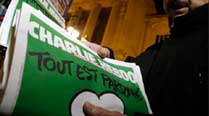
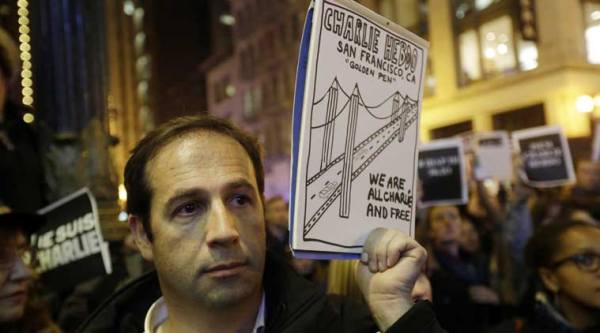
No lack of world leaders at Sunday’s march in Paris in memory of the people slain in the Charlie Hebdo terrorist attacks. It’s rare to see Israel’s prime minister and Palestine’s president walk in unison, if not hand in hand. In a sea of a million or more people, the BBC’s Lyse Doucet managed to find two gentlemen from India. “We regret” the attacks, said one. We are against terrorism, he added. “I have never faced” any discrimination, piped up the other one, “Everything is good here”.
Clearly, they spoke from limited personal experience or they were reluctant to criticise the host country in front of international TV. Everything was not “good” as we watched the coverage of the crisis and its aftermath. The recorded footage of the terrorists on the street outside Charlie Hebdo’s office was chilling; live coverage of the hostage crisis at the Jewish grocery store — like the stakeout at a Sydney café last month — reminded us why broadcast news remains relevant in the time of social media. Nothing, no Hollywood movie, can compare with the real thing, live.
Thereafter, it was “Je suis Charlie”. That focus was necessary, but it did frame the issue solely around freedom of expression. Freedom with responsibility got lost somewhere. And with that, the massacre of reportedly 2,000 civilians in Nigeria by Boko Haram terrorists became a footnote — a tragedy that remained outside the framed narrative.
Sudarshan TV, meanwhile, had more pressing concerns: “Why is the relationship between PK and the Isis not being investigated?” it wanted to know on Sunday.
Why indeed.
shailaja.bajpai@expressindia.com


