
Opinion In trade war with the US, China’s strong language hides its frailties
In China, youth unemployment has hit historic highs. The Covid pandemic was a spectacular failure of political accountability. The continuing anti-corruption campaign suggests that the Augean stables of China’s administration are far from being cleansed
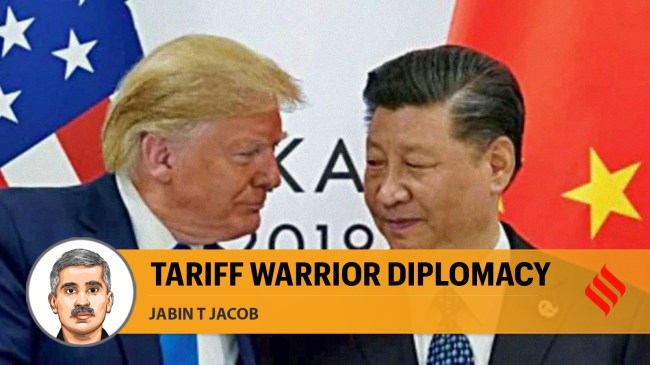 The strong language coming out of Beijing coupled with the general perception of American policy being unstable or reversible, has allowed a narrative to quickly gain ground – including not least in India – that American President Donald Trump is the one most likely to blink first. (File photo)

“If war is what the US wants, be it a tariff war, a trade war or any other type of war, we’re ready to fight till the end”. So declared, a Chinese Foreign Ministry tweet in March when the Donald Trump administration raised tariffs over China’s lack of cooperation in stemming the illegal flow of the opioid, fentanyl, into the US.
The strong language coming out of Beijing coupled with the general perception of American policy being unstable or reversible, has allowed a narrative to quickly gain ground – including not least in India – that American President Donald Trump is the one most likely to blink first.

However, while China certainly has the state capacity to not just weather the storm but to exploit it to advantage, its frailties are no less significant.
Never waste a crisis
The Trump tariffs are certainly an opportunity for Beijing to make a case for global leadership in the face of an unreliable and isolationist US. By describing Trump as “a businessman by nature”, used to cost-benefit analyses but incapable of long-term strategic planning, China is doing two things. One, it is running down Trump the individual and, by extension, the American system that produced him. Two, it is making a case for a strategy of responding to pressure with pressure, and arguing that showing weakness will only invite further pressure.
In the bilateral context, Beijing is thus using the Trump tariffs to legitimise and bring out in the open its decades-long strategy of countering American ingress into the Chinese market and to strengthen its policies of self-reliance.
At the global level, Beijing is also trying to create the impression that it is both capable and willing to stand up to the US and trying to get other countries to do the same in the hope that the more countries there are that are unwilling to compromise with the US, the stronger China’s own resistance. Chinese diplomats and commentators have particularly targeted American allies and partners – directly warning the Europeans against “appeasement” of the US while talking about “regional economic integration” and restarting negotiations on a trilateral free trade agreement with Japan and South Korea.
Meanwhile, the Chinese have argued that Trump’s rollback on tariffs on the rest of the world is an attempt to revive economic blocs and spheres of influence. While China professes its opposition to this and proclaims itself a champion of globalisation, a world divided into blocs is not necessarily a bad thing for Beijing. To try and take over global hegemony from the US without some degree of open contest or confrontation was always going to be a long shot for China’s rulers. Therefore, a world divided, where it is clearly the leader of one bloc, is the next best option for China.
Tall talk
In April, a Chinese Ministry of Commerce spokesperson while stating explicitly that “China and the US are not in talks on tariffs”, also said that “the US needs to show sincerity if it wants to talk… The US should revoke all unilateral tariffs on China if it wants to solve problems.”
That Beijing should at all refer to talks with the US suggests that the assertive language masks other concerns. Communist Party of China (CPC) General Secretary and Chinese President Xi Jinping’s meeting at the end of March with the heads of over 40 global corporations, including American ones, as well as Premier Li Qiang’s announcement in mid-April of measures to support exporters and incentivise MNCs to keep investing in China might suggest an attempt to make use of opportunities created by the trade war. This also explains Xi’s recent visits to Southeast Asia and, no doubt, the sudden desire to improve India-China ties with references to a “dragon-elephant tango”.
Other measures, however, suggest concerns about the fallout of the trade war domestically – steps have been announced, for example, to help businesses keep workers on their payroll and stimulate private sector investment. It is not surprising then that a Chinese White Paper on the trade war and other statements have been at pains to portray how useful bilateral trade has been for the American economy and consumers.
Clearly, for the Chinese, as everywhere else, external challenges take a distant second place to more immediate domestic concerns.
Youth unemployment has hit historic highs in China while the Covid pandemic was a spectacular failure of political accountability. The continuing anti-corruption campaign, meanwhile, suggests that the Augean stables of China’s administration are far from being cleansed.
It has not been easy for the CPC to get its people, particularly the youth, on board its domestic projects of “national rejuvenation”. Consider such trends as tang ping or “lying flat” – a reaction against the long hours of work expected from young Chinese for ever decreasing monetary returns or job satisfaction – or the lack of consumer confidence that continues to prevent the Chinese economy from executing a full post-pandemic economic recovery.
Resilience or deflecting blame?
Before the Trump tariffs, most Chinese possibly blamed the CPC and its leadership for their problems. The Chinese leadership might now be trying to use the opportunity to spin a narrative of standing up to what it has called the bullying behaviour by the US. However, political exhortation and attempts to milk the tariff war with the US, whether for external or domestic political objectives, will have its limits. Eventually, they will reflect not so much China’s resilience, as much as the Chinese leadership’s ability to deflect blame.
The writer is associate professor, Department of International Relations and Governance Studies, and Director, Centre of Excellence for Himalayan Studies, Shiv Nadar University, Delhi NCR

 Share
Share


