
Opinion The Mrs who doesn’t cook dinner — and a family that finds itself in the kitchen
Unlike the film, the script played out differently in our house. We were a nuclear family, and my father’s job as a fighter pilot meant we lived on large bases in remote towns. While help was available, cooking remained the woman’s duty.
 For the next 15 years, our kitchen was the heart of the home. Every major conversation — about careers, college, heartbreaks and life — took place over the sizzle of mustard seeds in oil. My father never spoke about equality, but his actions taught us more than any lecture ever could.

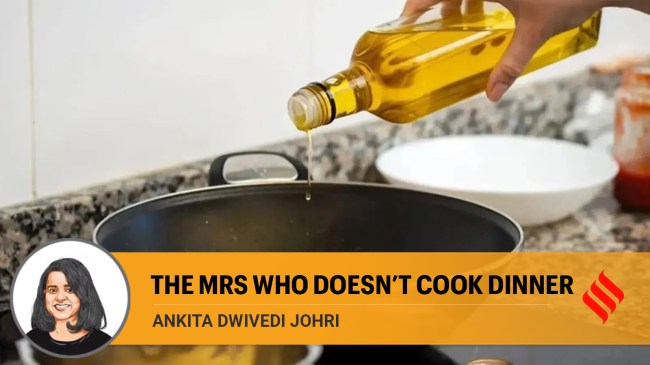
All through the 1990s, Chhaya would wake up at 5 am, mostly annoyed. Within 20 minutes, she had bathed, completed her pooja and planted herself in front of the stove. Before we — her three unruly, often ungrateful children — had even opened our eyes, she would push three tall glasses of Bournvita milk in front of our faces. After a sharp morning lecture to get ready, she would rush back to the kitchen, where the mustard oil had begun smoking in the kadhai, its sharp scent permanently woven into our curtains and sofa covers.
Then, she would cook up a storm — lunch and snack boxes packed with rice, dal and aloo chokha or bhujia. A separate salad for my father and parathas with either pickle or jam for us. She would also roll up cheese parathas and shove them into our hands as we rushed to the bus stop. As we waved goodbye, she rarely smiled. It was less farewell, more relief. And she still seemed angry.

Chhaya was always angry in the mornings.
So when I recently came across a post by the Save Indian Family Foundation (SIFF) about the film Mrs., claiming, “What stress does a woman feel while chopping vegetables or cooking? Zero. Cooking is like meditation,” I was reminded of Chhaya’s mornings.
Unlike the film, the script played out differently in our house. We were a nuclear family, and my father’s job as a fighter pilot meant we lived on large bases in remote, tier-three towns. While help was available, cooking remained the woman’s duty. Three C-sections had weakened Chhaya’s back, and the relentless cycle of housework and child-rearing only made it worse. She detested the expectation that she would do it all. And yet, she did.
One evening, after my parents returned from their daily walk, Chhaya went straight to the bedroom instead of the kitchen. My father, Arvind, called the three of us — my brother barely five, and I about 12. We assumed we were about to be scolded. Instead, he said something like, “From now on, Mummy will not make dinner. We will. She gets very tired by the end of the day.”
And just like that, without fuss or fanfare, our kitchen duties began.
At first, we struggled. My sister, grumbling, chopped onions. I kneaded the atta, my small hands pressing into the sticky dough. My little brother, still too young to cook, carried milk to our mother’s room.
But what surprised me most was my father’s skill. It wasn’t like when men say they cook and only stick to meat dishes on weekends. Arvind rolled chapatis, gave tadkas and even whipped up desserts — his shahi tukda, made with the surplus ration bread, was a family favourite.
The first few days were chaotic. We fumbled with pots, scattered masalas and left the kitchen looking like a pirate raid. But we were not let off without cleaning up. Peels went into the dustbin, countertops were wiped and leftovers packed.
There was no social media then, no viral stories of “progressive parenting”. I didn’t call my father a feminist (I do now), and Arvind didn’t see himself as one. But within a year, our dinner routine became second nature. By 6 pm, we were in the kitchen — chopping, kneading, stirring and laughing. My mother, a glass of warm milk in hand, stretched out on the sofa, watching her favourite soaps or simply falling asleep early.
When we asked my father where he had learned to cook, he shrugged. “I lived alone for years. I did everything myself.” No grand philosophy, just necessity.
Chhaya never showered us with gratitude either. She simply said, “I don’t like eating dinner, so why should I cook?” Fair enough. We were hungry, so we cooked.
As we got older, my father extended this logic to weekends. No sattu parathas for breakfast, just cornflakes with milk (thank you, ration) or Bihar’s traditional dahi-chura. No cooking. My mother loved those mornings. She made chai for herself, sat in the lawn and read the newspaper.
For the next 15 years, our kitchen was the heart of the home. Every major conversation — about careers, college, heartbreaks and life — took place over the sizzle of mustard seeds in oil, at times Rafi playing softly in the background. My father never spoke about equality or rights, but his actions taught us more than any lecture ever could.
In my mid-20s, when he passed away, we grieved for days, surrounded by relatives and well-wishers. Eventually, everyone left; life resumed. And one evening, at 6 pm, hunger struck. “I’m not hungry. I’m going to sleep,” my mother said.
The first food delivery apps had just launched. With jobs and salaries now in hand, we ordered takeout for the next six months. How the family found its way back to the kitchen is a story for another time.
But to this day, Chhaya doesn’t cook dinner. If someone asks, she smiles and says, “Hum dinner nahi khate toh nahi banate (I don’t eat dinner, so I don’t cook it).”
A former Express journalist, the writer is a reporter based in Doha, Qatar
National Editor Shalini Langer curates the fortnightly ‘She Said’ column

 Share
Share


