
Opinion Let The Elected Rule
Centre’s bid to give Delhi LG power on appointments of officers is misplaced.
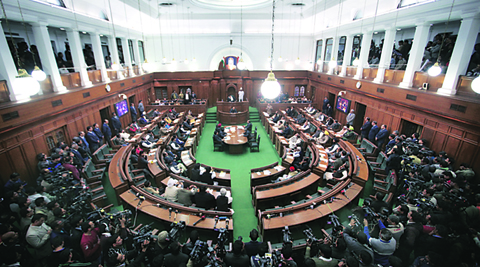

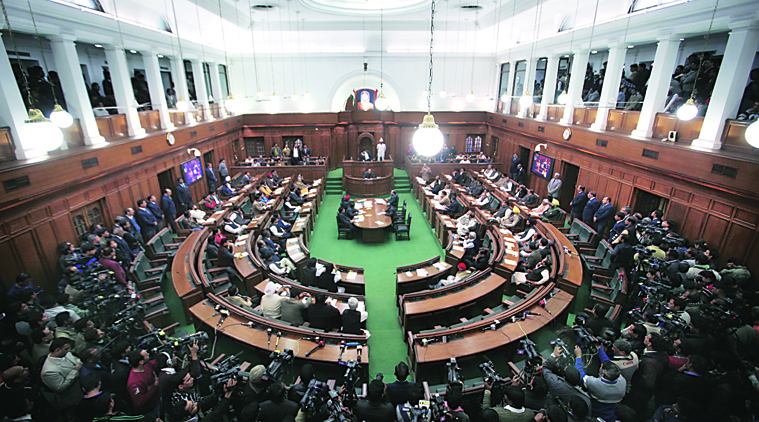 The Government of National Capital Territory of Delhi Act, 1991, lays down provisions for setting up a legislative assembly, the qualifications for its membership, its legislative duration etc. (Express photo by Oinam Anand)
By: Vivek K. Tankha
Delhi is in a legal and constitutional impasse, with the rift between the chief minister and his supporters, and the lieutenant governor. The key question is, who regulates the postings of IAS officers in the Delhi government, CM Arvind Kejriwal or LG Najeeb Jung, designated administrator of Delhi by the president. A reading of some crucial texts could yield an answer to the debate. First, Part VIII of the Constitution, which deals with the subject of UTs. Second, the All India Service Act, 1951, and related rules notified by the Centre. Third, the Government of National Capital Territory of Delhi Act, 1991, and the Transaction of Business Rules.

The UTs, which include the National Capital Territory (NCT) of Delhi, have less administrative autonomy than the states. But Article 239AA is a special provision conferring a degree of autonomy for the governance of Delhi. Under this article, Parliament has supervening jurisdiction in legislation for UTs. Second, the legislative assembly of Delhi has the power to make laws for the whole or any part of the NCT on subjects listed in the state or concurrent lists, if these subjects are applicable to UTs. Third, Entries 1, 2 and 18 of the state list are left out of the ambit of the Delhi assembly’s legislative powers. This means land, police and public order are outside its power. As with established states, Article 239AA, introduced by the 69th amendment, mandates that there shall be a council of ministers, headed by the CM, to aid and advise the LG on matters over which the assembly has the power to make laws. If there is a difference of opinion between the LG and the ministers, the former must refer the matter to the president. Evidently, the NCT, though called a UT, was conceptualised as a virtual state, minus the three important subjects.
To bolster the 69th amendment, Parliament passed the Government of National Capital Territory of Delhi Act, 1991. It lays down provisions for setting up a legislative assembly for Delhi, the qualifications for its membership, its legislative duration etc. Section 41 of the act specifies the instances where the LG has discretionary powers. First, in matters that fall outside the purview of powers conferred on the assembly, but such powers must be delegated to the LG by the president. Second, when he is required by law to perform a judicial or semi-judicial function. Neither applies to the subject of the present controversy. This falls under an act of Parliament.
Under Section 3 of the All Indian Services Act, 1951, the Centre, in consultation with the state governments concerned and by notification in the official gazette, can lay down rules to regulate the recruitment and conditions of service of the persons appointed. The All India Administrative Service Cadre Rule, 1954, is relevant to the present debate. It defines “state” as “a state specified in the First Schedule to the Constitution and includes a UT”. It says that the Centre, in consultation with the state government (or UT), shall determine the strength and composition of the cadre, as well as the allocation of officers. Most importantly, it lays down that cadre postings are the prerogative of the state government, which may be read as the government of the NCT of Delhi in this case.
To sum up, the UT of Delhi, governed by Part VIII of the Constitution, has legislative competence akin to that of a state, except in the case of public order, police and land. Parliament has supervening powers to legislate on the subject of UTs in the public interest. The All India Services Act and cognate rules define states as including UTs. And it would seem that the Centre’s attempt to assume executive power over items in the state list by issuing a notification giving the LG absolute powers in the appointment of bureaucrats is misplaced. Parliament has already enacted a statute under Entry 70 of the Union list covering the appointment and posting of IAS officers in states or UTs. Under Article 239AA, the LG has to work on the aid and advice of the council of ministers, in the exercise of functions related to matters in which the state is so authorised. The dictum laid down in the classic SC decision in Shamsher Singh must, of course, apply.
The writer is a senior advocate, former additional solicitor general of India and former advocate general of MP
 Share
Share


