
Opinion The Bill sa’ab we all loved
A bit of us dies too when the authors we read pass away. In this tribute, I remember British-Indian travel writer Bill Aitken who died on April 16. He arrived in Mussoorie in 1969 and made it his own
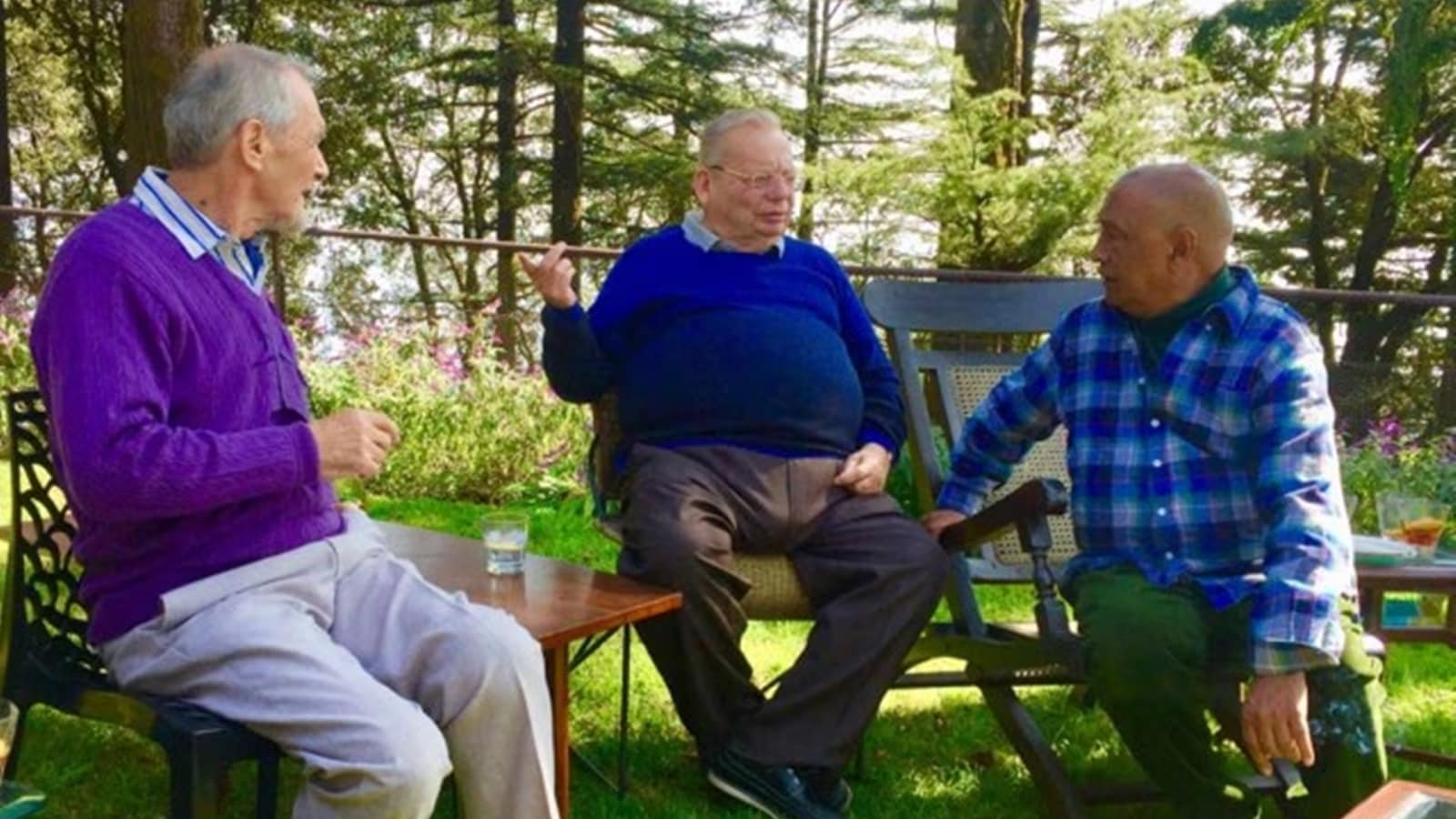 Lunch at Oakville, home of writer Stephen Alter: From left, Bill Aitken, Ruskin Bond and Ganesh Saili. (Credit: Ganesh Saili)

“Bill sa’ab!” – as William McKay Aitken, the British-Indian travel writer was called by all who knew him – crossed the “golden bridge” aged 91. I recall our first meeting at Dehradun’s Bala Hisar, where we had gathered for a friend’s birthday. One recalls that in those times, birthdays were not as big a deal as they tend to be today. Just a sprinkling of friends gathered over a piece of cake to wish one the best in the times to come.
“A bit of music would be nice?” someone suggested. Off went Bill, getting off his chair like a jack-in-the-box, straight up Palpitation Hill to a nearby cottage. He picked up his guitar, or that was what he thought, until he sat down again. Gingerly, one at a time, he opened the clasps on the black box as we looked on. The lid fell open; there was nothing inside! It was just an empty case, except for a few sheets of music that tumbled out. In a hurry to return, he had failed to see whether or not the guitar was in the case.

Out of breath, he laughed, “I’m aching all over!” His laughter was so infectious that soon we were all giggling. Come to think of it, that laughter was what saw him down the years.
His birthday was on April 9, and last year, a special lunch was organised at St Bernard’s Cottage, near Waverley Convent, at the home of Rani Indu Bala and her sister Sachi of Jind, the owners of Dehradun’s renowned Colonel Brown School. I witnessed the sisters’ generosity; their table creaked with food, topped off with a finger-licking fig dessert.
Rewind to 1969, when Bill sa’ab arrived at Oakless Cottage from Mirtola Ashram in Almora, where he had been tasked with baking bread by Ashishta, his guru, who would call him “Our master baker!” One day, his guru had sent him off to assist Rajmata Prithwi Bir Kaur in her affairs. That had marked his arrival at this hill station.
His illness this time began with an accident. Freddie, his Apso, passed away recently. Leaning over to write his beloved pet’s name on the fresh cement, he fell off the stool he was perched on. He was rushed to the local mission hospital, where I last saw him as the doctors prepared to send him in an ambulance for a CT scan. Rani Indu Bala, of Jind helped shift him to a private hospital in Dehra, but to no avail. That was where he breathed his last.
In his last moments, I wonder if he dreamt of his old Jawa going across Ladakh? Accompanying him on that legendary trip were author Stephen Alter and the talented photographer Gurmeet Thukral. The Jawa motorcycle has no stepney. So the resourceful Bill resorted to good old Indian jugaad. “I fitted an extra wheel instead of a leg guard!” he told me later. It worked perfectly for a while, as jugaad tends to do, but eventually the bumpy road loosened the bolts, and the wheel slipped clear off the bike and rolled straight into the waters of the gushing Indus River. “Without a valid visa, in plain sight, it floated down the river straight across into Pakistan!” he joked.
Given the dearth of good reading material, I guess, as a last resort, he would (probably perforce) have to read my column in the local newspaper. As was his wont, he rang me last week after reading a piece in which I had mentioned that the AQI was once so good during the epidemic days that the imperial minars of Delhi were reportedly visible from Mussoorie! “Ganesh, I now understand how Frederick Wilson could have seen the Himalayan ranges from Ambala!” he said.
A bit of us goes away too when the authors we read pass on. Among his 20-odd books, my favourites remain Seven Sacred Rivers (1992), Footloose in the Himalaya (2003) and The Nanda Devi Affair (1994). Bon voyage, Bill sa’ab, may your journey extend beyond the characters you vividly depicted in your books.
Saili, born and home-grown in the hills, is author of two dozen books, some translated into 20 languages

 Share
Share


