


Tags:


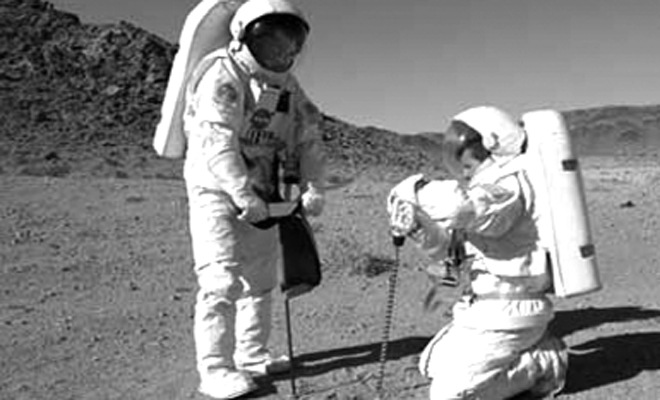
Before humans went into space,the basic concern was that they might not be able to survive long periods of weightlessness. as man heads for mars,and india plans its own mission to the distant planet,a look at the tests that have been conducted in the past or are being conducted to acclimatise both humans and machines to different situations in space.
NASA bed rest studies

Experiment is designed to study the effects of prolonged exposure to microgravity
Requires volunteers to remain horizontal for 70 days
Volunteers will be paid 18,000
Is meant to help develop methods that will allow astronauts returning from space missions to physically adjust to daily life
Beds can be adjusted into positions that reproduce the effects of different gravity levels on the human body
Another focus area is the psychological effects of long-term confinement to a reduced gravity environment
Mojave desert field tests
Researchers are investigating how humans will explore on Near-Earth Asteroids NEAs and the two moons of Mars Phobos and Deimos
Field experiments were conducted in April this year at Fort Irwin,California
Evaluated how different anchoring systems might allow astronauts to remain bound to a low-gravity body
Inflatable Lunar Habitat
NASA conducted a 13-month test which began in January 2008 in Antarctica
Tested how to provide shelter to astronauts for extended stays on the moon
Tested the power consumption and damage tolerance of the structure
Gauged astronauts ability to pack and transport the habitat while wearing spacesuits
Haughton Mars Project
NASAs Science and Exploration System Mission Directorates,Mars Institute,and SETI Institute conducted an experiment at Haughton Crater,located on Devon Island,Canada
The sites rocky arctic setting,geological features and biological attributes allowed them to gather requirements for possible robotic and human missions to Mars
Scientists performed exploration surface activities
Operational concepts such as extravehicular activity traverses,long-term hi-data communication,complex robotic interaction and suit engineering were tested
NASAs Extreme Environment Mission Operations NEEMO
Florida Keys National Marine Sanctuary is home to the National Oceanic and Atmospheric Administrations Aquarius Undersea Laboratory
NASA uses the laboratorys lunar-like environment as a semi-permanent site for testing lunar exploration concepts
Astronauts also execute a variety of undersea moon walks
Is 62 feet beneath the surface
It is a 45-foot-long and 13-foot-diameter complex
Zero-gravity Locomotion Simulator
Helps understand the metabolic cost of locomotion in partial gravity
Develops exercise prescriptions
Optimises hardware
Develops and characterises advanced exercise device concepts
What do scientists look for in animal astronauts?
Portability
Experience in lab
Ability to handle pressure
Animal astronauts must be small
Enough to fit in a spacecrafts
Compact quarters
The Americans chose to work with monkeys and chimpanzees as they were
accustomed to working with them in the lab
Also because they share several physiological similarities to humans
Once the species is picked8230;
Tests are conducted to determine the stand out member of the pack
Soviets subjected their recruits to a series of Right Stuff-style tests
The animals were trained for confinement,for loud noises and
vibrations
They were taught to relieve themselves in space suits a special sanitation device is attached to the suit
Only female dogs were eligible,because they were an easier fit with the sanitation devices
Only stray mutts were tested because it was thought the street-tough animals would fare better
In the us,chimpanzees were spun around in centrifuges,to get them acclimatised to G-forces
The earliest ones sent were sedated
Albert I,who was launched in a V-2 rocket,apparently suffocated before he got off the ground
The Soviets chose to launch many of their important test flights with dogs because they experimented on them since the beginning of the 20th century most famously in the experiments of Ivan Pavlov
Compiled by Vishal Menon; Graphic: Pradeep Yadav


