Journalism of Courage
 6 min read



July 27: 542 points down. July 30/31: 316 points up. August 1: 615 points down. The uncertainty has only begun, with the Sensex rising 50 points yesterday. This seesaw is here to stay and for investors who came in over the last four years, who so far have only met Mr High Returns, it is time to look at his shadow, Mr High Risk. Like it or not, Mr Risk accompanies Mr Returns. Sometimes investors think Mr Returns is their friend, and put in money as if the friendship will end if the increased investing stream ends 8212; this is what has happened over the past four years, between May 2003 and today. At other times, investors feel close to Mr Risk and look to another entity, Mr Zero Risk, whose shadow is Mr Low Returns 8212; the period between February 2000 and May 2003, for instance.
This uncertainty is here to stay. According to experts, the epicentre of this time8217;s financial earthquake with destruction across the world lies in risks in the US subprime lending market. Subprime lending is the offering of loans to borrowers who have bad credit histories and hence do not qualify for market interest rates but higher ones. Somewhat perverted in its creation, the problem doesn8217;t end in its creation or culmination or even with banks 8212; critics argue that this encourages predatory practices that hurt borrowers, who, when they default, end up bankrupt; while bankers say they8217;re only helping citizens who otherwise would be financially excluded get credit.
The whizkids of Wall Street have converted this practice into a debt wish. They bought these loans from banks, repackaged them into securitised debt products called collateralised debt obligations CDO, and sold them to investors. Before the sale, however, the bonds had to be rated and credit rating agencies gave them investment grade ratings, which in hindsight were perhaps not warranted. Again, in hindsight, investors who bought the CDOs are being termed 8216;too greedy8217;. And as money managers told their investors that the CDOs in their portfolios were, in hindsight, all but a glossary, panic set in. And beyond all this hindsight lies a foresight: over the next few months, expect lawsuits to follow.
But what do ACC, Reliance Energy or Hindalco, the biggest losers on Nifty on August 1, have to do with CDOs? The answer: uncertainty. But does uncertainty mean that the underlying companies that comprise the various indices like Sensex or Nifty are going to stop their profits streak? The numbers say no 8212; as the first quarter results show, net profits of 1,654 companies for the period April 1, 2007 through June 30, 2007 are up 39 per cent, compared to 32 per cent in the previous year. This is on a lower sales growth 19 per cent versus 29 per cent, implying productivity gains, and despite rising interest costs, which have grown 45 per cent compared to 25 per cent.
If companies are doing fine, is it that in a fit of irrational exuberance investors have pushed up prices to unsustainable heights? Possible 8212; PE multiple of Sensex, even after being beaten down 841 points in just four trading sessions, is still over 20 times, way above most developed markets UK8217;s and Germany8217;s 13, France8217;s 16 and emerging economies Russia8217;s 11, Brazil8217;s 14, Indonesia8217;s 16, but close to Taiwan8217;s 21, and Japan8217;s and Malaysia8217;s 23. As I have argued earlier, the relatively higher valuation for Indian equities is nothing to worry about as it is backed by globally above-par corporate performance 8212; with just six companies in Fortune 500, corporate India is still to attain global scale.
The path to that scale is currently being built by heavy investments 8212; private, public and PPPs 8212; in infrastructure. Not as much as China8217;s but much more than ever seen before. Physical connectivity, infrastructure of roads, ports, railways and airports will speed up goods delivery. Communications infrastructure of telecom is already doing its magic to productivity and will continue. Regulatory and financial infrastructure that oversees all these and links them through finance banking, insurance, capital markets and pensions will, we hope, make doing business in India a more pleasant, more profitable experience. Coming to ride that infrastructure are not only crores of rupees but billions of dollars as well.
So, with an almost certain medium- to long-term future ahead, just what is the uncertainty we8217;re talking about? It is short-term trading and speculation that create higher volatility. But unless you are riding this volatility full time, chances are against you. Now, 8216;chance8217; is a word that takes us into a realm that goes beyond investing 8212; it takes us into a casino where, looking at the cards you8217;ve been dealt that is today8217;s numbers, you take 8216;bets8217; on whether to buy more or sell out. Which suits the temperament of some people just fine.
For the larger mass of people wanting to create long-term wealth, however, these are noisy but often profitable blips. An 841 point fall in just four days that has brought the prices of many good companies down by over 20 per cent makes them more attractive than they were. It8217;s like buying the latest Rs 10,000 iPod for Rs 8,000 or getting a Rs 3,000 iPod Shuffle for your sweetheart for free. But why bother? Your mutual fund would be doing that for you anyway, just continue with your systematic investment plan.
When I use the word 8216;you8217;, I mean it as India being a young nation. Compared to the current numbers where every third Indian is below 15, by 2020 the average Indian will be 29 years old average Chinese and American will be 37, average Japanese 48. These young people will be closer to Mr Returns because they8217;re not mortally afraid of Mr Risk. They will enter, stay in and profit from the markets.

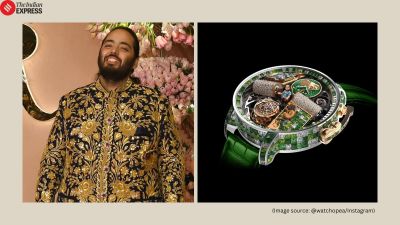
Luxury watchmaker Jacob & Co has unveiled a one-of-a-kind timepiece, the Opera Vantara Green Camo, as a tribute to Vantara, the wildlife rescue and conservation initiative based in Gujarat and led by Anant Ambani, the younger son of Mukesh and Nita Ambani. The watch was introduced on January 21, 2026.