Journalism of Courage
 5 min read



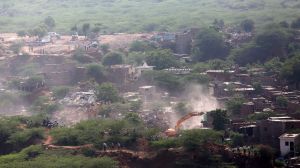
The Delhi High Court8217;s recent order regarding illegal construction in the capital8217;s Lal Dora areas 8212; that it, its urban villages 8212; comes as a surprise as the matter has been debated for some years now. Nevertheless, it has fortuitiously revived it at a time when issues concerning urban management are in the limelight.
What is a Lal Dora area? Do building by-laws apply to the urban villages of Delhi, or are landowners allowed to run amock as almost independent republics in the middle of a planned city? How come things have come to this stage that the courts are having to interpret the DMC Act? Beyond these apparently mundane queries lies a deeper problem: that our land acquisition and land management laws have not been detailed in a good enough manner to ensure that such situations do not occur again. For, this problem is endemic to all our fast growing cities today. When the city grows 8212; and many more will do so as the economy expands opportunities 8212; how does the land acquisition and planning process embrace the existing village settlements which exist.
It would be instructive to first examine the history of these urban villages. In revenue parlance, Lal Dora defines the space in which villagers may build residential quarters. It is more common in the plains of India where villages were traditionally built in clusters for reasons of community living and security. The Lal Dora literally red line was drawn out on the village revenue maps as a ring within which villagers could build their abodes. The rest of the village areas 8212; the agricultural land on which crops may be grown 8212; are termed revenue estate lands. The fundamental principle that must be understood here, especially in the context of today8217;s urban mess, is that land is not the right of any individual under the Constitution of India. Land belongs to the state, and the state may allow an individual to use the land leased out for a specific purpose. So it is in the case of Lal Dora lands.
When the city of Jaipur was laid out a few centuries ago, under the shadow of the Amer Fort, two villages were shifted out to make way for the grid pattern designed by Maharaja Jai Singh. Similar is the case of Edwin Lutyen8217;s New Delhi 8212; planned in 1920 after clearing an area of about 25 sq km south of the Walled City of Shahajanabad. Five villages, including Madhepur where we now have Connaught Place, Raisina where Rashtrapati Bhawan sits on the hill, Malcha and a few smaller ones were removed; their residents were shifted to newer better quarters, and given employment in the building of the new town, and thus rehabilitated. Chandigarh8217;s planners followed suit. To create the 70 sq km of Phase 1 of the new city in 1952, 18 villages were removed from the face of the earth 8212; their residents were given space and employment in the new town, and thus resettled. Even here in Phase 2, the lack of political and executive will resulted in a few villages getting hemmed in by the planned city.
In the case of New Delhi, Lutyens found archaeological wonders in the plan area 8212; the Lodi tombs, Purana Qila, and some other monuments which, even then, were defined as archaeological treasures under the ASI act. These he retained. In fact he aligned the streets to keep the domes visible as focal points in the city plan.
Just a few years later when the Delhi we see now was laid out, Delhi8217;s planners blundered. They did not apply the planning tools of their predecessors and allowed the Lal Doras to exist. The agricultural lands were acquired to create the colonies of the rich 8212; neatly laid out Vasant Vihars and Greater Kailashes 8212; but the urban villages were neglected without any planning norms. The result? While Vasant Vihar is a posh, leafy colony of 45,000 people in 300 hectares, Basant Gaon has a density of 25,000 in 5 per cent of that area, a mere 15 hectares of an urban village hemmed in from all sides. So is the case with the Zamrudurs and Shahpur Jats, not to mention about 130 of them all over Delhi whose names many of us would never get to hear of.
That is not to say that we cannot find democratically acceptable ways of solving the blunders of the past.
But there is no awareness of this basic town planning problem. So the Gurgaons and Noidas are being planned in the same way 8212; leaving the poor villager with no land of his own even as we acquire it for the city, little dignity, even less sanitation, and no traditional employment. These are serious issues concerning how our future cities are to be planned. They need mature, visionary thinking so that planning and land acquisition and management processes can be perfected to encourage better towns and cities.
After all, has the Tehri dam not submerged numerous villages and the Tehri town? So we need to begin thinking about the future of our cities, not merely of how they are to defend the blunders of the past.