Journalism of Courage
 4 min read



Despite the cries of distress that are certain to emanate from the medical community, the Supreme Court has taken an unexceptionably balanced view on consumer rights in medical malpractice cases. In fact, it could easily have been a little more adventurous in its definition of consumer8217;. It has only ruled that the parents of a minor child qualify as consumers. The definition could have been extended to the next of kin. The medical profession has serious reservations about using major procedures preferably without the consent of the next of kin. In the event of an accident, then, why should it not be accountable to the same entity, especially if the patient is in no condition to pursue his own case?
The court has also served public interest by seeking to dispel the notion that the medical profession is a soft target for compulsive litigants. This point of view, which has been propagated by the profession in its own interest, is a complete misrepresentation. Litigation in India is notoriously difficult,especially for a family that also has to cope with treating, say, a brain-damaged child. On the contrary, the public is always a potential soft target for the doctor. As the court itself has pointed out, there is a distinct power element in the doctor-patient relationship, and the patient is always at a disadvantage, because he instinctively puts himself in the hands of the specialist. Until recently, this power imbalance was regularly abused by the doctor, who dictated a course of therapy without taking the patient into his confidence and explaining his ailment to him. This tradition has thankfully ended. Now, it is time for the profession to be completely demythified and made as accountable as any other. It was in a position to police itself in the old days, when there were a small number of doctors and private practice was less respected than service in a hospital 8212; preferably a teaching hospital. But now, the sheer number of doctors, the majority of whom operate on their own 8212; and often on their ownterms 8212; makes self-regulation impossible. The medical profession must submit to the same controls that regulate other trades.
The profession had earlier tried to imply that it cannot be called to account by the law on the ground that it is technically inadequate. However, medicine is not some arcane art. It is a highly codified body of knowledge and procedures of treatment are meticulously standardised. A disease is treated in precisely the same way whether it happens in Britain or Borneo. With this level of procedural consistency, the profession cannot claim that the law does not have the expertise to evaluate its performance. The evaluation consists only in seeing whether the doctor in the dock has gone by the book. The law is as competent to rule on a medical case as in the case of financial irregularity. As the Supreme Court has noted, most malpractice cases are self-evident anyway, and the principle of res ipsa loquitur literally, the issue shall speak for itself8217; may safely be applied. Itis usually a case of a surgical oversight 8212; the ubiquitous forceps problem 8212; or the maladministration of anaesthesia. The law does not need technical skills to come to adequately comprehend such matters.

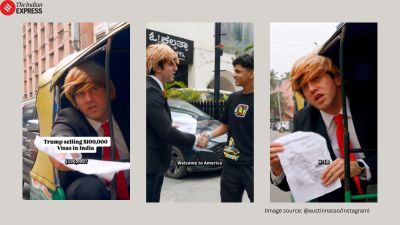
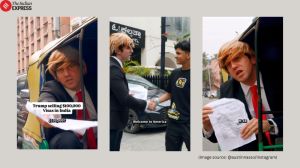
A satirical video by a US-based comedian has been making the rounds online after it showed a spoof version of US President Donald Trump apparently “selling H1-B visas” on the streets of India for a hefty price. The clip, posted by Instagram creator Austin Nasso—who has close to a million followers—features him fully leaning into a Trump impersonation.