Journalism of Courage
 7 min read



Recent developments in Pakistan underline the importance of Islamic language, ideas and imagery to the legitimisation of political rule. Still, despite the implicit consciousness of shared beliefs, Islamic political language, symbols and values require a broader conceptualisation. Muslim politics, too, must be placed into multiple and shifting contexts. We must recognise, as a recent book by Dale F. Eikelman and James Piscatori suggests, that Muslim politics constitutes the field in which an intricate pattern of co-operation and contest over form, practice and interpretation takes place.
Such a recognition enables us to establish the relationship between doctrinal prescriptions and practice in Muslim societies, trace the linkage of religion and politics, and challenge the unreflective presumptions that go into the making of many dated and deeply flawed theories. A number of critical issues, some relating to the efficacy of a secular polity in a Muslim milieu, figured in Pakistan8217;s National Assembly debatelast week. Personally, I did not draw comfort from what was said either in support of or in opposition to the Islamic Sharia Code Bill.
Notwithstanding the eloquent speeches, the criticisms offered by opposition leaders, mainly drawn from Benazir Bhutto8217;s Pakistan8217;s People Party, failed to carry much conviction to television viewers like me. Most speakers, guarded and defensive in their approach, should have taken their cue from the NGOs and human rights groups and challenged the underlying assumptions that go into the making of such a legislation. They did nothing of the sort. Nor did they invoke the alternative frameworks which exist within the Islamic tradition and have lent, for decades, a fair degree of political and institutional stability in more than 40 Muslims countries.
In short, I found the liberal and modernist voices, which are still heard loud and clear in Turkey, Iraq, Syria, Algeria and Egypt, muted in the Pakistan Assembly. Surely, the issue at stake in South Asia generally is to promotemulticulturalism, secularise politics, demarcate the religious boundaries from the public domain, and prevent the cynical use of religious symbols by the priest-politician combine.
The stark choice for the peoples and governments is to either create and adhere to a theocratic state or secularise society on the strength of a liberal and enlightened secular discourse. I believe Nawaz Sharif8217;s government, still haunted by the shadow of Ziaul Haq8217;s ill-conceived Islamisation fervour, has taken the first step towards the creation of a theocratic state. If the current predictions about the Islamist bandwagon rolling on in Pakistan come true, history may not exonerate Nawaz Sharif for his grave error of judgment.
In opting for a Sharia-based polity, Nawaz Sharif traverses a rough and unwieldy terrain. But what prompted him to do so? Does he not head a stable government? Did he need the Bill to buttress his otherwise unassailable political position? Was he obliged to make concessions to the Islamists, many ofwhom stand discredited in the eyes of the people? The reality is that his government had no immediate domestic compulsions to flaunt its Muslimness. Nobody accepts his own claim that the Bill8217;s provisions would restore law and order, end sectarian and ethnic strife and resolve the deepening economic crisis.
On balance, he has in his enthusiasm not only betrayed the people8217;s democratic aspirations but also created space for strident Islamists to impose their old-fashioned codes on the people. In a nutshell, what he and the 151 out of the 217 Assembly members have embarked upon is not a modern but a retrograde project. By taking recourse to the age-old practice of using religion for political legitimisation, Nawaz Sharif has ignored the warning that fundamentalism is an inherently divisive ideology.
For the time being, he may have weakened both the opposition and, in the wake of General Karamat8217;s resignation, the military establishment. But religious rhetoric, as one of his unfortunate predecessors wouldhave discovered on the gallows, often backfires. He must know that religio-political fundamentalism devours its own protagonists. Islam is and will remain a way of life for the Muslim communities.
Indeed, Islam offers 8220;agency8221; to its adherents in the sense that sociologist Anthony Giddens uses the terms 8212; an individual8217;s or group8217;s capability to intervene, or to refrain from intervening, in a series of events so as to influence their course. But fundamentalism, often nurtured by the West to serve its own ends, has ceased to be a dominant and all-pervasive force in today8217;s world. This is a cause to celebrate.
Though secularism is still a far cry and Afghanistan8217;s militarism and fanaticism remains a disturbing element, fundamentalist stirrings of the Khomeni brand has lately lost some of its fervour. The Shia orthodoxy in Iran has been tamed, though not humbled; the Islamic-oriented Welfare party in Turkey has lost some of its elan; the Muslim Brotherhood in Egypt and the FLN in Algeria, having capturednewspaper headlines in the past, are gasping for breath; the CSIS countries are unmoved by the rhetoric of the mullah.
Pakistan8217;s electorate, too, repudiated Zia8217;s religious legacy, though they have every reason to feel disappointed that the turbaned men with flowing beards are back in business with their sermons and fatawa religious decrees.
Predictably, Pakistan8217;s dwindling minorities and human rights activists have fulminated against the Bill. What augurs ill for their future is that only 16 Assembly members voted against it: the rest stared at the peril without knowing what to do to avert it. Why? For decades the country8217;s dilemma is to either carve out its place as a modern nation-state or assert its distinct Islamic identity. Quite simply, the uneasy tension between the protagonists of these two distinct world-views are unlikely to be resolved by the Islamic Bill.
A possible outcome, one that must alert us in India, is that Sunni fundamentalism may well gain a fresh lease of life inneighbouring Pakistan. In such a scenario, we can ill-afford to ignore Mirza Ghalib8217;s warning: Ub kaha jaeya ga sailaab-i bala mere baad where else is this deluge of misfortune to go after I8217;ve gone!.
Meanwhile, Pakistan8217;s citizens must wonder if their interests were safe in the hands of a ruling elite that deploys religion merely to gain political leverage. Their nightmare, beginning with Zia8217;s inglorious regime, is not yet over. Already, reports suggest that the Big Brother has arrived with his rabble-rousers, judges and executioners, ready to strike down any one who dares to deviate from the legislated code of conduct. If so, their feelings find expression in what Ghalib wrote more than a century ago:
I go some way with every man I see advancing swiftly.
So far I see no man whom I can take to be my guide.


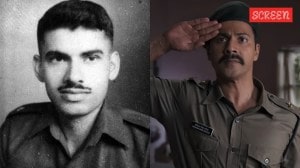
Vishal Bhardwaj’s crime thriller O Romeo, starring Shahid Kapoor and Triptii Dimri, has landed in trouble. Since Shahid’s character is allegedly based on the life of real-life gangster Hussain Ustra, the latter’s daughter has now sued the makers, including Bhardwaj and Sajid Nadiadwala’s Nadiadwala Grandson Entertainment, and demanded Rs 2 crore for the unauthorized portrayal of her father.