5 min read

Journalism of Courage




Minutes before Islamic militants and government troops began killing each other in northern Lebanon six weeks ago, a flurry of cellphone calls set the tone for the contagion of violence.
The calls began at 2:55 a.m. on May 20 when Lebanese security forces surrounded a Tripoli apartment building used as a safe house by Fatah al Islam, a newly-formed militant group with Qaeda aspirations.
8220;Stop it or I will go out and attack,8221; the group8217;s military commander, Abu Hureira, said from his headquarters in the Palestinian refugee camp Nahr al Bared, north of Tripoli, according to a recording of the conversations that was played for reporters with The New York Times.
A sheik acting as an intermediary relayed the warning to Maj Gen Achraf Rifi, head of Lebanon8217;s Internal Security Forces, who replied, 8220;You will surrender8230;or you will die.8221;
Seconds later, General Rifi8217;s men stormed the safe house, killing 12 suspected militants. In response, Fatah al Islam rushed into an army checkpoint at the camp8217;s entrance, killing 23 soldiers sleeping in tents. The continuing battle, which has claimed more than 200 lives, has ruined the camp, now the scene of daily artillery barrages as the Lebanese Army tries to flush out Fatah al Islam.
The fight has drawn scrutiny here and abroad because the militants are foreigners and veterans of the war in Iraq. As Lebanon falls increasingly into a state of political paralysis, the risk of militants setting up base here is raising alarms, especially among European intelligence officials.
A year ago, this country found itself in the middle of a war between Israel and the Lebanese militia Hezbollah. Although the war8217;s catastrophic damage drew Lebanese together, they quickly turned on one another politically. Killings, bombings and political protests have become routine.
Political forces find themselves stalemated, with no one firmly in charge. Politicians on each side accuse those on the other of blocking reconstruction to prevent them from getting credit. Parliament has to select a new president in September, but with the governing coalition and the opposition hostile to each other, that could set off an unraveling of what remains of the system of governance.
8220;If you are in a hole, at least stop digging,8221; said Ali Hamdan, foreign affairs adviser to Nabih Berri, speaker of Parliament and a close ally of Hezbollah. 8220;Unfortunately, the Lebanese keep digging.8221;
While Lebanon8217;s troubles are not principally about Islamic militancy, some fear it could become the kind of place that attracts more of it, especially from the Iraq war.
General Rifi, the internal security chief, estimates that 50 to 60 fighters are still in the camp and they include skilled and determined militants from Saudi Arabia, Syria, Yemen and Algeria who fought with the insurgency in Iraq. The group8217;s leader, Shakir al-Abssi, was an associate of Abu Musab al-Zarqawi, the leader of Al Qaeda in Mesopotamia killed last summer. 8220;One reason we attacked Abssi was to get a message to those people that you don8217;t have to come to Lebanon after your mission in Iraq,8221; General Rifi said.
But Abssi has been drawing support from Europe as well, according to a Western European intelligence official who spoke on condition of anonymity.
Meanwhile, Lebanon has been hit with a rash of car bombings and other violence since the fighting with Fatah al Islam began, including a car bomb in the south that killed six United Nations peacekeepers.
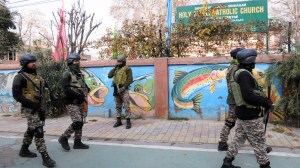
Today, the Lebanese are increasingly divided by rolls of razor wire spread across roads and wrapped around buildings and homes. They are separated by military checkpoints that tie up traffic. Nearly a dozen members of Parliament have left the country, fearful they will be killed. Some UN officials have moved from their heavily guarded offices in the centre of Beirut to smaller, less obvious space deep behind a sea of razor wire.
Given Lebanon8217;s fractured politics 8212; and the backing of Hezbollah by both Iran and Syria and of the government by Western powers 8212; it is too soon to know who has been behind the many incidents.
But Lebanese officials say they have had shootouts with several clusters of foreign Islamic militants, some of whom had clear ties with Abssi8217;s group. 8220;We have no sleeper cells in Lebanon,8221; said a Lebanese Army official, who spoke on condition of anonymity. 8220;They are all waking up.8221;
If there is one unifying element to the national psyche, it seems to be that the leadership 8212; both of the government and of the opposition 8212; has failed by paralysing the country and failing to find a governing consensus.
Hezbollah came out of the war against Israel highly popular. But today its leaders are accused by some of focusing too much on domestic politics and failing to achieve their stated goals, which has prompted unusually heated debate within Hezbollah over its direction.
8220;They were not expecting the results of instigating against the government to be transformed into sectarian tensions between Sunnis and Shiites in the street, which was about to become an even bigger problem,8221; said Talal Atrissi, a political sociology professor at Lebanese University and an expert on Hezbollah. 8220;The other party was able to use the sectarian tension to face Hezbollah and to transform the battle to its benefit.8221;
But on the street, there remains great admiration for Hezbollah, but dissatisfaction with its political management.