3 min read

Journalism of Courage




VADODARA, Dec 2: It was in 1825 when the world8217;s first train ran between Stockton and Darlington in England. On April 16, 1853, the miracle on wheels was staged for the first time in India on a 21-mile-long track between Bori Bunder and Thane by the GIP Railway. Today the technological marvel has become integral to the nation8217;s lifeline under the aegis of the Indian Railways.
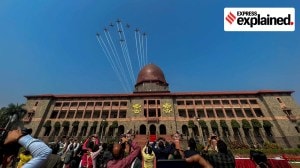
Vadodara, it so happens, houses the alma mater of the men behind the vision, that is, the Indian Railway executives. The Railway Staff College originally the Pratap Vilas Palace initiates both civil servants and executives into the dynamics of railway working, grooming them to shoulder responsibilities of increasing magnitude in an ever-changing scenario. A crucial element of which constitutes the foundation course 8212; the Model Room.
Comprising working models of 15 stations, miniature locomotives, coaches and wagons, the Model Room is a railway network in itself. This is where newly recruited probationary officers of different Railway services receive hands-on training on the vital train operation of signalling besides other safe systems of working.
The earliest method of signalling adopted by a British Station Master was to send a Bobby8217;, a man on a horse, who would wave a flag to the approaching train to let the driver know if it could enter the station. A queerer signal was a candle burning at a distance. 8220;After miscellaneous experiments evolved the semaphore type signal followed by the multiple aspect semaphore, which are now being replaced by colour light signals,8221; says faculty member P Chakrapany.
Signals are meant to control movements and points for diverting the movement from one line to another. 8220;However, in order to permit higher speeds and improve safety, points and signals were linked together to function in a co-ordinated and mutually controlling manner, known as interlocking. Thus, unless the train8217;s route is not set, the signal will not be released,8221; explains Chakrapany as he demonstrates the process on a model station.
While the traditional method of operating points and signals by means of hand-operated levers still exists, widely used means today are modern electrical appliances like Panel Interlocking and Route Relay Interlocking, he says. The predominantly used system of working to ensure safe and streamlined approach in the Indian Railways train operations is the Absolute Block System which the Model Room exhibits.
It also includes a section containing double line and single line models of the Automatic Block System adopted by metros like Calcutta, Mumbai, Delhi and Chennai where several hundred trains run on a daily basis. There is also a Marshalling Yard where good trains are dealt with.
The intricacies are captivating, almost drawing a feeling of awe, till episodes of sudden failures and the ensuing loss of human life by the hundreds strike the mind. Chakrapanay blames it essentially on human failure.
8220;Accidents cannot be avoided but can definitely be reduced. One reason why the technology fails us is because the equipment is not commensurate to the traffic demands. But an important factor is the deterioration in social attitudes and circumstances.
quot;It is from this society stricken with poverty, greed, inertia and nonchalance that we draw our manpower from. How many want to be responsible?8221; he says.