Journalism of Courage
 4 min read



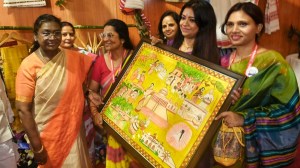
A Patachitra painting, a coaster with inlay work, a Bastar iron work deer. What do they have in common? Simply, that they are all borne from the vast reservoir of talent popularly known as Indian crafts. Most of us have bought or received these at some point. Imagine if all the entire Indian middle class 300 million had at least two of these or similar works of craft at home, as well as bought at least one of these as gifts for others. It would mean, most simplistically, a market for 900 million such works. Many of them have already been bought, resulting in a potential glut. And because the designs are repetitive, the market optimistically looks like it has reached a plateau and there seems to be little scope for its expansion. Basically, both buyer and producer have put the outputs from traditional visual arts practioners in a narrow niche.
It8217;s an error every which way: economically, ecologically, politically, because in such art is encoded a world view, wisdom and a materials economy that is unique and acts as a means of self-assertion. By reducing it to a few boring things, or embellishments, its life, its very essence is being taken out of indigenous art practice.
Of course, this is not a new thought, and stores such as Fab India and Dastakar have sought some solutions to this. Both, in a sense, have followed a line of remaining in the realm of the traditional, improving what exists, offering employment and incentivising craftspersons to continue to keep their tradition alive. Without these initiatives, we would have been much poorer.
But how do you break that divide of traditional and contemporary, decorative and handy, and move ahead?
Here8217;s an idea. Or rather, two.
The first one is about the work of Barnali Nandi, an artist who has worked brilliantly with chikankari, batik and paints on board to create works for her first solo exhibition in Delhi. Barnali uses these skills both visually and to suggest a sense of deeply imprinted layers, evolved in sedimentary fashion. In a flash, she negotiates for another space for these art forms.
Needless to add, this does not address the problem of mass stereotyping of crafts, although it does take it out of the boring niche it occupies.
The second, and more powerful idea, is being propounded by Kaaru, an enterprise of artisans, designers, architects and craftspersons. Kaaru claims to design for everyday living, and therefore one is not surprised to find sleek, contemporary coasters, trays, chests, tables and sofas. What makes them different is the manner in which, say, a stone carver8217;s idol is blended with Bastar iron forging, or a Sanchi paper cutter effortlessly joined with giant wooden combs in a table made by a skilled carpenter using old techniques. It doesn8217;t stop here: there is no mass production, a careful assessment of materials to over-consume scarce resources like Shisham wood that takes 60 years to mature, and flaws in the materials are integrated into the design. This easy, seamless shift of the traditional into the contemporary without losing its inherent value, of being able to take the form of a useful product, could be the first step to leverage a market that is based upon sustainable livelihoods that nurture Indian art.