Journalism of Courage
 6 min read



At the Congress Working Committee meeting last Saturday, Prime Minister Manmohan Singh listed seven challenges facing the country. Five of these challenges were related to internal security, including leftwing extremism and communalism. The remaining two were inflation and the energy deficit. While Finance Minister P. Chidambaram made a spirited 20-minute intervention and apprised the Congress8217;s apex body about measures he intended to take to control inflation, the rest of the meeting was given over to back-slapping on the success of Indo-US nuclear deal.
No one asked Home Minister Shivraj Patil, who due to his phenomenal incompetence has become an object of ridicule even in the ruling party and among the Congress8217;s allies, to address the CWC on internal security. Perhaps the busy Congress leaders did not want a long-drawn high fat and low protein lecture from Patil.
Exactly 11 minutes after the conclave ended at the Parliament
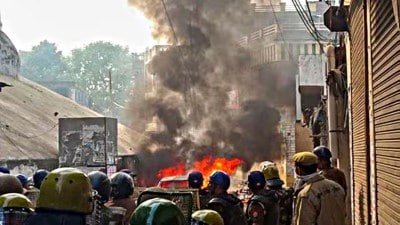
Annexe at 6 pm, an improvised explosive device IED went off just 5 km away at Gaffar Market, in Karol Bagh. In the next half an hour four more bombs exploded in Delhi8217;s busy markets, in the city8217;s worst terrorist incident since the October 2005 Diwali blasts, which to date remain unsolved.
That only the nuclear deal, and not terrorism, was the focus of the CWC appears symptomatic of the ostrich-like mentality of the ruling UPA and the Congress, both of which have a strange reading of the sensitivities of the minorities. With crucial assembly and Parliament elections only months away, this reading is showing itself in a kind of appeasement that had Congress, BSP and SP leaders trooping to the house of the Ahmedabad blast accused, Abu Bashir, last month to offer sympathies to his relatives after he was arrested.
Rather than segregate politics, religion and terror, the present ruling dispensation and the opposition are using the frequent bombings to throw mud at each other. Two days after the 7/11 Mumbai train blasts in 2006 at the Union cabinet meeting, two senior ministers in front of the prime minister pointed fingers at assorted groups for the carnage despite National Security Advisor M.K. Narayanan stating that Pakistan-based jihadis were behind the local train bombings. Cut to the July 31, 2008 cabinet meeting after the July 26 Ahmedabad blasts. After Shivraj Patil meandered on internal security from the Gorkhaland agitation, Amarnath crisis, Bangalore, Ahmedabad and Surat bombings before the cabinet, again a senior minister argued that the Centre should take over the Ahmedabad and Surat cases as one could not trust Narendra Modi. At both meetings the prime minister chose to refrain from divisive issues.
Interestingly, the Ahmedabad blasts could not have been solved by the Gujarat police if the Intelligence Bureau under the home ministry did not locate Abu Bashir in Saraimeer in Azamgarh and help in the arrest of top SIMI leaders like Safdar Nagori and Sajjid Mansuri.
Just like the BJP on the nuclear deal, rather than take credit for putting the Ahmedabad and Jaipur blasts culprits behind bars, the Congress and some of the UPA ministers are out to discredit the Gujarat SIMI catches for mere political gains.
In the span of just three years, Delhi has been hit twice by terrorists, with attacks in Mumbai, Hyderabad, Lucknow, Varanasi, Bangalore, Jaipur, Ahmedabad and Surat in the meanwhile, all booming markets and urban centres. But neither the politicians nor the security agencies seem to realise the dangers of indigenous terror. By hitting at the regional economic hubs of the country, the terrorists are out to target the secular fabric of the country 8212; and this includes fanatic Hindus who died making bombs in Kanpur last month and the VHP leader Pravin Togadia, who goads Hindus to master IED technology. The SIMI leader and Ahmedabad blast accused, Sajjid Mansuri, revealed the rabidity and commitment of the terrorists out to target India during interrogation by the Gujarat police.
A federal investigation agency and a strong national anti-terror law are required to counter the subversives. While an impartial agency is needed to overcome inter-state and political rivalries to investigate the terrorist attacks in order to book the saboteurs, a tough anti-terror law would ensure faster conviction and accountability. Otherwise, the enforcement agencies will be bogged down in legal procedures. Classic illustrations of the present red-tape are the Uttar Pradesh police refusing to quietly hand over Bashir to the Gujarat police and SIMI8217;s so-called 8220;amir8221; Shahbaz Hussain to the Rajasthan police despite both state governments repeatedly urging Lucknow that the media glare would ensure that their accomplices escape. And that is exactly what happened as SIMI8217;s key mastermind, Subhan Qureshi, aka Tauqeer, and Gujarat SIMI chief, Qayamuddin, escaped the police dragnet.
While Prime Minister Manmohan Singh realised the seriousness of the SIMI terror threat after the Ahmedabad arrests and so did Patil and Narayanan, the government did precious little to counter it. Losing sight of the fact that SIMI8217;s heroes include Osama bin Laden, Shivraj Patil confined himself to talk about revival of the 8220;kotwali system8221; to counter terror.
For a country that has aspirations of occupying a seat at the global high table, terrorist attacks at regular intervals send out a message of poor governance, of hapless citizens left to fend for themselves as the state abrogates its responsibilities. This was again evident after the Delhi blasts as like in the past it was the same public and constables who were carting the dead and injured, with emergency services slow to offer assistance.
Briefing the Union cabinet after the Ahmedabad blasts, Shivraj Patil argued the 8220;need to strengthen existing intelligence gathering apparatus at both state and Central level with utmost vigilance that needed to be maintained for the safety and security of the citizens.8221; The time has come for both the government and the public to take the debate forward on ways and means to operationalise new internal security mechanisms. With India8217;s major cities being bombed at will by terrorists, the government8217;s response has to radically change.
Merely changing clothes, Minister Patil, does not help.
shishir.guptaexpressindia.com