Journalism of Courage
 6 min read



Three important visits of West European Heads of Government were decided upon between August and October last. Italian Prime Minister Romano Prodi and the Greek and French Presidents were scheduled to visit this month. Prodi and Greek President Costis Stefanopoulos were to visit during the first half of January and President Jacques Chirac of France was to be chief guest at the Republic Day celebrations. These visits were to be a response to visits by then Vice-President K. R. Narayanan, then President Shankar Dayal Sharma, and I.K. Gujral over the last three years. Political instability and the destabilisation of the Gujral Government had briefly put these visits in jeopardy. There are reliable reports that senior advisors of these dignitaries as well as of President Clinton had suggested that their visits, scheduled between January and April, should be postponed till the elections are over. They said that not only should these visits take place when a new Government is formed but also after the stability and policy orientations of the new power structure in India have been assessed.
Significantly, despite such advice, three visits 8212; those of Prodi, Stefanopoulos and Chirac 8212; are to take place as scheduled. The dates of Clinton8217;s visit are not finalised. In any case no specific date for his visit was firmed up till the end of December. The Italian visit is underway, and the Heads of Government of France and Greece are also to visit this month. The decision to come before the election and despite political uncertainty was taken personally by these dignitaries. There is speculation that the assessment of their diplomatic missions in New Delhi overrode the caution of their foreign offices and policy-planning headquarters.
That these important European leaders have decided to visit implies a certain faith on the part of their Governments, and of the European Union EU itself, in the institutional integrity of India8217;s political structure. It reflects an assessment that India8217;s political uncertainties do not diminish its potential as an economic and technological partner. Factors in these positive perceptions could be the substantive credibility of Indian democracy in the eyes of Western Europe. Second, India8217;s track record of responsiveness to macro-level issues of global concern, such as human rights, good governance, democratic environment management and gender issues, are being acknowledged as a positive contribution to structuring international cooperation. Third, despite critical evaluations of the speed of India8217;s economic modernisation and reform programmes, its domestic and foreign economic politics are assessed as enhancing its capacity for economic cooperation with the industrially advanced countries.
Italy, Greece and France are active EU members. They are also participants in the activities of NATO in its new, evolving incarnation, transcending the organisation8217;s military objectives. Italy and France are economically and politically active in Central and West Asia. The importance of utilising the visits of their leaders to enhance relations cannot be overemphasised. After the United States, the EU is perhaps the most important power centre in the world in terms of investment, industrial and technological capacities. Italy and France are especially important for India8217;s interests.
Though there are differences between India and Italy on some political issues such as non-proliferation and the expansion of the UN Security Council, Italy has been generally supportive of India8217;s advocacy of the democratisation of the UN and the expansion of its major organs. In comparison to the Western media8217;s coverage of Indian events, the Italian media has been more balanced and encouraging in its assessments of India8217;s democracy and economic policies. Indo-Italian economic cooperation has increased since India8217;s economic liberalisation began. Agreements exist for the promotion and protection of investments, avoidance of double taxation, and on cooperation in checking drug-trafficking and terrorism. India8217;s exports to Italy in 1998 were worth 1,328 million, Italian exports in 1996 worth 1,208 million. Italy is involved in India8217;s transport, power, electronics and chemical sectors. It has actively encouraged Indo-European cultural and academic cooperation since its chairmanship of the EU.
Though the range and content of India8217;s relations with Greece may not match those with larger countries, their historical and cultural relations constituted a very strong bond. Bilateral trade has been expanding. India exports goods worth nearly 93 million to Greece and imports important goods worth nearly 17 million from it, consisting of petrol, petroleum products, manufactured metal and iron products. Greece has been perceptive about Indian political concerns in multilateral fora. Its foreign policy is responsive to the post-Cold War interests of developing countries.
President Chirac8217;s visit is of special significance. He is no stranger to India, having visited in January 1976 as Prime Minister of France. As Mayor of Paris, he underlined his interest by making the Festival of India in France a success in 1985-86. He undertook special goodwill gestures by holding civic receptions for Rajiv Gandhi in 1985 and Narasimha Rao in 1992 despite being out of France8217;s central power structure at the time. Indo-French bilateral trade has increased by 40 per cent since 1991 to French Fr11.25 billion about Rs. 79 billion in 1996. French investments, approved and in the pipeline, are of the order of about Fr24 billion Rs. 17 billion. France is the fourth largest foreign direct investor in India, and 333 Indo-French technical and financial joint ventures are in operation.France being a permanent member of the UN Security Council and a nuclear-weapons power, there are differences of opinion on disarmament and distances on issues like UN reform. But parallelisms exist on UN peacekeeping, implementation of WTO agreements and aspects of proposed international regimes governing the transfer of technologies. India has potential for defence cooperation with Italy, Greece and France, for which contacts have been established and maintained in the last decade or so.
France and Italy are also strategically and economically involved in Iran, Pakistan and the Central Asian Republics. Although Prodi, Stefanopoulos and Chirac are visiting during Gujral8217;s limited tenure, their interest should evoke a substantive response from India and provide a foundation for expanding relations with their countries, and with the EU collectively.

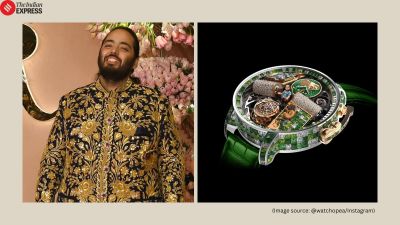
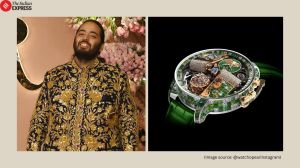
Luxury watchmaker Jacob & Co has unveiled a one-of-a-kind timepiece, the Opera Vantara Green Camo, as a tribute to Vantara, the wildlife rescue and conservation initiative based in Gujarat and led by Anant Ambani, the younger son of Mukesh and Nita Ambani. The watch was introduced on January 21, 2026.