4 min read

Journalism of Courage




Confusion over common concern
8220;You go straight then you turn left to go right8221;.
8220;But that still blocks traffic8221;.
8220;Yes but you can8217;t turn here and then if you8217;re coming from the other side you don8217;t get on to the road directly you8230;8221;
I tried. Honestly I tried to figure out how the new Bandra flyover was supposed to work. I asked regular travellers. People who make it their business to discover every bylane, route and diversion to help them beat the clock. They said they weren8217;t sure. Then they said it might make sense when the whole Worli sealink was completed. Perhaps. And we left it at that. But now that a whole side of a brand new flyover has been shut to traffic I am beginning to wonder if I am the only one perplexed.
We in Mumbai have got used to inaction. For as long as I can remember there has been talk of finding ways to ease congestion. New road links, an underground metro, restrictions on car users, hovercrafts, etc. etc. Nothing ever came of these schemes. Trains have gotmore crowded, traffic crawls and we have got used to it taking pleasure in small details. New steps at the station. How nice! A fresh coat of paint for dividers. Great!
So then, under the circumstances, when schemes of an almost surreal nature and magnitude 8212; 55 flyovers, a green belt reclaimed from the sea 8211; are being dropped into our laps like instant manna from the skies why is there scepticism and confusion rather than joy? Is it because we are wary of quick solutions? Is it because we are concerned about how these schemes are to be funded? Is it because we just don8217;t know what8217;s going on?
Amazingly, for changes of such a sweeping nature and cost, there has been little public debate. There has of course, been strong opposition from environmental groups. Some of their reservations revolve around ecological damage due to reclamation. The lopsided priorities served by flyovers 8211; as much as 88 per cent of city8217;s population apparently relies on public transport, a hefty proportion of which would berailway users who would benefit little from flyovers, moreover the concept itself militates against the growing trend in well-planned urban centres the world over to restrict entry into cities rather than facilitate it. The likelihood of public schemes being utilised for private gain 8211; as in the case of 45,000 square metres of traffic-inviting commercial space being created under the Andheri flyover 8211; is another concern as is the crucial issue of whether the huge sums of money being spent on these plans would not be better spent on solving basic problems such as the water shortage.
The government has been dismissive of these objections. In a recent discussion, Nitin Gadkari, Maharashtra8217;s minister for public works described enviromentalsists as eco terrorists8217; with a vested interest in obstructing development. Now even if you take the position that however hard you try you cannot please everyone. That any concrete action is bound to hurt someone and that sacrifice is necessary for the larger good. Or, asmany people believe, a disproportionate amount of attention has been conferred on the environment in recent times. Even if you believe all these things, it has to be acknowledged that the concerns expressed by environmental groups on the subject are by no means trivial and need to be addressed in the long term interests of the city.
But why limit the debate, such as it is, to environmentalists. Why not include others as well 8211; urban planners, architects, law enforcement officials, sociologists 8211; in short anyone who could contribute their experience and talent for the common good. In a city brimming with talent it doesn8217;t make sense for any government to deprive itself of the opportunity to hear diverse views or the citizens of his right to be better informed about decisions taken in his interest.
The writer is a former editor of Elle

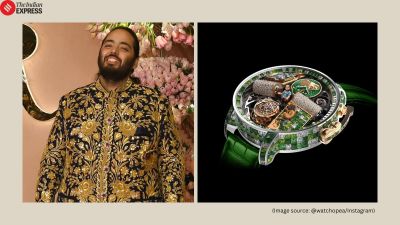
Luxury watchmaker Jacob & Co has unveiled a one-of-a-kind timepiece, the Opera Vantara Green Camo, as a tribute to Vantara, the wildlife rescue and conservation initiative based in Gujarat and led by Anant Ambani, the younger son of Mukesh and Nita Ambani. The watch was introduced on January 21, 2026.