14 min read
© The Indian Express Pvt Ltd



 Mirabai Chanu at the academy in UP's Modi Nagar where 43 children, between 8 and 14, have been training with her and coach Vijay Sharma. (Express photo by Praveen Khanna)
Five months ago, two ‘strangers’ came to Lomason Khundrakpam’s hometown in Manipur’s Imphal West. They measured his weight and height, shoulder width and thigh circumference, and asked the 10-year-old to jump onto a stack of 25 metal plates. The pile came up to his neck. Unfazed, the 4-foot-tall Lomason took a short run-up, sprinted towards the metal pile, drew all the energy he could from his lithe frame and managed a gravity-defying leap — landing right on top of the plates.
The auditioners were stupefied. Days later, Lomason was on his way to Modi Nagar in Ghaziabad, UP, to start a new life — as a weightlifter.
 The academy has children picked by the legendary athlete-coach duo, who went to some of the remotest villages with rich weightlifting traditions. (Express photo by Praveen Khanna)
Back then, the young boy did not know that the duo testing him was the legendary athlete-coach combo of Mirabai Chanu and Vijay Sharma.
For a decade, with the sport itself mired in troubles, from doping scandals to paucity of talent, the athlete and her coach ensured they kept the flag flying for Indian weightlifting — Mirabai’s World Championship title eight years ago, the Olympic silver in 2021 (49-kg category) and the world record, when she lifted 119 kg at the 2021 Asian Championships in clean and jerk category.
But the ‘who-after-Mirabai’ question always loomed. So, after the Paris Olympics, the duo decided to do the heavy-lifting once again — this time, to identify the baton bearer for the future generation or, as coach Sharma says, “hunt for the next Mirabai”. Since September last year, they have been on a country-wide search, going to some of the remotest villages with rich weightlifting traditions — from Kurundwad, a tiny town on the banks of the Panchganga river in Maharashtra, to the ancient Assamese city of Sivasagar, famous for its palaces and temples.
The sports-mad Imphal, also Mirabai’s home, was their final stop. “It was nostalgic to return there,” Mirabai gushes. “More than 200 children turned up! I would have never imagined.”
One of them was Lomason, who became part of a hand-picked group of 43 — all aged between 8 and 14, 38 of them girls — that calls itself ‘Weightlifting Warriors’. Fifteen of the 43 are from Manipur, 12 from Assam, six from Uttar Pradesh, five from Maharashtra, two from Tamil Nadu and one each from Arunachal Pradesh, Odisha and Haryana.
Sharma says the decision to recruit more girls than boys was a conscious one. “Girls are more driven,” Sharma says. “And serious… and disciplined.”
He knows. After all, he has raised one – Mirabai — and the two now hope to nurture many more.
At the Modi Nagar academy, Lomason glances at a life-size photo of Mirabai and Sharma flashing the Tokyo Olympics silver medal, and says softly: “I want to be like Mira didi.”
The seeds of this ambitious project were sown at an unlikely location: a surgeon’s office.
In late 2023, Mirabai aggravated an injury during the Hangzhou Asian Games, where she heroically came close to a medal despite writhing in pain. From Hangzhou, Sharma and Mirabai headed straight to Mumbai to get her condition assessed by sports medicine expert Dr Dinshaw Pardiwala.
As Dr Pardiwala examined one of his many famous patients, Sharma went into a mental spiral. “I was talking with Viren bhai (Viren Rasquinha, CEO of the Olympic Gold Quest, a foundation that supports athletes in their quest for Olympic medals) about the dire situation we were facing,” he says. “For close to a decade, we have had only one athlete who has competed consistently at the world and Olympic stages and that’s Mira. After her, we don’t have anyone who can be competitive beyond the Commonwealth.”
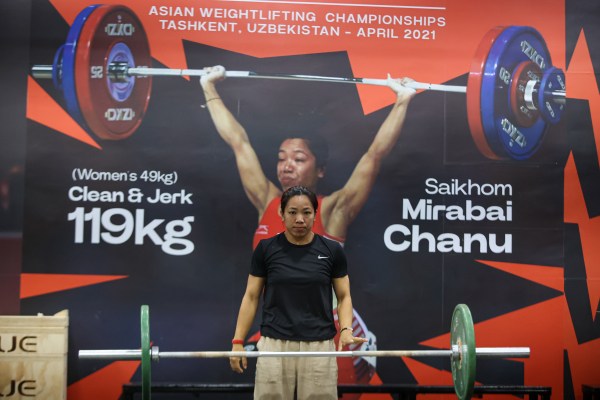 Mirabai has been India’s sole representative at the last two Olympics. The situation is unlikely to change at the Los Angeles Games in three years. (Express photo by Praveen Khanna)
It’s a frightening reality that Indian weightlifting has routinely confronted.
India has had a sentimental relation with weightlifting. In 2000, Karnam Malleswari became the first woman from the country to win an Olympic medal when she won a bronze medal at the Sydney Games. Before her, Kunjarani Devi won seven silver medals at the World Championships from 1989 to 1998, missing just once in 1993 due to an injury. Mirabai Chanu continued the tradition and remained a strong medal contender at the last three Olympics, going on to win a silver in Tokyo. There has been a bagful of Commonwealth medals too.
Despite these heartwarming performances, Indians have rarely held their own in the presence of the bigger players — mainly from China, followed by those from the US and Europe.
Then, there’s the long shadow of doping. According to the Sports Ministry’s annual report for 2023-24, weightlifting had the second-highest dope cheats in the country — 33 — after athletics, a trend that goes back to more than a decade.
The drying talent pipeline has been another major concern. Mirabai has been India’s sole representative at the last two Olympics. The situation is unlikely to change at the Los Angeles Games in three years. That is, if Mirabai’s aching body holds up until then — next year’s Asian Games will be her first big test.
 Weightlifting as a sport offers 10 gold medals at the Olympics, making it one of the high-medal events. (Express photo by Praveen Khanna
Sharma opens up about the “international embarrassment” when he travels for competitions. “Coaches from other countries ask me, ‘How come you are happy with just two (Olympic) medals?’” Sharma says. “They are right. But before we think of winning more medals, we first have to ensure our athletes qualify in every weight category. Without quantity, it’s hard to get good quality.”
The focus on weightlifting is a strategic decision. The sport offers 10 gold medals at the Olympics, making it one of the high-medal events. By focussing on increasing participation numbers, which have so far been dismal, India can at least hope to be in contention for these medals.
That’s how ‘Weightlifting Warriors’ came into being. “I have spent my whole life until now working with elite athletes,” Sharma says. “I’ll spend my remaining time nurturing young talents, teaching them the correct techniques and creating a steady stream of lifters.”
Sharma, whose family left Akhnoor, the scenic town in the foothills of the Himalayas, and settled in the plains of Modi Nagar, Ghaziabad, turned a family-owned building into a full-fledged academy equipped with a gym, dining area, an office and residential rooms. He got help from the Indian Weightlifting Federation when he went around scouting for talent.
 Coach Vijay Sharma (middle row, second from left; on Chanu’s right) turned a family-owned building into a full-fledged academy equipped with a gym, dining area, an office and residential rooms. (Express photo by Praveen Khanna)
Mirabai left Patiala — her home for more than a decade, ever since she moved from Imphal East and started living at the National Institute of Sport where the national team is based — and relocated to Ghaziabad.
She trains here by herself, lives with the young trainees and coaches them. “Coaching comes naturally to me, I like to think,” she says. “That’s my plan when I stop competing. It is very tough, but it is something I must do to ensure my sport grows.”
Mirabai’s long-time backers, OGQ, bought into the project and took care of everyday operations. “It’s a very big project but also very exciting,” says Rasquinha, the hockey Olympian. “Our goal is to create the next Mirabai Chanu in eight years.”
It’s a punt to take untested youngsters and try to convert them into champion lifters of the future. But Sharma and his team remain optimistic.
Clang. Stomp. Grunt. Repeat.
It’s half-past-seven in the morning and the brightly lit gymnasium in the basement of an austere building is a hub of activity. Some trainees lift the barbells above their heads in one snappy motion. A few others, not ready yet for higher loads, work on their core.
Sharma’s hawkish eyes don’t miss a thing: A 12-year-old’s right knee bends fractionally outwards and he makes a mental note; it’ll be rectified before the next session. He notices another trainee’s thighs shaking when she lifts the barbell above her head; more strength training will be advised.
For years, Sharma has grudgingly admired China’s gigantic sports machine, of which weightlifting is just a small cog, but one that’s delivered them a staggering 43 gold medals at the Olympics — including half of the titles at Paris, just like in Tokyo.
A strategy that sets the Chinese grapplers apart from the rest of the world is the disciplined training that young weightlifters are put through, and the single-minded focus on perfecting their technique. In contrast, the Indian elite lifters are loaded with technical flaws because they would “start late and not be taught the correct techniques, something that stays with them”, says Sharma. “At the national camp, it is not possible to start from scratch and make athletes change what they have been doing for many years.”
 Mirabai grew up hearing the names of Karnam Malleswari and Kunjarani Devi — she idolised them and wanted nothing more than to be able to lift weights like they did. (Express photo by Praveen Khanna)
Even Mirabai, the most successful Indian weightlifter of this century, has “some technical imperfections”, he says. Mirabai, too, is conscious of this.
As she walks onto the floor of the gym, drawing glances from the trainees who are still in awe of her, she smiles: “There are times when I feel this bunch is lucky.”
Mirabai’s first brush with weightlifting wasn’t in a gym like this. It was a rudimentary facility back in Imphal and instead of barbells, she began by lifting bamboo canes before gradually proceeding to use equipment.
There was “no support”, except from her family and the three coaches at the facility. And no one to make timely interventions and correct her technical flaws. “I could have been so much better,” she sighs.
Mirabai, of course, is talking about the finest of margins that often makes the difference between a gold and silver at the Olympics. One that separated her from the best Chinese lifters. This tiny gap, she says, can be traced to the formative years and the different approaches of the two countries.
“In other sports, athletes in India start when they are 8 or 9 years old. But not in weightlifting. I don’t know why. Maybe because of the nature of the sport. No academy teaches weightlifting to 7-or-8-year-olds,” she says. “Look at China, in contrast. They might not make the 8-year-olds lift heavy weights at that age. But they condition their bodies and minds in such a way that by 14, they are ready,” she says.
 At the dining hall, Mirabai stands behind a food counter, flipping omelettes for the young athletes and serving piping hot tea to the staff. (Express photo by Praveen Khanna)
International sport, at this level, is a game of patience. There is no magic wand and the results of this intervention, as Rasquinha said, are unlikely to be visible until eight years or so, that too if everything goes as planned.
Like Sharma stayed by her side for a decade, and continues doing so, Mirabai says she’s in this for the long haul and is already looking forward to transitioning into a coaching role once she stops actively competing.
“Sir (Sharma) and I have been talking about this for years. Long plan karte hai (we’ll plan long-term), we told each other. This is for 2036 (Olympics). But for that, we have to prepare them from this moment onwards. It’ll require a lot of patience,” she says.
Until they reach the age of 13 — the starting point of the sub-junior age category for competitions — the recruits will only be taught the correct technique, Sharma says. “We don’t just want to produce weightlifters, we want the most complete lifters technically,” Sharma says. “This is the age to shape them, and drill the right concepts in their minds.”
Nine-year-old Varnika Sherawat takes a deep breath when asked about her dream. “Mera dream?” Varnika, who is from Sadarpur in Ghaziabad, repeats. “Weightlifting karna hai, Mira didi jaisa banna hai (To lift weights like Mirabai).”
Next to her, Priyanka Patil nods approvingly. A year ago, the 11-year-old saw Mirabai competing at the Paris Olympics. Months later, the weightlifter was at her village in Maharashtra’s Sangli district, hunting for talent. “I was hooked from the moment I saw didi on TV. It is a dream to live and train with her,” says Priyanka, whose parents are farmers.
 Until they reach the age of 13 — the starting point of the sub-junior age category for competitions — the recruits will only be taught the correct technique (Express photo by Praveen Khanna)
Mirabai grew up hearing the names of Karnam Malleswari and Kunjarani Devi — she idolised them and wanted nothing more than to be able to lift weights like they did. Now, she is surrounded by girls and boys who want to be like her.
On the lifting platform, Mirabai dips into years of knowledge and passes it on to the next generation. At the dining hall, she stands behind a food counter, flipping omelettes for the young athletes and serving piping hot tea to the staff. During recreation hours, she collaborates with the academy staff and organises movie nights on off days or simply chats with the children “to make sure they don’t feel homesick”.
On June 23, Olympic Day, she got drawing books and colours for all the children and asked them to draw on the theme of weightlifting, and the Olympics. One had podiums and a silhouette of Mirabai on top, a few made sketches of the barbells with the five rings around it.
Sharma and Mirabai know that sometimes, it’s all they need to do — hand out a blank canvas and watch the children dream.