Journalism of Courage



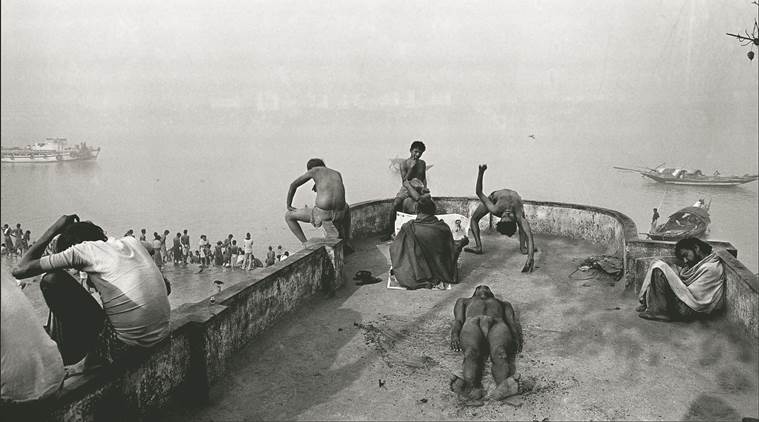 The legendary photographer Henri Cartier-Bresson saw Rai’s first ever show he did in Paris and nominated the latter to the cooperative Magnum Photos.
It was the picture of a baby donkey that set the ball rolling for Raghu Rai. Sent to the London Times in 1965 by his brother, the late S Paul, the picture still stands as one of the most iconic photographs by the master. Ahead of his 75th birthday on December 18, Raghu Rai speaks about three images made by him during three different decades.
Morning Rituals at Malick Ghat, Kolkata, 1989
“The first visitor to the first ever show I did in Paris was Henri Cartier-Bresson,” says Rai, recalling the many gestures of kindness extended to him by the legendary photographer he was so inspired by. It was, in fact, Cartier-Bresson that nominated Rai to the photographic cooperative Magnum Photos. “They invited me in 1972 because he told them that my work was good. On receiving the telex, I shrank. I thought there are all these greats and then me? It was only in 1977 when I decided to leave the newspaper that I saw the telex message sent by James Fox (former Editor-in-Chief of Magnum) again,” he adds. He wrote to Fox asking if they were still interested in working with him. Rai, then, went on to become the first Indian photographer at Magnum Photos. Encouragement from Cartier-Bresson, too, continued. “When they started his foundation, an exhibition and a book were produced of the 100 images that Cartier-Bresson loved. So, they asked if they could use one of my photographs in that collection. This is
that photograph.”
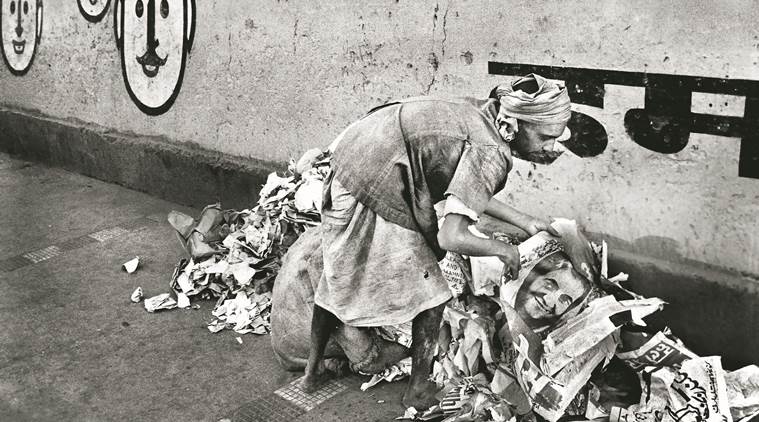 This image was taken during elections held after 21-month-long Emergency in 1977. Once the voting was over, Rai came across a man collecting posters for raddi near Jama Masjid in old Delhi.
After elections, 1977
Almost at the same time that Raghu Rai began his career as a photojournalist, Indira Gandhi rose to power as India’s first female Prime Minister. He photographed her nearly every day, capturing moments, both political and personal, of her remarkable rise and her meteoric fall after the elections of 1977. Of his several books, three bear her name on their cover — Indira Gandhi, A Life in the Day of Indira Gandhi and Indira Gandhi: A Living Legacy. “The access she gave me was immense. We could be standing four-five feet away from her and take pictures. When I went to photograph Manmohan (Singh) and Modi, we wouldn’t be allowed beyond 30 feet of them. I understand that today there are many more photojournalists than there used to be, but as they say, if you’re not close enough, your photograph isn’t good enough,” he says. Partly, it must have been the proximity to his subject that enabled such emphatic images of Mrs Gandhi to emerge. But it is also Rai’s faith in his intuition and his keenness to observe the energy he encounters on the field that beams through his photographs, leading the reader of his works to the truth held by the moment.
This image was taken during the elections held after the 21-month-long Emergency in 1977. Once the voting was over, Rai came across a man collecting posters for raddi near Jama Masjid in old Delhi. “I felt this image captured the essence of that election. On the day, I went to the Janta Dal rally with all the opposition parties as well as to Gandhi’s rally. My then editor, Kuldip Nayar, asked me what I thought the result of the election would be. My feeling was that Congress will not win. During her speech, she had said, ‘Bhaiyon aur beheno agar aap mera saath dein…’ but it seemed what she meant was: Aur agar apne mera saath nahi diya toh main aapka vote chheen loongi. The anger and fear in her voice, her body language, her energy communicated that to me,” says Rai, who then took this photograph to his editor. “While he agreed that it was a powerful image, he decided not to carry it in the paper. He feared that if she won, we would both land up in jail,” he says. Adamant that this would be the only picture he would submit, he stormed out of The Statesman office. As the results poured in the next day, Nayar began to look for Rai. He was informed that his chief photographer had not come to work. “He called me and requested that I come into the office. This photograph was then published on the front page of the newspaper the next day.”
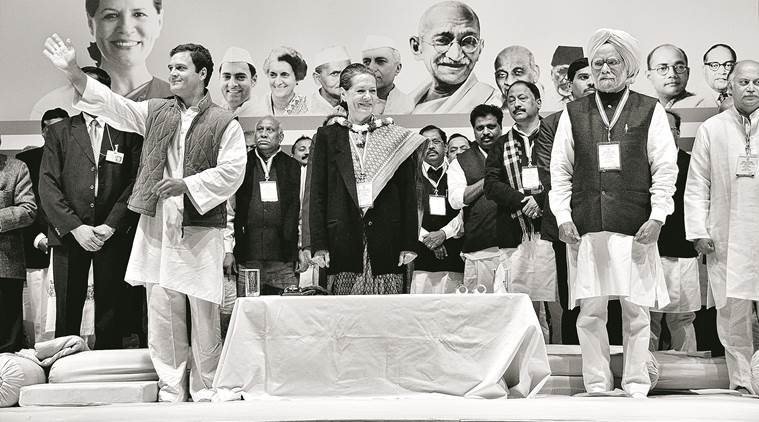 During the 2014 Congress session, Rai photographed Manmohan Singh, Sonia and Rahul Gandhi
At Congress session, New Delhi – 2014
Though it was no longer routine for Rai to photograph political figures, the 2014 Lok Sabha elections drew him to the political arena once more. “The perception of the Congress was that they are non-performers. They are corrupt and do not feel accountable to the people of the country. While Manmohan was considered a good man, he was also looked upon as someone who had made no difference to the party or the country. On the other hand, Modi brought with him all that drama. I just couldn’t stay away,” he says. The result of observing Singh and Modi during their respective party meetings is a compendium of pictures published as The Tale of Two: An Outgoing and an Incoming Prime Minister. “During the Congress session, Manmohan, Sonia and Rahul walked in together. Sonia sat down at the centre with Rahul beside her, and Manmohan sat a few feet away from them. There were cheers for Sonia and Rahul but none for Manmohan. Nobody wished him. Nobody spoke to him and he didn’t speak to anyone either. His silence was deafening,” says Rai, who then photographed him repeatedly on this occasion. “I kept taking pictures of him but he wore only one expression and that was of a lonely, tortured man,” he adds.

 6 min read