Journalism of Courage



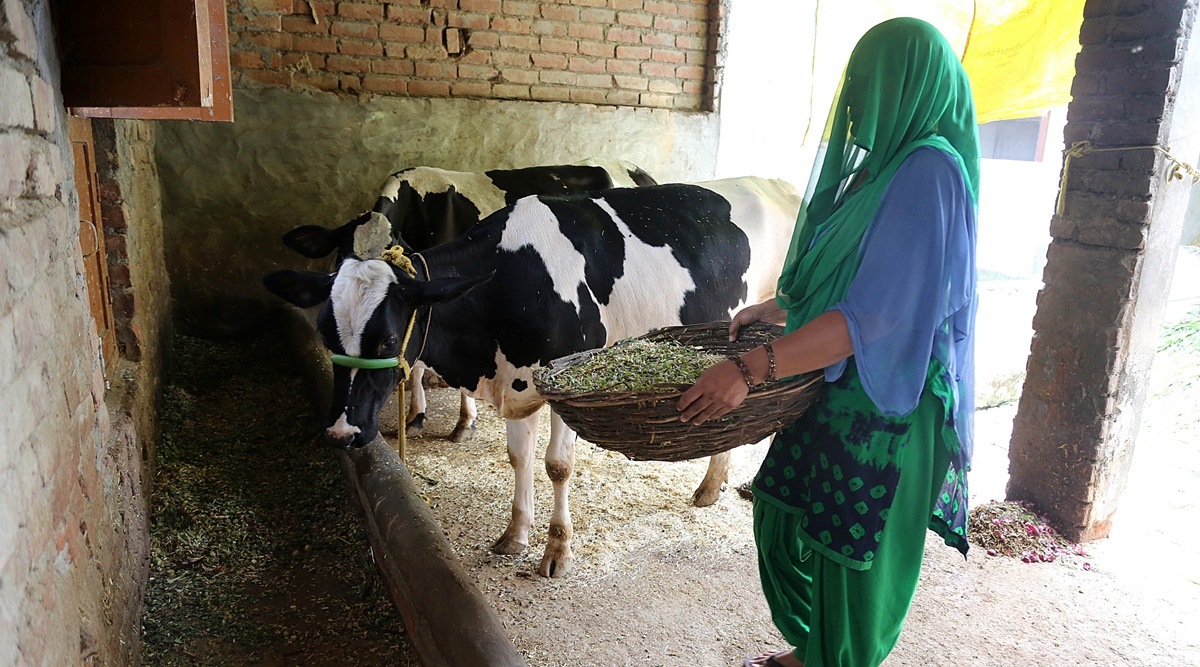 Suman Lata, a resident of Mirzapur in Kurukshetra District of Haryana feeding the cattle with fodder at cowshed behind her house in Kurukshetra on Wednesday, July 05 2017 (Express/ Achieve photo by Jaipal Singh)
 There is no respite in sight for families dependent on cattle rearing as the annual rate of fodder inflation rose to 27.66 per cent in November.
Wholesale Price Index (WPI) data released Wednesday by the Commerce and Industry Ministry showed that the index value for fodder was recorded at 225.7 in November, registering an increase of 27.66 per cent over the same month last year (176.8).
Fodder inflation stood at 27.31 per cent in October and 0.68 per cent in November last year.
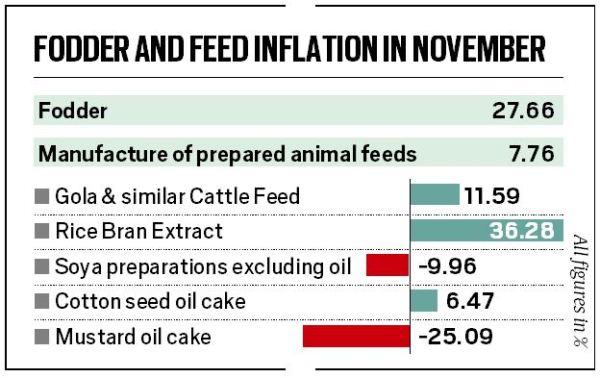
Not only fodder, feed prices also trended upward. The inflation for ‘manufacture of prepared animal feeds’, a WPI subgroup, rose to 7.76 per cent in November. It was 3.38 per cent in October and 14.86 per cent last year.
The ‘manufacture of prepared animal feeds’ subgroup has a weight of 0.35630 in the WPI and includes five items — gola & similar cattle feed; rice bran extract; soya preparations excluding oil; cotton seed oil cake; and mustard oil cake.
In this sub-group, the highest inflation (36.28 per cent) was recorded by ‘rice bran extract’. It was followed by ‘gola & similar cattle feed’ (11.59 per cent) and ‘cotton seed oil cake’ (6.47 per cent). Two other items, however, recorded negative inflation — soya preparations excluding oil (-9.96 per cent) and mustard oil cake (-25.09).
The level of fodder inflation in November 2022 was — the highest since June 2013, when it hit an all-time high of 29.70 per cent.
The upward trends in fodder and feed inflation are in contrast to softening of the overall WPI inflation in recent months. The overall WPI inflation has seen a downward trend in recent months, falling to 5.85 per cent in November– the lowest in the last 21 months — fodder inflation has been rising since December 2021, hovering over 20 per cent during the last 10 months.
In October, this year, The Indian Express had reported that fodder inflation had soared to a nine-year high — 25.54 per cent in August, causing hardship to rural households. The issue of fodder prices has also resonated in the Parliament.
On December 13, Union Minister for Fisheries, Animal Husbandry and Dairying Parshottam Rupala had informed Lok Sabha that the country is “deficit” in fodder.
“The country is deficit in fodder. The ICAR- Indian Grassland and Fodder Research Institute (IGFRI), Jhansi has estimated that there is deficit of 11.24% ,23.4% and 28.9% in green fodder, dry fodder and concentrates respectively, in the country,” Rupala said in written reply to a question asked by 10 members — six from BJP (Subrat Pathak, Sudheer Gupta, Ravi Kishan, Ram Kripal Yadav, Bidyut Baran Mahato and Ravindra Kushawaha) and four from Shiv Sena (Shrirang Appa Barne, Sanjay Sadashivrao Mandlik and Prataprao Jadhav and Dhairyasheel Sambhajirao Mane).
Rupala said, “A meeting to review the fodder situation in the country was held on 06.10.2022 under the Chairmanship of Secretary, Department of Animal Husbandry and Dairying, Government of India with the State Governments/ the stakeholders. The states informed that there was no fear of a crisis as such but a hike in price was reported for fodder, which may reflect the general trend in inflation.”
“On 4 November 2022, Department of Agriculture and Farmers Welfare approved National Dairy Development Board (NDDB) as an Implementing Agency under the scheme of Formation and Promotion of 10,000 Farmer Producer Organizations (FPOs) to form and promote 100 FPOs, primarily fodder centric and animal husbandry activities as secondary activity (Fodder Plus model). NDDB, has been designated to form these FPOs during 2022-23 within the contours of the scheme’s guidelines,” he said.

 4 min read