5 min read
© The Indian Express Pvt Ltd



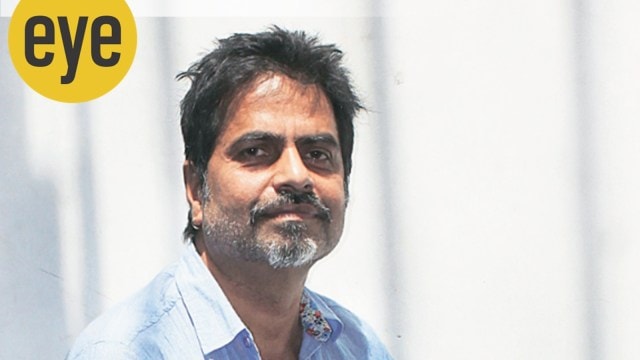 Sudarshan Shetty
Growing up in a modest one-room chawl in Mumbai’s Byculla neighbourhood, artist Sudarshan Shetty distinctly remembers the numerous sounds that surrounded him: from the call of the hawkers to vendors strumming instruments to fluff cotton for mattresses to the echo of trains heard from a distance. As a young boy he did not pay much attention to the everyday din but it did become part of his subconscious memory. The nature of the hum might have changed when he later moved to Dadar and was a student at the Sir JJ School of Art. But it’s there even now when he works out of his studio near Chembur.
In his video, titled A Breath Held Long, showing at Serendipity Arts Festival in Goa — alongside his sculptural objects dictated by the content within the video — he ponders on this impossibility of silence, proposing an intersection between voice, body and the city and the act of breathing as a metaphor for life within an urban landscape. “The act of breathing in and out becomes a compositional device, intervals through which rhythm and exhaustion surface as material conditions for speaking and being,” says Shetty, in his video.
On view at the Directorate of Accounts Building, near the Mandovi river waterfront, the video, on 16 mm celluloid, opens atmospherically with dark clouds floating in the sky. In its 29 minutes, viewers traverse through the city in a non-linear narrative where actors and non-actors share experiences from within the city in third-person accounts “without punctuation”. The scenes shift from a protagonist speaking from a bench underneath street lights with traffic rushing past to a woman climbing a narrow wooden staircase in what appears to be a chawl. A group of youngsters sits on a flight of stairs under an overbridge, and another segment has been shot inside an overfilled grocery store.
“Several of the sequences are reminiscent of my experience of growing up in this breathless urban landscape. It’s an effort to capture the intangible character of the city that I hold dear to me, which perhaps is not the Mumbai typically represented in popular images,” shares the artist. The vignettes themselves come from notations scribbled by Shetty, reflective of his own experiences and observations, ranging from moments of discoveries to rekindling old memories, finding and losing love. The city is seen slipping by from inside a bus with singers performing. “This is inspired by my experience of travelling by train where very often one may find a group of commuters break into a chorus. I wanted to recreate that and include it in the video as one of the stories itself,” says Shetty.
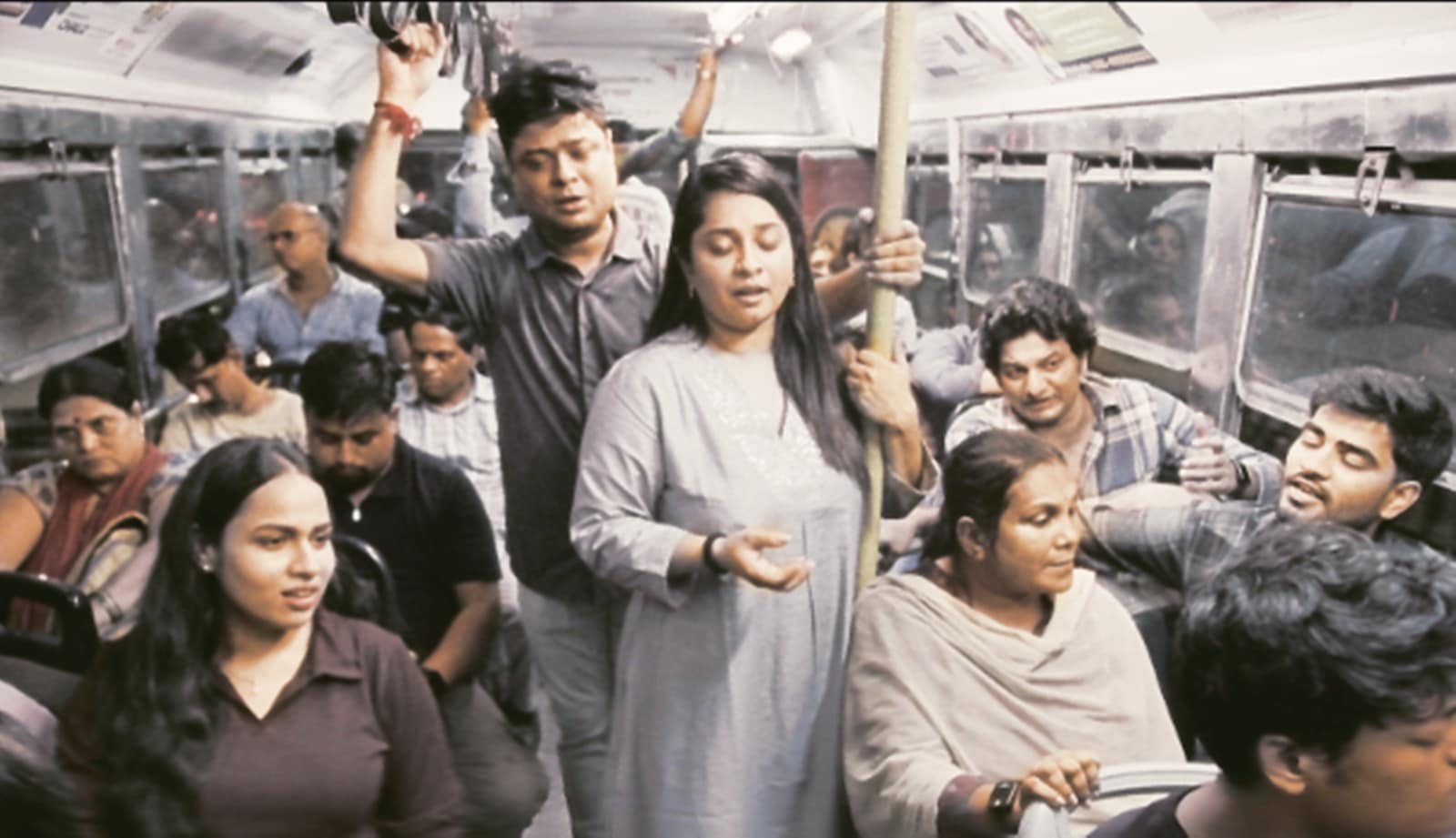 A still from the video installation
The soundtrack also features Madhup Mudgal’s Murshid nainon beech nabi hai, a doha by Kabir, where the words talk of a path to an inward journey and the experience of the emptiness within a bustling city.
Known to bring together the poetic and the philosophical, blending sculpture, installation and moving images to explore lived experiences and impermanence, this is not Shetty’s first engagement with Mumbai as a subject. In 2012, he transformed one of its most beloved relics, the double-decker bus, into a public installation. Stationed at the Bandra-Kurla Complex, his Flying Bus was fitted with wing-like extensions. The 2010 exhibition, “This Too Shall Pass”, at Mumbai’s Bhau Daji Lad Museum, saw him respond to the museum collection through exhibits for which he also sourced found objects from the city’s markets to explore afterlives and reflect on Mumbai’s own shifting landscape. In the 2013 video Waiting for Others to Arrive, he took viewers into an abandoned Ghatkopar chawl that was soon to be razed. “I grew up in this city, it’s a part of my being. However much I may love or hate it in equal measure, I feel a compulsion to talk about deeply personal experiences of living through it, that may be of some meaning for others too. There is a wealth of things that need to be exhumed,” he says.
And though these lived experiences could belong to any place on the map, it is Mumbai that also stays with the viewers. In the final stretch, shot from inside a local train, the camera looks out onto the tracks that seem to run endlessly. The moment connects to a graffiti seen earlier in the film, that read: ‘Sometimes when we travel we forget who we are’, a line that, perhaps, gestures toward the journey of life itself.