Premium
This is an archive article published on September 30, 2018

By the Book: War, What is It Good For?

This week, books on the ravages of war - from 'I Believe in Unicorns' and 'No Guns At My Son’s Funeral' to 'Dear World: A Syrian Girl’s Story of War and Plea for Peace'.

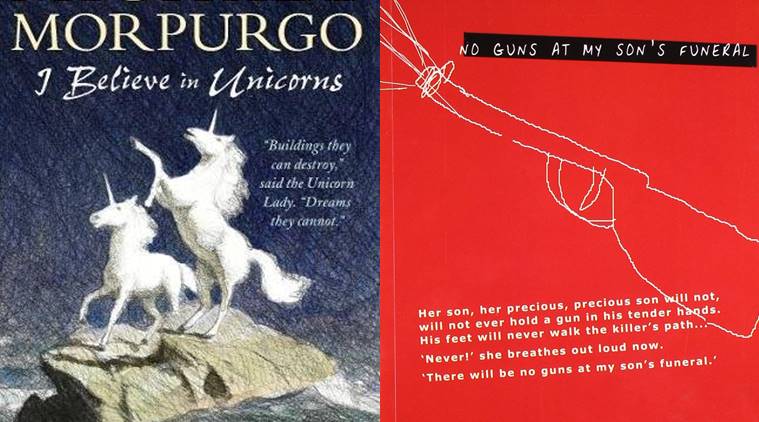
I believe in unicorn, No Guns At My Son’s Funeral, Dear World: A Syrian Girl’s Story of War and Plea for Peace, book, childrens' books, books for children, books on war, ward books, indian express, indian express news Books on ravages of war – I Believe in Unicorns (L) and No Guns at my Son’s Funeral (R). (Source: Walker Books and Roli Books)

The University Grants Commission suggested observing September 29 as “Surgical Strike Day” across varsities and higher educational institutions to pledge support to the Army on the second anniversary of the operations it carried out to foil infiltration attempts by terrorists from PoK in 2016. But, war — be it civil war, armed conflict or guerrilla warfare — is a humanitarian crisis whose burden is too heavy to bear for all concerned. If teenager Anne Frank’s diary introduced generations to the atrocities of the Nazis under Hitler during World War II, here’s a look at three lesser-known but poignant children’s books that highlight the trauma of war, that, as musician Edwin Starr rightly said, is good for “absolutely nothing”.

On September 26, 2016,  a little Syrian girl took to Twitter to articulate what many of her countrymen had been praying for: “I need peace.” Bana Alabed had been three when civil war upended what should have been an ordinary childhood. Instead of school and games of hopscotch with friends, she grew up with the sound of bombs and the fear of death. In Dear World: A Syrian Girl’s Story of War and Plea for Peace (2017, Simon and Schuster, appropriate for: 8+), Alabed, eight, speaks about growing up in the middle of a never-ending war and how it took from her things most people take for granted: friends, lessons, family outings. Interspersed with letters from her mother, the book offers a touching account of a child’s vision of war and a family’s struggle to stay together in the middle of death and destruction.

When Paro Anand’s No Guns At My Son’s Funeral came out in 2005, (Roli Books, appropriate for 12+), it struck a chord for its very realistic depiction of the impact of the Kashmir crisis on the young. Aftab is born in the troubled Valley and his life is a curious mix of cricket, curfews, fear and adrenaline rush. But, unknown to his parents, Aftab is also drawn to the charismatic Akram, who is gathering forces to carry out a dangerous mission against the state. Soon, Aftab is drawn into his circle of hate. Aftab’s struggles to balance his family’s hope for Aman and his growing faith in Akram’s ideology of an eye-for-an-eye soon spiral out of control. In a world, where violence is only an incitement away, Anand’s book is a heartrending, terrifying story of the real cost of war.

If Private Peaceful (2003) is one of Michael Morpurgo’s most well-known children’s books on war, one of his most heartwarming stories is I Believe in Unicorns (2005, Walker Books, appropriate for 7+). In an unnamed European country, eight-year-old Tomas would rather spend his days playing than going to school, reading or visiting the public library. But, when a new librarian joins and begins telling stories to the children who gather there, slowly Tomas becomes a convert to the power of literature to hold and to heal. When war and destruction come to his country, Tomas and the other children must help his father and the librarian to save the treasures they all hold dearest: the books in the library.

Paromita Chakrabarti is Senior Associate Editor at the  The Indian Express. She is a key member of the National Editorial and Opinion desk and  writes on books and literature, gender discourse, workplace policies and contemporary socio-cultural trends. Professional Profile With a career spanning over 20 years, her work is characterized by a "deep culture" approach—examining how literature, gender, and social policy intersect with contemporary life. Specialization: Books and publishing, gender discourse (specifically workplace dynamics), and modern socio-cultural trends. Editorial Role: She curates the literary coverage for the paper, overseeing reviews, author profiles, and long-form features on global literary awards. Recent Notable Articles (Late 2025) Her recent writing highlights a blend of literary expertise and sharp social commentary: 1. Literary Coverage & Nobel/Booker Awards "2025 Nobel Prize in Literature | Hungarian master of apocalypse" (Oct 10, 2025): An in-depth analysis of László Krasznahorkai’s win, exploring his themes of despair and grace. "Everything you need to know about the Booker Prize 2025" (Nov 10, 2025): A comprehensive guide to the history and top contenders of the year. "Katie Kitamura's Audition turns life into a stage" (Nov 8, 2025): A review of the novel’s exploration of self-recognition and performance. 2. Gender & Workplace Policy "Karnataka’s menstrual leave policy: The problem isn’t periods. It’s that workplaces are built for men" (Oct 13, 2025): A viral opinion piece arguing that modern workplace patterns are calibrated to male biology, making women's rights feel like "concessions." "Best of Both Sides: For women’s cricket, it’s 1978, not 1983" (Nov 7, 2025): A piece on how the yardstick of men's cricket cannot accurately measure the revolution in the women's game. 3. Social Trends & Childhood Crisis "The kids are not alright: An unprecedented crisis is brewing in schools and homes" (Nov 23, 2025): Writing as the Opinions Editor, she analyzed how rising competition and digital overload are overwhelming children. 4. Author Interviews & Profiles "Fame is another kind of loneliness: Kiran Desai on her Booker-shortlisted novel" (Sept 23, 2025): An interview regarding The Loneliness of Sonia and Sunny. "Once you’ve had a rocky and unsafe childhood, you can’t trust safety: Arundhati Roy" (Aug 30, 2025): A profile on Roy’s recent reflections on personal and political violence. Signature Beats Gender Lens: She frequently critiques the "borrowed terms" on which women navigate pregnancy, menstruation, and caregiving in the corporate world. Book Reviews: Her reviews often draw parallels between literature and other media, such as comparing Richard Osman’s The Impossible Fortune to the series Only Murders in the Building (Oct 25, 2025). ... Read More


Latest Comment
Post Comment
Read Comments
Advertisement
Advertisement
Advertisement
Advertisement