5 min read

Journalism of Courage



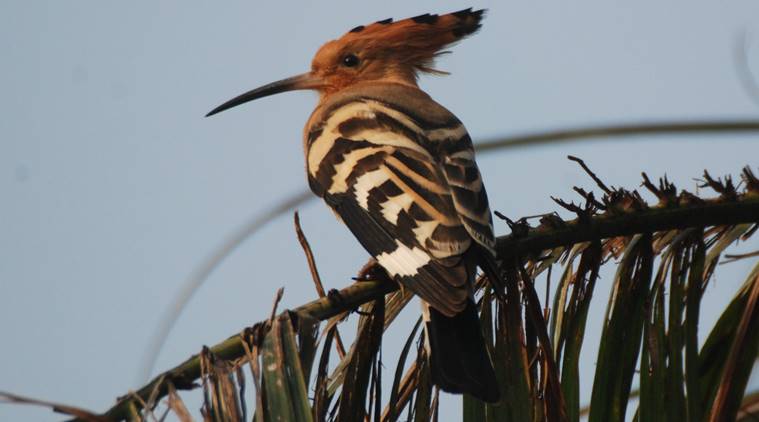 An enigmatic hoopoe enjoying its view. (Source: Photo by Ranjit Lal)
At first glance, most people tend to identify this bird as a woodpecker: like many woodies, it has a crest, a long bill and a zebra-striped plumage. But woodpeckers are normally seen travelling vertically up a tree bark, drumming, pausing and picking up insects. This one, dressed in raw silk colours — with a black-and-white-tipped crest (that can make its head look like a small pickaxe, or, unfurl, to resemble a Japanese fan), zebra-striped back and wings, waddles around on the ground, industriously inserting its long down-curving forcep-like bill into the earth. It’s a fastidious bird, seemingly at home on immaculate lawns and golf greens (among other more natural lightly wooded, open habitats.) Welcome to the onomatopoeic Hoopoe: a bird whose deep, hollow-sounding “Hoo-po, hoo-po-po” call echoes repeatedly like a ventriloquist.
Hoopoes are found in Africa, Europe and central Asia, and, in India, are said to be summer migrants as well as residents. In fact, the first Everest expedition reported seeing them at an altitude of 21,000 feet — showing no signs of hypoxia. They have been around for quite a while. The Egyptians worshipped them, and it appears that they got on the wrong side of King Solomon — for being unpunctual — while reporting to him about the activities of his enemies (I think there was some distraction caused by the Queen of Sheba, too). While many people relished them (as usual their body parts were claimed to cure all kinds of ailments), they were forbidden food for others. Today, the hoopoe is the national bird of Israel.
As far as their own meals are concerned, hoopoes are mainly insectivorous, probing the earth with their bills (as they feel around for grasshoppers, worms, beetle-larvae and other goodies) and might add some plant matter and berries to this diet. They provide farmers with a free and valuable insecticide service. We are, of course, spraying our own poisonous pesticides all over our fields and gardens, poisoning their young.
Waddling along on a swathe of green in pairs that keep a healthy distance from each other, hoopoes may seem very self-contained and self-possessed birds. But, apparently, they have a crazy side to their nature, too: Salim Ali mentions how groups of hoopoes — maybe three or four birds — have been observed to suddenly take to the air and fly around as if “demented”, fluttering and flitting like butterflies from branch to branch, with their crests extended and tail flared. No one has explained this wacko behaviour but it’s nice to see that even such circumspect civilised-looking birds have a wild side!
They’re big fighters, too, especially the boys. While fighting over property during the breeding season (usually between March and June), they will face each other, crests flared, bills first pointing downwards and then directly at each other and begin jabbing. It can get dangerous and they have been known to blind one another in such duels. The property the males fight over are usually a hollow or slit in a tree trunk or a hole in a stone wall — which is what they call home. They will line this skimpily with grass, leaves, feathers and rubbish and the chosen one will settle down here to raise a family. The entrance is made even narrower and throughout the incubation period — madam’s job entirely — her partner will, rather in the manner of hornbills, feed her conscientiously. Usually between five and seven dirtily speckled greenish-blue eggs are laid. Both parents feed the babies.
And now, to let you into a charming if dirty secret about these birds: Their in-house hygiene is appalling. (No swachch-anything here!) The lady of the house, alas, lets excreta, food debris fester in her home and it stinks the place out. Worse, at this time, her preen-gland (the uropygial gland) swells up and produces a thick, brown goo that is extremely foul smelling, thanks to a chemical called dimethyl-sulphide. This guck, she applies all over herself and to her eggs, too. It keeps predators (there are a couple of raptors which are partial to hoopoes) at bay. But this evil-smelling stuff is good for her and her babies-to-be. It has substances (lipids and something called sebum) which make her feathers flexible and waterproof. Also, it was recently discovered it plays host to a good bacterium (Enterococcus faecalis), which is the “natural predator” of a bad bacterium (Bacillus licheniformis), which is a keratin destroyer — the stuff feathers are made out of. The goo also gets through the pores of the eggs and provides a shield for the babies inside. But, be warned: if you try funny stuff with hoopoe babies (such as remove them from their nest) they will turn around and squirt you with a face-full of highly stinky liquid faeces — an experience you will not relish. (I’ve been hit by pigeon bombs and they stink badly; hoopoes are specialists in this department!) It was the main reason why I refrained from investigating a nest in Delhi’s Lodi Gardens some years ago as I spotted one parent rushing back home with a beak-full of juicy caterpillar. All I could say was “Bon appetit!”