3 min read
© The Indian Express Pvt Ltd



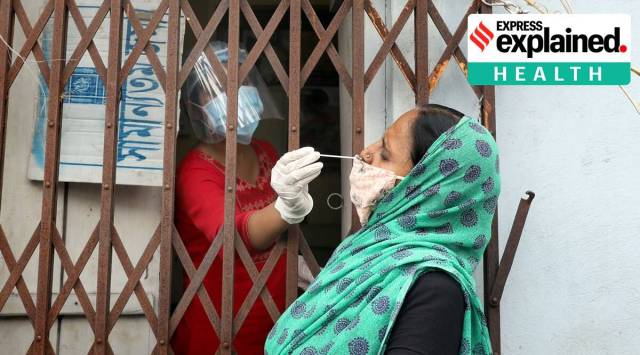 A health worker collects samples for Covid-19 testing at an urban primary health centre in Kolkata. (Express Photo: Partha Paul/File)
In Covid-19 patients whose symptoms were mild, researchers found that they were more likely than sicker patients to have signs of prior infection by similar, less virulent coronaviruses. The study, by researchers from the Stanford University School of Medicine researchers, has been published in the journal Science Immunology.
The findings suggest that people with Covid-19 may experience milder symptoms if certain cells of their immune systems “remember” previous encounters with seasonal coronaviruses — the ones that cause about a quarter of the common colds children get. These immune cells are better equipped to mobilise quickly against SARS-CoV-2 if they’ve already met its “gentler cousins”, the scientists concluded.
Newsletter | Click to get the day’s best explainers in your inbox
They suggested that their findings may help explain why some people, particularly children, seem much more resilient than others to infection by SARS-CoV-2. They also might make it possible to predict which people are likely to develop the most severe symptoms of Covid-19.
The immune cells in question are killer T cells. The study showed that killer T cells taken from the sickest Covid-19 patients exhibit fewer signs of having had previous run-ins with common-cold-causing coronaviruses.
Human cells routinely saw up some samples of each protein they’ve made into tiny pieces, and display those pieces (called peptides) on their surfaces, so that T cells can inspect them. When a killer T-cell notices a peptide that doesn’t belong on a cell’s surface, it multiplies furiously, and its numerous offspring fire up to destroy any cell carrying these peptides.
The researchers assembled a panel of 24 different peptide sequences that were either unique to proteins made by SARS-CoV-2, or also found on similar proteins made by one or more (or even all) of the common-cold-causing coronavirus strains.
They analysed blood samples taken from healthy donors before the pandemic began, meaning they’d never encountered SARS-CoV-2 — although many presumably had been exposed to common-cold-causing coronavirus strains. They found that unexposed individuals’ killer T cells targeting SARS-CoV-2 peptides that were shared with other coronaviruses were more likely to have proliferated than killer T cells targeting peptides found only on SARS-CoV-2. The T cells targeting those shared peptide sequences had probably previously encountered one or another gentler coronavirus strain, and had proliferated in response, they concluded.
— Source: Stanford University School of Medicine