7 min read

© The Indian Express Pvt Ltd



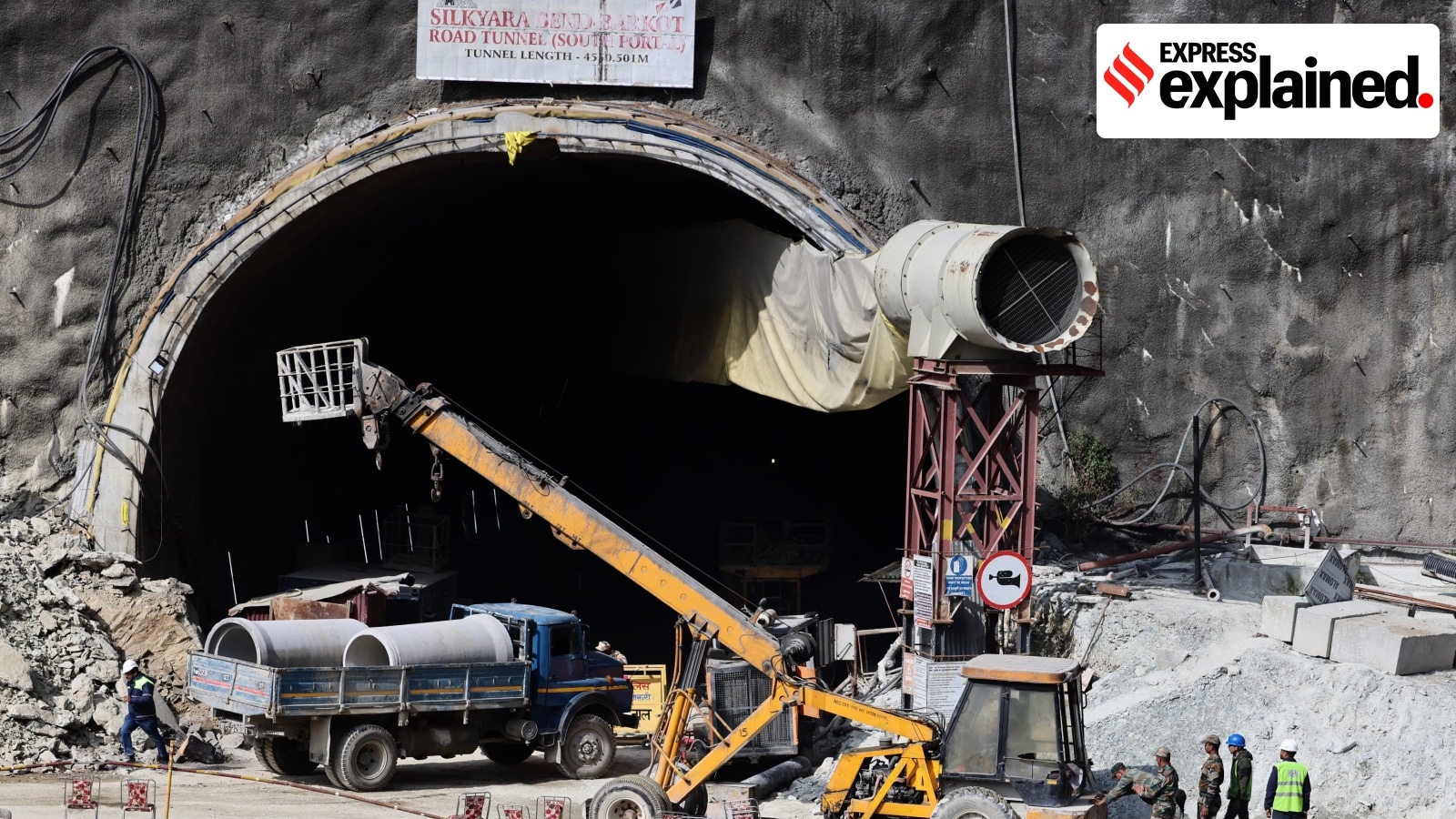 The Silkyara-Barkot tunnel in Uttarakhand in 2023. (Express photo by Chitral Khambhati)
On November 12, 2023, the ambitious Silkyara Bend-Barkot Tunnel on the Dharasu–Yamunotri highway section of NH-134 (old NH-94), being built as part of the Char Dham Mahamarg Pariyojana, suddenly collapsed. The incident trapped 41 workers inside the tunnel and triggered a full-scale rescue operation involving multiple agencies, including rat-hole miners. After a gruelling 17-day operation, all the workers were safely rescued. As their families waited anxiously, the incident raised serious concerns in the administration, underscoring the urgent need for measures to ensure such accidents do not occur in the future.
Now, almost two years after the incident, the Ministry of Road Transport and Highways (MoRTH) has released comprehensive guidelines for the prevention and mitigation of road tunnel collapses.
“In recent years, multiple incidents of tunnel collapses have been reported during the construction of tunnels on National Highways. These incidents have been primarily attributed to inadequate attention to detail during the planning and execution phases of tunnel projects. The recurrence of such events highlights the critical need for rigorous oversight and strict adherence to safety protocols,” said the Ministry on December 5, while issuing the guideline.
The primary objective of a road tunnel is to provide seamless passage to vehicles in difficult terrain like mountainous regions, snow-bound areas, eco-sensitive areas, water bodies, congested areas, etc. Since the Ministry has taken up its long-term initiative to extend its road network to far-flung border areas, as part of strategic projects, these guidelines hold much importance.
DPR, GBR and the risk register
A road project begins with the preparation of a detailed project report (DPR), which contains all the technical details about the terrain. However, the Ministry found that many tunnel DPRs lack the necessary technical depth and reduced the whole exercise to just procedural formalities rather than effective risk management tools.
The project in charge of the authority “shall be responsible for ascertaining the correctness of the geological and geotechnical investigation conducted as part of the DPR…The fundamental principle of risk mitigation is “risk shall be borne by the party best equipped to manage it” and shall be central to contract design,” the guidelines said.
It said that the terms of reference (ToR) for DPR consultants shall mandate the preparation of a geotechnical baseline report (GBR) and a risk register.
“The Risk Register should include the perceived hazards and associated risks for the project and indicate potential mitigation measures with comprehensive explanations for their basis, based on the DPR studies. The baseline report shall serve as a reference for determining expected efforts and aim for the highest practical accuracy…All the construction tenders shall be issued for bidding with the GBR and Risk Register as part of the information provided to bidders,” the guidelines said.
Apart from this, for tunnel projects, the detailed design and its proper implementation are much more crucial than any other civil engineering projects since the ground itself serves as a support system.
Predicting ground properties based on a limited number of tests and investigations, it noted, is “an oversimplification”, particularly in the Himalayas. “Inadequate geological and geotechnical investigations lead to great variation between the ground conditions predicted in the DPR and those actually encountered during the construction stage. This, in turn, results in time and cost overruns in the project,” said the new guidelines.
To produce the foolproof design of a tunnel, the new guidelines suggest investigating special ground conditions such as squeezing, swelling, rock bursts, shallow cover zones, sections beneath perennial streams/nalas, hot water ingress, and the presence of toxic or flammable gases (particularly in the case of long tunnels).
NATM or TBM
Tunnelling in India is done primarily based on two kinds of technologies: the new Austrian tunnelling method (NATM) and the use of a tunnel boring machine (TBM). NATM works on the principle of a “design as you go” approach. It is deployed where the rock structure of a mountain is not uniform and behaves differently as the excavation progresses. It involves a controlled blasting method for tunnelling. Whereas, TBM is deployed in areas where the rock formation for a longer stretch is the same.
The Ministry’s guidelines say that there should be a clear procedure for incorporating NATM, defining how site observations will be used to optimise excavation sequences, and the required excavation and support sheet (RESS) shall be maintained for each round. A similar level of alertness shall be there in case TBM tunnels also, particularly to ensure safety in scenarios involving roof collapses, water ingress. or a combination of both, says the new guidelines.
“Tunnels shall be categorised into collapse-risk zones based on the potential for structural failure, even after primary support systems are installed. In high-risk zones, an Np-4 escape pipe of a minimum 0.9-meter-diameter shall be placed in the invert area and extended into lower-risk zones to provide emergency access. At least one mobile rescue container (capacity: 12 workers) shall be positioned 150 300 meters behind the tunnel face, with a fixed container (capacity: 24 workers) every 2 kilometres. These containers must provide at least 24 hours of survival capability,” the guidelines said.
Shift manager to be a rescuer
According to these guidelines, the shift managers of the project must be trained to implement the emergency response plan (ERP). ERP is prepared in advance to address all possible scenarios identified in the project risk assessment. It has to be updated weekly based on actual site progress.
It also said that at the time of the incident, agencies like the NDRF, SDRF, and the Armed Forces rush to the site for a rescue operation, but they are often not equipped to operate independently and require support from technical experts to ensure their own safety.
To address this issue, the guidelines have defined the roles of different authorities, such as the incident commander, as designated by the District Magistrate, agencies engaged in the tunnel construction, local administration, NDRF/SDRF commander, etc. It has also charted out detailed response strategies in the event of tunnel collapse.
Many tunnels in the loop
According to MoRTH’s reply in Parliament on December 12, 2024, a total of 42 tunnels covering 60.37 km in length in 27 projects of National Highways have been completed to date. Apart from this, 57 tunnels covering 93.96 km in length are currently under implementation in 37 projects on NHs in the country.
The Ministry also said that three tunnels covering 9.68 km in length have been approved for construction in 3 projects at an estimated cost of Rs 1,962 crore. Besides, one 6-lane project in Maharashtra costing Rs 4501 crore, including the construction of 2 tunnels having a total length of 3.47 km, has been apprised by Public Private Partnership Appraisal Committee (PPPAC).