


© The Indian Express Pvt Ltd
Tags:


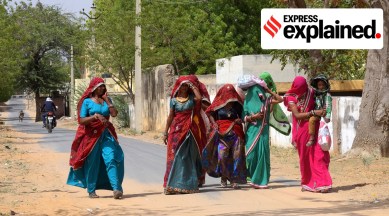
For the second year running, Rajasthan has registered the highest number of rape and attempt to rape cases, as per data released by the National Crime Records Bureau (NCRB) for 2020.
In terms of rape in Metropolitan cities, with 409 rape cases in 2020, Jaipur is next only to Delhi city with 967 cases. However, at 28.1, its crime rate for rape is more than double of Delhi city, which is at 12.8 rape cases per lakh population.


However, when it comes to absolute numbers for crimes against women, Rajasthan (34,535) is next only to Uttar Pradesh (49,385) and West Bengal (36,439).
When it comes to IPC section 376 (rape), Rajasthan tops the list with an incidence (FIRs registered) of 5,310 and 5,337 victims, translating into a rate of 13.9. In absolute numbers, Uttar Pradesh is a distant second with an incidence of 2,769 and 2,796 victims. In terms of crime rate for rape, Haryana is second with 10 cases per lakh.
The national average crime rate for rape is 4.3 per lakh population. For attempt to commit rape (Sec 376/511 IPC) too, Rajasthan tops the list with an incidence of 965 and 968 victims.
However, at 13.2 per cent, Rajasthan has among the lowest pendency rate with police among the states when it comes to crime against women. It is next only to Gujarat, which has the lowest pendency at 10.7 per cent. The national average is 35.2 per cent.
After shooting up drastically in 2019, mainly due to strict measures and various initiatives by the Ashok Gehlot government, the overall cases declined in the state in 2020.
The figures for crime against women (IPC+SLL) in Rajasthan increased from 25,993 in 2017 to 27,866 in 2018 to 41,550 in 2019. In 2020, they’re at 34,535. So while there was an increase of 7.21 per cent from 2017 to 2018, the increase from 2018 to 2019 was a drastic 49.11 per cent. Now, the 2020 figure is 83.11 per cent of the 2019 figure.
Hence, while Rajasthan still needs to do a lot more for women, there has been an overall decline in crimes against women in the state in 2020.
Overall too, IPC+SLL crimes also shot up drastically in the state between 2018 and 2019 but declined in 2020. While there was an increase of just 1,873 cases between 2017 and 2018, the increase between 2019 and 2018 was 53,848 cases. Between 2019 and 2020, there has been a decrease of 44,016 cases.
From total IPC+SLL crimes of 2.5 lakh in 2018, the state jumped to 3.0 lakh cases in 2019 and is now at 2.6 lakh cases in 2020, thus registering a decline.
Post 2019, the increase in crime figures in Rajasthan can mainly be attributed to strict measures and various initiatives by the Ashok Gehlot government, which came to power in December 2018. The chief among them is strengthening the framework around mandatory registration of FIR.
Soon after assuming power, Gehlot emphasised the need to mandatorily register an FIR. A January 31, 2019 circular by then Director General of Police Kapil Garg, said that “registration of FIR is the fundamental duty of police.” In the detailed note, he wrote how an immediate registration of FIR for a cognisable offence “reflects sensitivity and efficiency of police before the complainant,” and how a delay in registration of FIR aggravates the pain of the complainant and works to the benefit of the accused.
At a police department review meeting in June 2019, Gehlot said that every complainant who arrives at a police station be heard patiently and “registration of FIR should be ensured.” He said that “complaints about hesitation in registering FIR or about behaviour (of police) will not be tolerated.” Importantly, he said that “there is no need to worry if more FIRs lead to rise in crime figures.”
The office of the Director-General of Police has, time and again, sent circulars to district police reminding them of January 31, 2019 circular. One such circular from February 5, 2020, reminded them that “parivadi ki report har surat mein darj ki jaave (complainant’s report should be registered under all circumstances).”

All of this mainly started in May, 2019, post Lok Sabha elections. Soni says that the government also undertook “a large number of decoy operations” to see whether FIRs were being lodged at police stations.
There were a host of other measures undertaken by the government to make the process more transparent. In May 2019, following the Thanagazi gangrape case in Alwar, Gehlot announced that FIRs could directly be registered with the SP’s office if local police stations did not entertain a complaint. On July 1, 2019, the state government also made it mandatory to register every complaint on Crime and Criminal Tracking Network and Systems (CCTNS). “FIRs were being registered on CCTNS but now the difference was that every complaint should also be registered in the system,” Soni said.
Following the Thanagazi rape case and no let-up in crime in the district, Alwar was divided into two separate police districts – Alwar and Bhiwadi – in August 2019.
“Also, earlier people used to approach the courts for registration of FIRs under CrPC 156(3). This saw a decline too from 28 per cent (in 2018) to 16 per cent in 2019 end, since cases were being freely lodged by the police,” Soni said.
Registration of more cases doesn’t necessarily mean that crime has increased. In Rajasthan, the police department’s campaign to register every complaint has led to an increase in registration of FIRs in the state, and thus the overall drastic rise in figures between 2018 and 2019, before a decline in 2020.
NCRB itself says that “the primary presumption that the upward swing in police data indicates an increase in crime and thus a reflection of the ineffectiveness of the police is fallacious. ‘Rise in crime’ and ‘increase in registration of crime by police’ are clearly two different things, a fact which is often confused. Thus an oft-repeated expectation from certain quarters that an effective police administration will be able to keep the crime figures low is misplaced. Increase in crime numbers in state police data may in fact be on account of certain citizen centric police initiatives, like launching of e-FIR facility or women Helpdesks, etc.”
Newsletter | Click to get the day’s best explainers in your inbox


