October has always been a tough month for grid managers, given that the annual all-India electricity peak demand is recorded during that month. But there are five reasons why this October is different.

One, a sharp surge in power demand over a span of less than two months that marked a near-complete opening up of the economy after multiple lockdowns forced a demand crash over 18 months.
Then, there’s the issue of less coal stock build-up in April-June, 2021, as the devastating second Covid wave impacted mining operations as well.
While the monsoon months typically lead to a mining output trough, the extended rains this year resulted in further delays in the post-monsoon normalisation of coal supplies, especially in the open-cast mines in the country’s eastern hinterland.
Added to that is the fact that Indian thermal power plants have sharply reduced the import of coal due to international prices hitting a record high, which makes the option of restarting some idle capacity in Gujarat on a short lead time an uphill task.
Both imported coal and gas — there is some idle gas-based capacity in India’s east coast — are out of the equation this time around, as countries from Europe to China are in a mad scramble for fuel sources to tide over domestic energy shortages. So, restarting these plants is simply not a viable option this time around, leading to more dependence on domestic coal.
Story continues below this ad
While some of these factors are unusual, there is no getting away from an underlying factor that now seems increasingly evident: almost everyone in the electricity generation value chain — grid managers and policy planners, utilities in the supply chain, thermal power plant managers and state-owned Coal India Ltd — failed to anticipate the surge in demand, and stock up.
A labourer keeps watch as coal is unloaded from a truck in the village of Rajapur in Jharia, a remote corner of Jharkhand. (AP Photo/Aijaz Rahi, file)
The biggest trigger, though, is the scale of the demand surge. For the period August-September, power consumption has jumped from 106.6 BU (billion units; a unit is 1 kWh) per month in 2019 — a non-Covid year — to 124.2 BU per month in 2021. During this period, the share of coal-based generation has also increased from 61.91 per cent in 2019 to 66.35 per cent in 2021.
As a consequence, total coal consumption in the month of August-September 2021 increased by 18 per cent in comparison to the corresponding period in 2019, straining supply chains and exposing the laxity of power plant managers in adhering to the normative fuel stock stipulations.
With coal supplies failing to keep pace, as against the requirement of maintaining 15-30 days of fuel stocks, over half of the country’s 135 major coal-fired power plants that are monitored on a daily basis are now left with stocks of less than three days, according to data from the Central Electricity Authority.
Story continues below this ad
India’s coal fired thermal power plants account for 208.8 GW, or 54 per cent of India’s 388 GW installed generation capacity, and, despite the Government’s overt focus on renewable capacity addition, have seen an increase in share in India’s overall power mix to over 66 per cent in 2021 from under 62 per cent in 2019. The importance of base-load generation is clearly showing up.
The hope in policy circles is that from the latter half of October, the demand would slowly begin to taper off as temperatures cool in the country’s north, as is the case almost annually.
CIL’s coal despatches are also picking up — from under 1.4 million tonnes (MT) per day in the beginning of the month to levels of 1.5 MT per day on October 7 to a target of 1.7 MT per day by mid-October. This would likely help in the gradual build-up of stocks at power plants in the near future.
But given the explosive surge in demand this year, and the festival season still ahead of us, supply chains are likely to remain stretched and grid managers could be forced to stay on their toes till the end of October.
Story continues below this ad
Newsletter | Click to get the day’s best explainers in your inbox


 5 min read



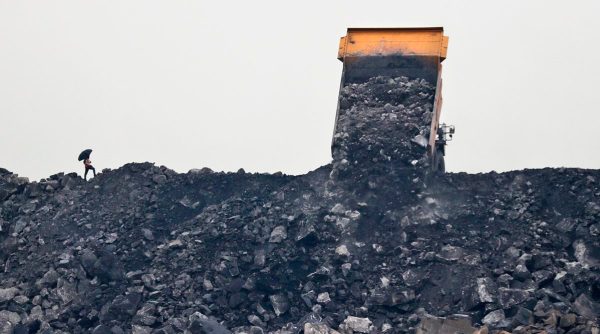 A labourer keeps watch as coal is unloaded from a truck in the village of Rajapur in Jharia, a remote corner of Jharkhand. (AP Photo/Aijaz Rahi, file)