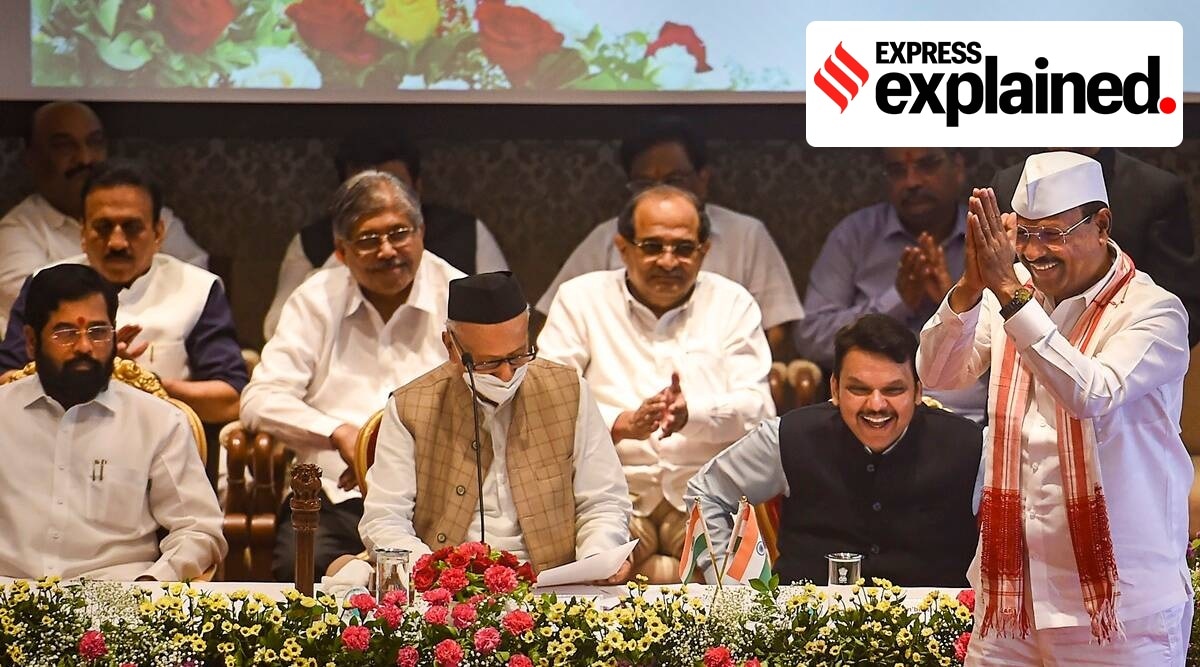
The opposition parties of Maharashtra, during the ongoing winter session of the state Assembly at Nagpur on Monday (December 26), demanded the resignation of Maharashtra Agriculture Minister Abdul Sattar, part of Chief Minister Eknath Shinde’s Shiv Sena faction. They cited a recent Bombay High Court order that found “prima facie worth” in allegations against him over the allegedly illegal regularisation of government land.
The Nagpur Bench of the Bombay High Court has stayed an order that Sattar gave earlier, asking how “public utility land/gairan land is allowed to be usurped by private individuals”. Last week, based on another order of the Bombay HC, the opposition demanded the resignation of CM Shinde in the NIT plots case.

It was alleged that Sattar had taken a decision despite the civil court order having disallowed the claims of a private person over the possession of public gairan (cattle-grazing) land. The bench said that the PIL “has brought to our notice something, which has the potential of shaking the public confidence in the system of governance of the State.”
What was the Bombay High Court’s order?
A division bench of Justice Sunil B Shukre and Justice Mahendra W Chandwani on December 22 passed an order based on a Public Interest Litigation (PIL) by one Shyam Nivrutti Deole and lawyer Santosh Dattarya Pophale.
The petitioners claimed that a June 17 decision by Sattar, who was Minister of State for Revenue in the previous MVA government, had resulted in the unlawful regularisation of land in the Washim district. The plea challenged this decision.
Senior advocate Sunil V Manohar, representing the petitioners, submitted that a public utility land, measuring 37 acres and 19 gunthas, was regularised in favour of the respondent private person even after his claim in the proceedings was “outrightly rejected by the Civil appellate court”.
The Nagpur bench of the Bombay High Court recently issued notice to the state government, Sattar, the Divisional Commissioner, Amravati and to the Divisional officer, Washim, seeking their response to the plea challenging June 17 order. The HC has now put an interim stay till January 11 on the operation of the order by Sattar. It also directed the petitioners to deposit Rs. 50,000 within three weeks as a precondition to hear the PIL and show their bona fides.
Story continues below this ad
What material did the PIL petitioners refer to?
In support of his arguments, Manohar referred to the findings of the Additional District Judge, Washim, in a judgement passed in April 1994. He said that Sattar has disrespected the decree of the civil court, which refused to protect the alleged possession of the said private person over the public utility land.
Manohar said that as per the 2011 Supreme Court judgement in Jagpal Singh v State of Punjab case, no public utility land/gairan land can be regularised and allotted to any individual person or a private body.
He added that based on the apex court verdict, the Maharashtra government, on July 12, 2011, issued a government resolution (GR) which put a complete prohibition on the transfer of gairan lands to private individuals or bodies. However, such transfer was permitted in favour of central government or state government departments for implementing government schemes or for public purposes.
What did the High Court observe?
To ascertain the petitioner’s claims, the bench perused the impugned order and other material and opined that “there is prima facie substance” in the argument of Manohar.
Story continues below this ad
It also noted that the June 17 order “prima facie utterly ignores Civil Appellate Court’s decree” of 1994. “We prima facie find that the impugned order has been passed by not considering in any manner the observations of the Additional District Judge,” the bench noted.
It said that Sattar did not consider a law laid down by the SC and ignored the state government’s 2011 GR. The court noted that Sattar had passed the June 17 order despite being aware of the civil court’s decree disallowing the private person’s claim. The HC pointed out that the Collector of Washim district had brought the dismissal of the private person’s suit to the notice of Sattar.
Moreover, the court noted that Manohar brought to its notice an “important” fact – that the Washim Collector, after realising the illegality of the order, had written to the Additional Chief Secretary (ACS) on July 5, informing him that if the said order was to be implemented, it would lead to contempt of SC, HC orders. He sought directions from the ACS.
“We find that the issue raised in this petition, which puts a question mark over the manner in which the public utility land/gairan land is allowed to be usurped by private individuals, requires consideration by this Court,” the court noted.


 5 min read