Premium
This is an archive article published on April 15, 2021

Explained: B.1.617 variant and the Covid-19 surge in India

Genome sequencing data have presented evidence of the 'double mutant' in 61% of samples in Maharashtra. But whether this new variant is driving India's ongoing surge can be said only after more data is available.

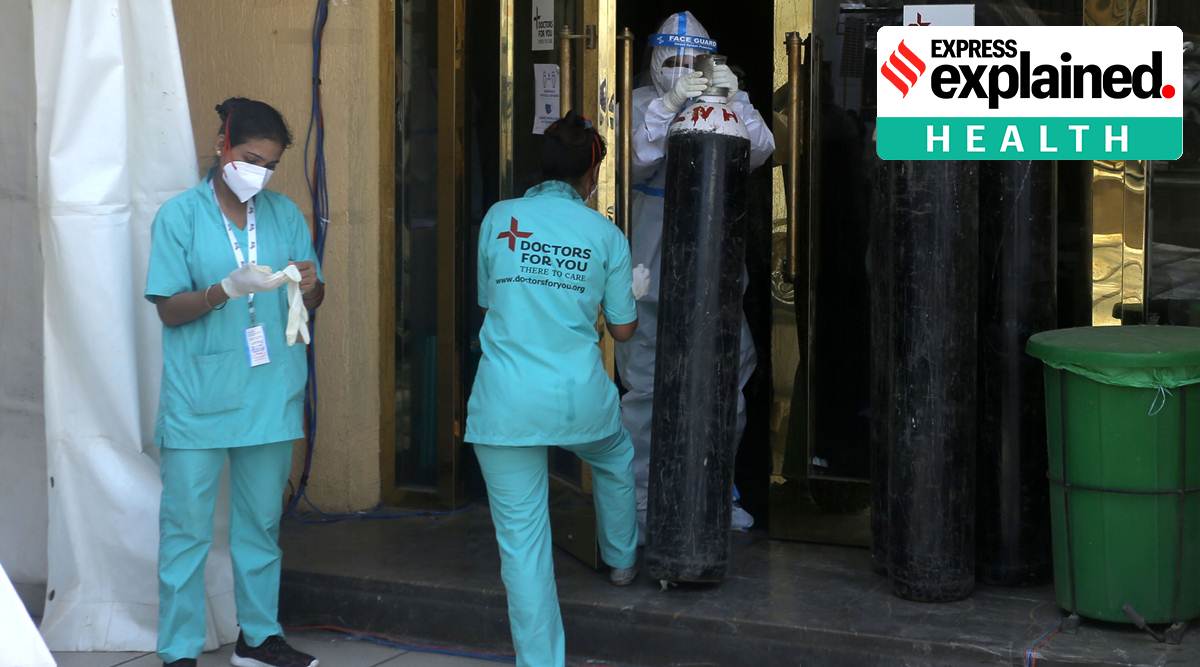
Healthcare workers prepare beds at Shehnai Banquet Hall in New Delhi, which has been converted into a temporary ward for Covid-9 patients. (Express Photo: Amit Mehra)Healthcare workers prepare beds at Shehnai Banquet Hall in New Delhi, which has been converted into a temporary ward for Covid-9 patients. (Express Photo: Amit Mehra)

During a meeting with district laboratories in Maharashtra last week, the National Institute of Virology (NIV) shared limited data showing a break-up of 361 genome-sequenced samples collected between January and March this year.

The headline finding from the analysis: the presence of a double mutation was detected in 220 — almost 61 per cent — of the samples. This double variant was last week classified as the “B.1.617” variant.

Newsletter | Click to get the day’s best explainers in your inbox

What is the B.1.617?

The B.1.617 variant of SARS-CoV-2 carries two mutations, E484Q and L452R. Both are separately found in many other coronavirus variants, but they have been reported together for the first time in India.

The two mutations are found in the virus’s spike protein. The spike protein helps the virus to bind itself to the human cell’s receptors and gain entry into a host cell.

The E484Q mutation is similar to E484K, a mutation found in the United Kingdom (lineage B.1.1.7) and South Africa (B.1.351) variants of the coronavirus.

The L452R mutation has been found in fast spreading variants in California (B.1.427 and B.1.429). It can increase the binding power of spike proteins with ACE2 receptors on human cells, making it more transmissible. L452R can also potentially enhance viral replication.

Story continues below this ad

Together, E484Q and L452R are more infectious, and can evade antibodies.

Where has the B.1.617 been found?

There is limited data. It was first reported from Maharashtra. In January, 19 samples from various districts were sequenced, and B.1.617 was found in four. In February, 234 samples were sequenced from 18 districts, and 151 samples — from at least 16 districts — had this variant. And in March, as many as 65 of 94 samples had it.

So far, Amravati, Nagpur, Akola, Wardha, Pune, Thane, Aurangabad, and Chandrapur districts have presented strong evidence of the presence of B.1.617. Fewer samples were sequenced in other districts, and the variant was found in some. Sequencing is pending for more samples.

📣 JOIN NOW 📣: The Express Explained Telegram Channel

Story continues below this ad

Is this variant more virulent?

There is no evidence so far. Most patients can do with home isolation, although clinical experience needs to be combined with genome sequencing data to generate scientific evidence. Clinical anecdotes from doctors suggests the variant spreads faster, is more infectious, can infect entire families, but is less virulent and doesn’t cause dramatically more hospitalisations.

“Most patients are asymptomatic and that is a good indication. But in absolute numbers so many cases have put a burden on health infrastructure,” said Dr Shashank Joshi, an expert on the Maharashtra Covid Task Force.

How much has it spread?

Dr Sujeet Singh, director of the National Centre for Disease Control (NCDC) has pointed out that very few samples from Maharashtra have been sequenced so far, and it is too early to draw definitive conclusions on how widespread the double mutant is. However, the central government had reported in March that 15-20 per cent samples in Maharashtra had this variant; on the basis of the latest sequencing data we know that this number is now over 60 per cent.

Clinicians and district administrators in Maharashtra are reporting that unlike in the first wave, entire families are getting infected in the second wave. This could indicate either that physical distancing and isolation measures are inadequate in the household, or that the virus has become more transmissible.

Story continues below this ad

Could B.1.617 be driving the ongoing surge in Covid-19 cases?

Dr Gangandeep Kang, professor of microbiology at Christian Medical College, Vellore, said 60.9 per cent samples carrying this variant “most likely” showed a link between the mutation and the surge — however, for an accurate answer at least 1 per cent of Covid-19 samples must be sequenced every week. With India at present testing over 1 lakh cases daily, and this would translate to roughly 1,000 genome sequences every day.

“We also need to look at how many people a person is able to infect, and the RT-PCR cycle threshold. We need to do live tracking. Data from January holds little value in April,” Dr Kang said.

Dr Gautam Menon, professor at Ashoka University, Sonepat, and at the Institute of Mathematical Sciences, Chennai, said: “What we have is suggestive but we need more genome sequencing data to understand which variant is driving the number of new infections in different states… To suggest that the rise in cases is due to this double mutant variant, we should have more time points. For instance, if we could say that we detected 30 per cent of this variant in samples on March 30, and then 40 per cent in samples on April 14, that would indicate that the new variant is dominating the spread of the disease.”

Story continues below this ad

Dr Menon too, underlined the need for greater data transparency. “It is possible, although increasingly unlikely, that the cases could also be connected to the previous strain,” he said. “Unless we know to what extent the increase can be attributed to the new variant, we will not be able to determine conclusively whether relaxations in Covid-appropriate behaviour with the older strain drove the increases or whether the increased infectivity of the new variant is responsible.”

Prof Vinod Scaria, principal scientist, CSIR-IGIB, agreed that “we cannot conclusively say that these variants are driving the surge in the second wave”. However, evidence suggests that at least in some states, the B.1.1617 lineage is predominant, and could be contributing to the rise in cases, he said. “This lineage is defined by 15 genetic variants including six spike protein variants. Two of these (E484Q and L452R) are involved in immune escape as well as increased infectivity,” Prof Scaria said.

Can the variant evade vaccines?

Again, the data are limited. Some people have indeed been infected after the first dose, but there is no data on whether their samples were sent for genome sequencing.

“We know that the South African variant is more capable of escaping immune response. We know that UK variant is the most transmissible. But we know nothing about B.1.617 so far, because we are not putting together data to draw conclusions,” Dr Kang said.

Story continues below this ad

Dr Menon underlined that while vaccines are not expected to prevent infection, they certainly prevent severe disease and death. “We expect that this will remain true even with the new variant. The only medium- to long-term solution to deal with Covid-19 is for people to get vaccinated.”

Anuradha Mascarenhas is a Senior Editor at The Indian Express, based in Pune. With a career spanning three decades, she is one of the most respected voices in Indian journalism regarding healthcare, science and environment and research developments. She also takes a keen interest in covering women's issues . Professional Background Education: A gold medalist in Communication and Journalism from Savitribai Phule Pune University and a Master’s degree in Literature. Author: She authored the biography At The Wheel Of Research, which chronicles the life and work of Dr. Soumya Swaminathan, the former Chief Scientist at the WHO. Key Focus: She combines scientific accuracy with storytelling, translating complex medical research into compelling public and human-interest narratives. Awards and Recognition Anuradha has won several awards including the Press Council of India's national award for excellence in journalism under the gender based reporting category in 2019 and the Laadli Media award (gender sensitivity -2024). A recipient of the Lokmat journalism award (gender category-2022), she was also shortlisted for the RedInk awards for excellence in journalism-2021. Her debut book At The Wheel Of Research, an exclusive biography of Dr Soumya Swaminathan the inaugural chief scientist of World Health Organisation was also nominated in the Popular Choice Category of JK Paper AUTHER awards. She has also secured competitive fellowships including the Laadli Media Fellowship (2022), the Survivors Against TB – New Research in TB Media Fellowship (2023) and is part of the prestigious 2025 India Cohort of the WomenLift Health Leadership Journey.” Recent Notable Articles (Late 2025) 1. Cancer & Specialized Medical Care "Tata Memorial finds way to kill drug-resistant cancer cells" (Nov 26, 2025): Reporting on a breakthrough for triple-negative breast cancer, one of the most aggressive forms of the disease. Discipline, diet and purpose; How a 97-year-old professor defies ageing'' (Nov 15, 2025) Report about Prof Gururaj Mutalik, the first Head of Department at Pune's B J Government Medical College who at 97 credits his longevity to healthy habits and a strong sense of purpose. 2. Environmental Health (The "Breathless Pune" Series) Long-term exposure even to 'moderate' air leads to chronic heart, lung, kidney issues" (Nov 26, 2025): Part of an investigative series highlighting that even "safe" pollution levels are damaging to vital organs. "For every 10 µg/m3 increase in PM2.5 level, there was 6-8% jump in medicine sales" (Nov 23, 2025): Using commercial data to prove the direct link between air quality and respiratory illnesses in Pune. 3. Lifestyle & Wellness News "They didn't let cancer, diabetes and heart disease stop them from travelling" (Dec 22, 2025): A collaborative piece featuring survivors who share practical tips for traveling with chronic conditions. At 17, his BP shot up to 200/120 mmHG; Lancet study flags why child and teen hypertension doubled between 2000 and 2020'' (Nov 12,2025)--A report that focusses on 17-year-old-boy's hypertensive crisis and reflects the rising global trend of high blood pressure among children and adolescents. 4. Scientific Recognition & Infrastructure For promoting sci-comm, gender diversity: IUCAA woman prof highlighted in Nature" (Nov 25, 2025): Covering the global recognition of Indian women scientists in gender studies and physics. Pune researchers find a spiral galaxy like the Milky Way from early universe'' (December 3, 2025)- A report on how Indian researchers discovered a massive galaxy that existed when the universe was just 1.5 billion years old , one of the earliest to have been observed so far. Signature Beat: Health, Science & Women in Leadership Anuradha is known for her COVID-19 reportage, where she was one of the first journalists to provide detailed insights into the Covishield and Covaxin trials. She has a dedicated interest in gender diversity in health and science, often profiling women researchers who are breaking the "leaky pipeline" in STEM fields. Her writing style is scrupulous, often featuring interviews with top-tier scientists and health experts from various institutions.   ... Read More


Latest Comment
Post Comment
Read Comments
Advertisement
Advertisement
Advertisement
Advertisement