5 min read
© The Indian Express Pvt Ltd



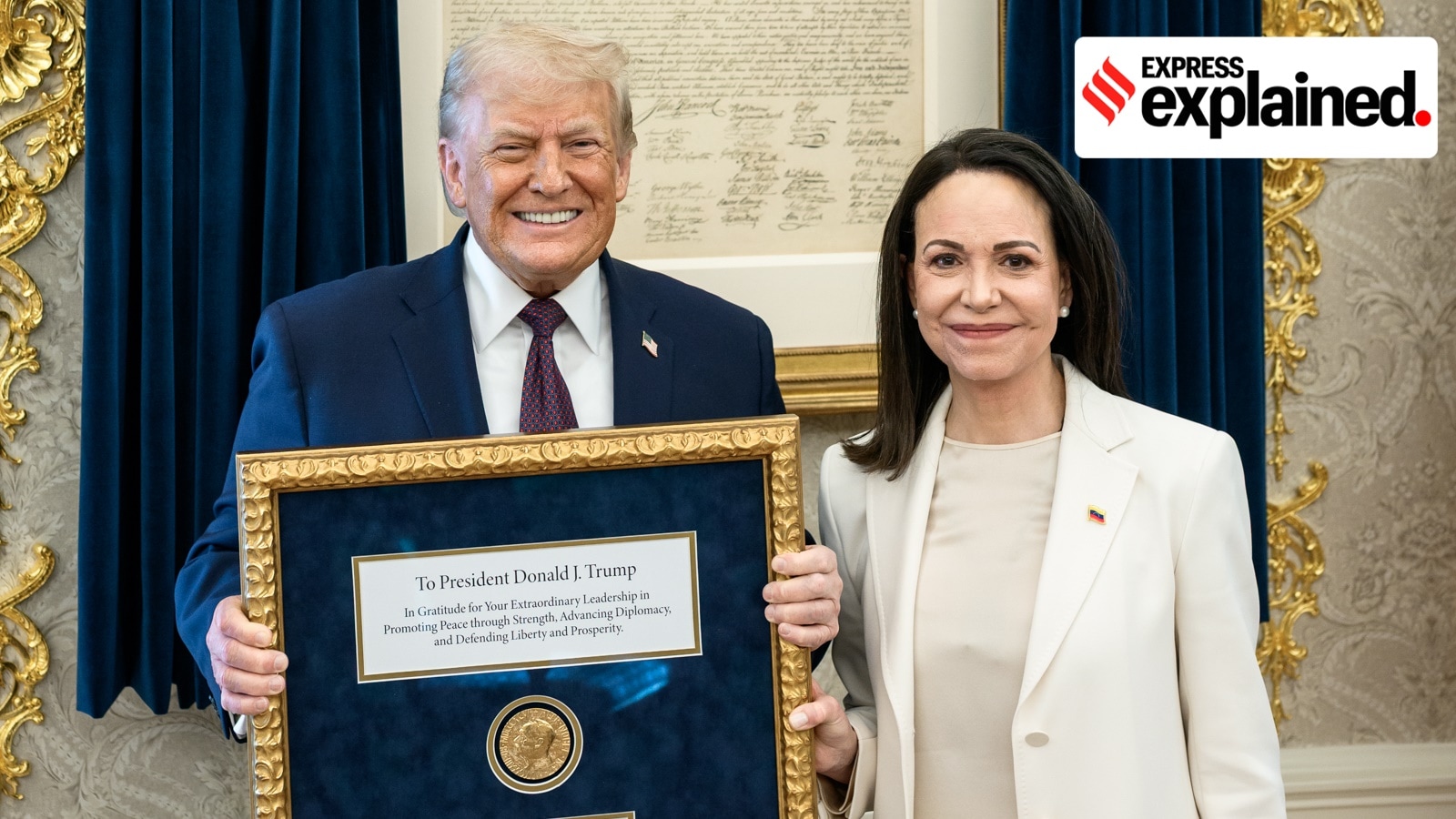 Venezuelan opposition leader María Corina Machado presents her Nobel Peace Prize to US President Donald Trump during a meeting at the Oval Office, in Washington, DC. (@WhiteHouse/X via PTI Photo)
Venezuelan politician Maria Corina Machado, the 2025 Nobel Peace Prize winner, met United States President Donald Trump on Thursday (January 15) and presented him with her award.
The meeting came after the US military deposed Venezuelan President Nicolas Maduro earlier this month, as well as Trump’s repeated comments on deserving the prize, claiming he has stopped various international conflicts during his year in power.
Trump wrote on his social media website, Truth Social, “It was my Great Honor to meet María Corina Machado, of Venezuela, today. She is a wonderful woman who has been through so much. María presented me with her Nobel Peace Prize for the work I have done. Such a wonderful gesture of mutual respect. Thank you María!”
 @WhiteHouse/X via PTI Photo.
No. The Norwegian Nobel Committee has reiterated that prizes cannot be officially transferred by the recipient(s), but that it “will not comment upon what the Peace Prize Laureates may say and do after they have been awarded the prize.”
It also cited the Statutes of the Nobel Foundation, which said that “No appeals may be made against the decision of a prize-awarding body with regard to the award of a prize”.
Acts of transfer or refusal of the prize are rare. Machado drew a parallel to how, in 1825, the Marquis de Lafayette — a French aristocrat who helped Americans fight British colonial rulers — sent a gold medal with an image of George Washington to the South American independence hero Simón Bolívar. According to The Guardian, she called it “a sign of the brotherhood between the people of the US and the people of Venezuela in their fight for freedom against tyranny”.
The Guardian also reported that after winning the 1954 Nobel Prize in Literature, Ernest Hemingway entrusted his medal to the Catholic Church in Cuba, a country in which he spent over two decades of his life. The prize was even stolen briefly, years later.
Two of the most prominent cases of refusal of the prize involve French writer Jean Paul Sartre, and the Vietnamese revolutionary leader Le Duc Tho, who was jointly awarded with former US Secretary of State Henry Kissinger. Sartre declined the Literature prize, which he was awarded in 1964, stating that he always refused official distinctions and did not want to be “institutionalised”, according to the Nobel website.
Tho’s reasons had to do with the war still raging in his country. Kissinger and Tho negotiated the 1973 Paris Peace Accords to have the US military withdraw from South Vietnam in its fight against the Communist North, amid the Cold War. They were jointly awarded the Peace Prize the same year.
The choice to include Kissinger also proved controversial. As the Nobel website says, “When Hanoi was bombed at Christmastime (in 1972) on Kissinger’s orders, Le Duc Tho agreed to an armistice. But when he received the Peace Prize together with Kissinger in the autumn of 1973, he refused to accept it, on the grounds that his opposite number had violated the truce.” It was later revealed that two out of the five members of the Norwegian Nobel Committee resigned in protest against the award. Kissinger later tried to return the award, but the committee refused.
Machado’s action is being perceived as an attempt to appeal to the US government, which, after it unseated Maduro, is a kingmaker in a post-Maduro Venezuela. So far, it has chosen to communicate with Acting President Delcy Rodriguez, who was the Vice President in Maduro’s administration.
US media reports have said that Trump was not in favour of propping up Machado, stating that she was “not respected” and did not enjoy popular support in Venezuela.
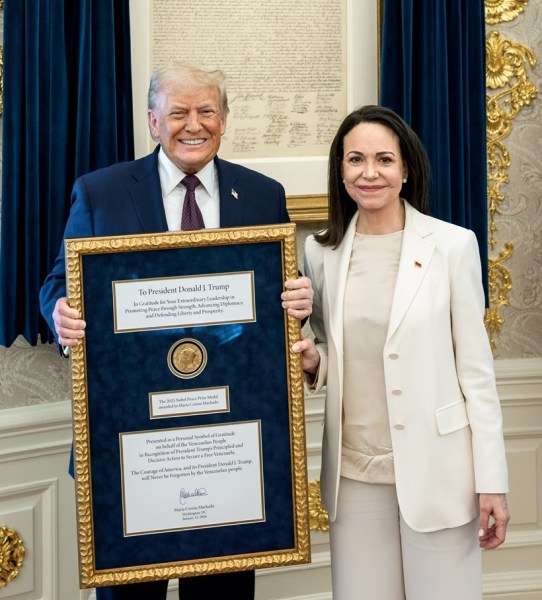
Still, Machado has consistently praised the US government. A photo from the Thursday meeting showed her and Trump standing together, with Trump holding a frame that named him and expressed gratitude for his “Extraordinary Leadership in Promoting Peace through Strength, Advancing Diplomacy, and Defending Liberty and Prosperity.”
It said the medal was “Presented as a Personal Symbol of Gratitude on behalf of the Venezuelan People in Recognition of President Trump’s Principled and Decisive Action to Secure a Free Venezuela.”