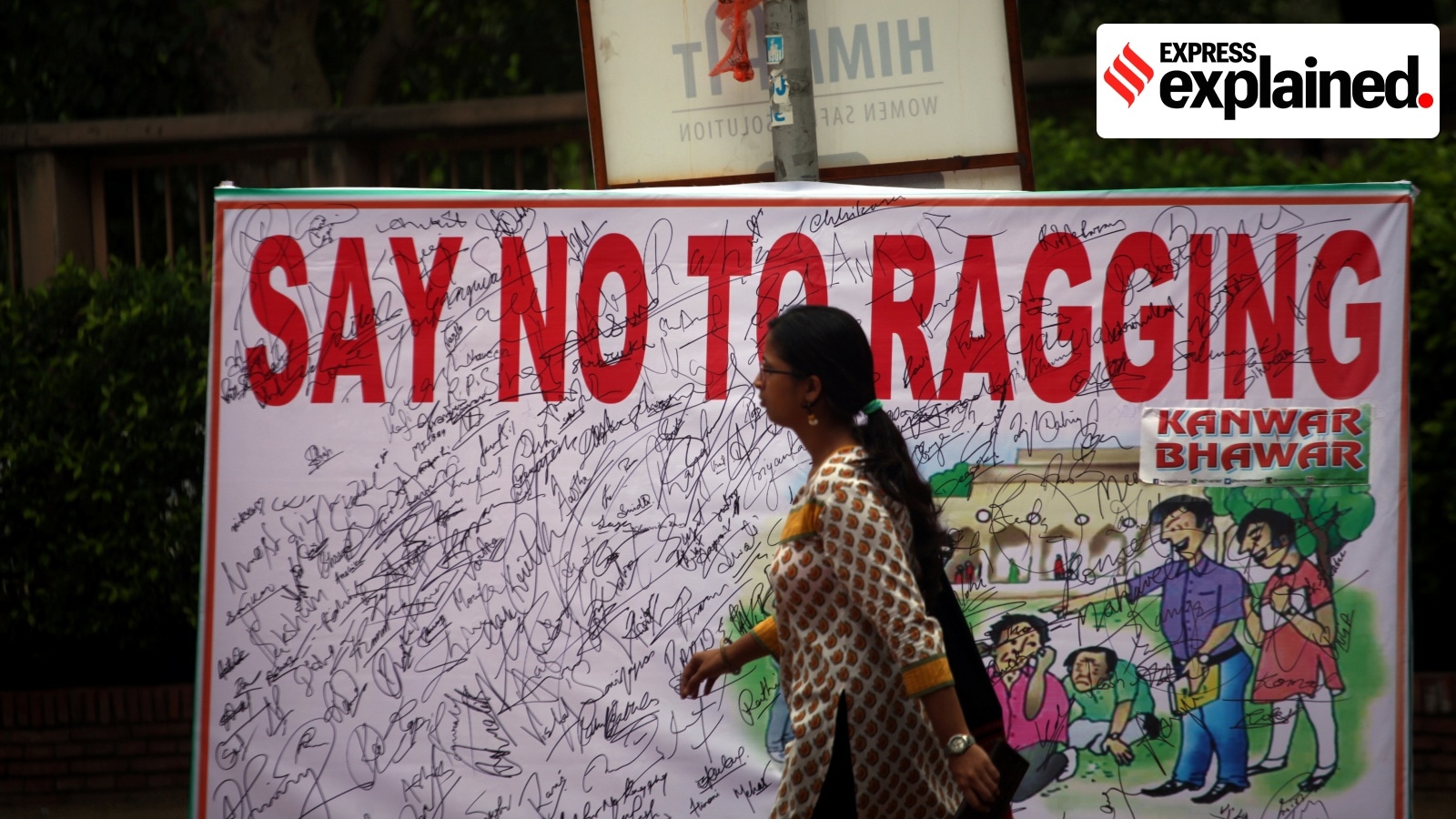
The Bill has broadened the definition of ragging, and prohibited any form of ragging committed through the Internet or in any digital mode. Here is a look at other provisions of the Bill
Written by Shaju Philip
Thiruvananthapuram | August 9, 2025 10:16 AM IST
1 min read
Whatsapp
twitter
Facebook
Reddit
The Bill says that every institution shall constitute an anti-ragging committee headed by its chief with eight representatives from various segments. (Photo: Oinam Anand)
A 12-member multi-disciplinary working group, constituted by the Kerala government in March, has drafted a Bill to amend the Kerala Prohibition of Ragging Act, 1998.
The committee was formed in March following a directive from the Kerala High Court, which acted upon a petition moved by the Kerala State Legal Services Authority (KeLSA) raising concerns about the increasing incidents of ragging in educational institutions.
What does the Bill say?
01
Ragging Act made applicable beyond academic institutions
The draft proposes to bring the premises of all academic institutions under the purview of the ragging act. This includes the institutions’ academic buildings, residential areas, playgrounds, and canteens, whether located within the campus or outside, bus stands, homestays, and all means of transportation used by students, whether public or private. The existing Act had defined its scope only as "the whole of Kerala."
02
Definition of ragging broadened
The draft has included the term “body shaming” within the purview of ragging, along with existing terms such as “teasing” and “abusing” or playing practical jokes on, or causing hurt. Additionally, while the existing Act says ragging is “asking a student to do any act or perform something which such student will not, in the ordinary course, willingly do,” the Bill has added “asking a student not to do any act or perform something which such student will do in the ordinary course” within the definition of ragging.
03
Online ragging prohibited
Any form of ragging committed through the Internet or in any digital mode shall be a cognizable offence. According to the existing Act, ragging within or outside any educational institution is prohibited.
04
Enhanced punishment
The punishment for committing, participating in, abetting, or propagating ragging within or outside any educational institution shall, on conviction, be increased to three years of imprisonment and a fine of Rs 25,000. Currently, the maximum punishment is two years of imprisonment and a fine of Rs 10,000.
05
Shift action against the accused
Whenever there is a complaint regarding ragging, written or oral, the institution head should immediately decide whether a case can be made out prima facie for registration of an FIR within 24 hours. Additionally, the accused person should be suspended forthwith. The existing Act had allowed seven days for the institution head to act upon the complaint before handing it over to the police.
06
Formation of anti-ragging committees
The draft states that every institution shall constitute an anti-ragging committee headed by its chief with eight representatives from various segments, such as faculty, senior students, freshers, and parents. There should be an anti-ragging squad at institutes, a state-level monitoring cell with a nodal officer, and an anti-ragging cell at each police station.
07
Punishment for false complaint or false information
Any person who makes a false complaint of ragging against any person, committed solely to humiliate, extort, threaten, or defame them, shall be punished with imprisonment for a term which may extend to six months, or with a fine, or both.
08
Protecting the confidentiality of the victim of ragging
No person shall make any report or quote regarding any victim of ragging, even in any form of media, which may have the effect of lowering their reputation or infringing upon their privacy.
The identity of the victim, including their name, address, photograph, family details, educational institution, neighbourhood, or any other details, should not be disclosed.
Shaju Philip is a Senior Assistant Editor at The Indian Express, where he leads the publication's coverage from Kerala. With over 25 years of experience in mainstream journalism, he is one of the most authoritative voices on the socio-political, religious, and developmental landscape of South India.
Expertise, Experience, and Authority
Decades of Regional Specialization: Shaju has spent more than two decades documenting the "Kerala Model" of development, its complex communal dynamics, and its high-stakes political environment.
Key Coverage Beats: His extensive reporting portfolio includes:
Political & Governance Analysis: In-depth tracking of the LDF and UDF coalitions, the growth of the BJP in the state, and the intricate workings of the Kerala administration.
Crime & Investigative Journalism: Noted for his coverage of high-profile cases such as the gold smuggling probe, political killings, and the state’s counter-terrorism efforts regarding radicalization modules.
Crisis Management: He has led ground-level reporting during major regional crises, including the devastating 2018 floods, the Nipah virus outbreaks, and the Covid-19 pandemic response. ... Read More


 1 min read