Premium
This is an archive article published on June 1, 2022

Explained: Reading GDP growth data

Newly released provisional estimates show GDP rose 8.7% in 2021-22. While aggregates show the economy has gone past pre-pandemic levels, the recovery has not been uniform across sections.

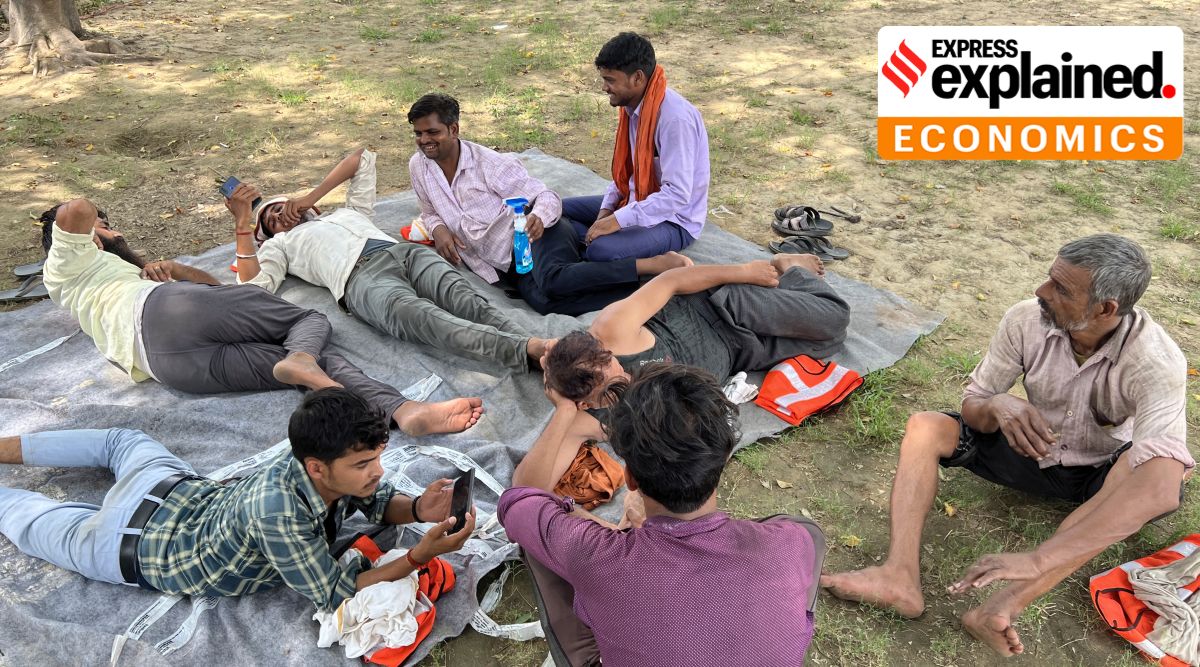
Labourers rest on a hot day in Lucknow, May 31, 2022. (AP Photo/Rajesh Kumar Singh)Labourers rest on a hot day in Lucknow, May 31, 2022. (AP Photo/Rajesh Kumar Singh)

India’s gross domestic product (GDP) grew by 8.7% in 2021-22 (or FY22) according to the “provisional estimates” released by the Ministry of Statistics and Programme Implementation on Tuesday. This growth comes at the back of a 6.6% contraction in GDP during 2020-21 when the pandemic led to massive disruptions and widespread lockdowns. The GDP measures the value of all “final” goods and services— those that are bought by the final user— produced in a country in a given period (say a quarter or a year).

The data released also showed that the Gross Value Added (or GVA) — another measure of national income — grew by 8.1% in FY22. In FY21, GVA had contracted by 4.8%.

The key questions are: Has the recovery in FY22 been good enough to recover from the contraction of FY21? If so, have all sectors recovered? If the recovery isn’t “broad-based”, which sectors or sections remain behind where they were before Covid struck?

🚨 Limited Time Offer | Express Premium with ad-lite for just Rs 2/ day 👉🏽 Click here to subscribe 🚨

How are GDP and GVA different?

While the GDP calculates national income by adding up all expenditures in the economy, the GVA calculates the national income from the supply side by looking at the value added in each sector of the economy.

The two measures of national income are linked as follows:

GDP = GVA + Taxes earned by the government — Subsidies provided by the government

Story continues below this ad

As such, if the government earned more from taxes than it spent on subsidies, GDP will be higher than GVA. If, on the other hand, if the government provided subsidies in excess of its tax revenues, the absolute level of GVA would be higher than that of GDP.

Simply put, GDP provides the demand side of the economy, and GVA the supply side.

What do the data show?

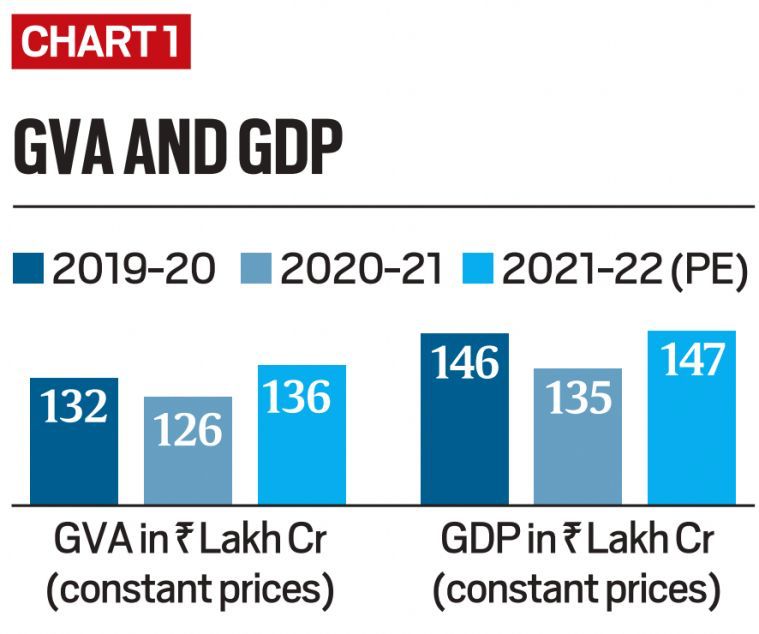
As Chart 1 shows, at the aggregate level, in terms of GDP as well as GVA, the economy has gone past the pre-Covid level (FY20). In other words, it has recovered all the lost ground due to the contraction in FY21. However, the sub-components of GDP and GVA reveal the true extent of this recovery.

Story continues below this ad
Simply put, GDP provides the demand side of the economy, and GVA the supply side. (Source: MoSPI)
What do the GDP data show?

Broadly speaking, GDP has four engines of growth in any economy.

In India’s case, the biggest engine is private consumption demand from individuals — the money spent by people in their private capacity. This demand typically accounts for 56% of all GDP and is technically called the “Private Final Consumption Expenditure” or PFCE.

The second-biggest engine is the money spent by companies and government towards making investments such as building a new office, buying a new computer or building a new road etc. This type of expenditure or “demand” accounts for 32% of all GDP in India; and is technically called Gross Fixed Capital Formation or GFCF.

Story continues below this ad

The third engine is the money spent by the government towards its day-to-day expenses such as paying salaries. This accounts for 11% of India’s GDP, and is called “Government Final Consumption Expenditure (GFCE)”.

The fourth engine is demand from“Net Exports” (NX). This is the money spent by Indians on foreign goods (that is, imports) subtracted from the money spent by foreigners on Indian goods (exports). Since in most years India imports more than it exports, the NX is the smallest engine of GDP growth and is often negative. It is for this reason that NX will be excluded from the rest of the analysis.

So, GDP = PFCE + GFCF + GFCE + NX

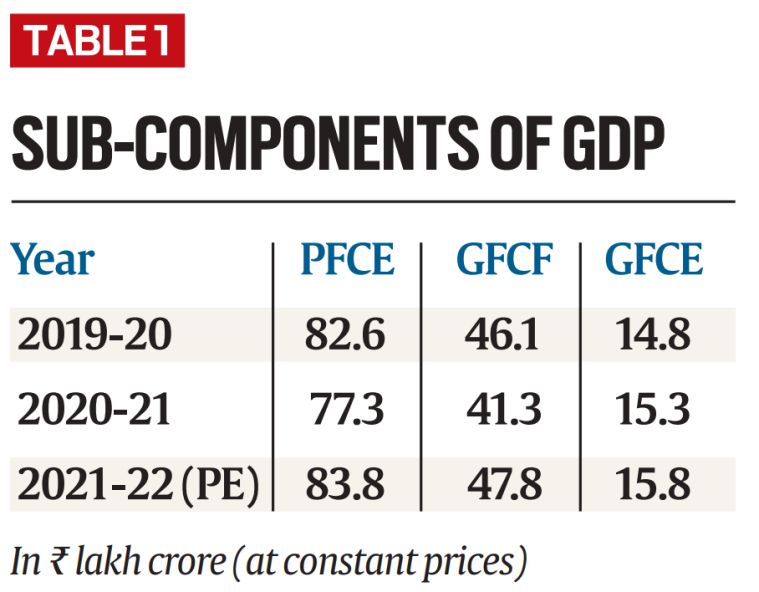
As Table 1 shows, while all components have gone past the pre-Covid level, the recovery is dissimilar. In fact, in percentage terms, the recovery is the opposite of the relative importance of the different types of demands.

Sub-components of GDP (Source: MoSPI)

So, while the government’s expenditures are more than 6% higher than FY20 levels, investments (with three times the weight) are up less than 4% and private demand (five times the weight) is just 1.4% above the FY20 level.

Story continues below this ad

What do the GVA data show?

Overall GVA was almost 3% more than the FY20 level.

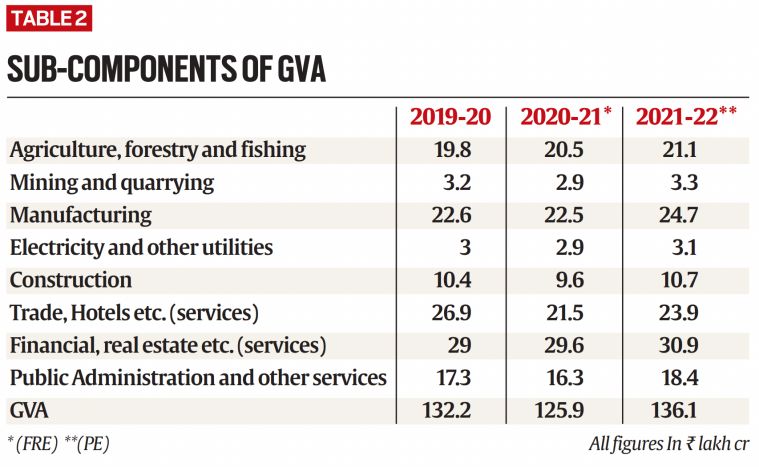
As Table 2 shows, while all sectors show an increase over FY21, different sectors of the economy tell a different story. Agriculture and allied sectors, for instance, never contracted and continued to grow through the last two years. At the end of FY22, it was 6.5% higher than the pre-Covid level.

Sub-components of GVA. (Source: MoSPI)

Manufacturing is up over 9% from pre-Covid levels. But there are other sectors (such as mining and construction) that either show a moderate increase or a deficit — contact-intensive services such as trade and hotel etc. are still more than 11% below pre-Covid levels.

What is the takeaway?

Story continues below this ad

It is a matter of relief that India’s economy has, at least on aggregate parameters, gone past pre-Covid levels. However, this recovery is neither uniform nor broad-based, and has created its own set of winners and losers.

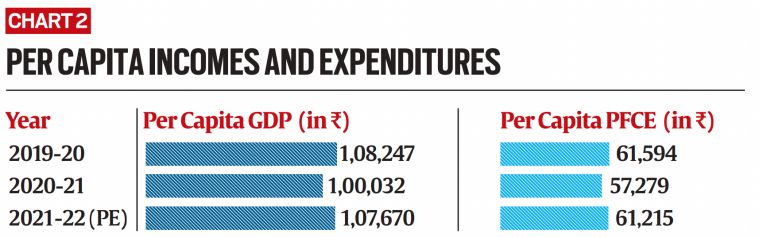
This so-called “K-shaped” recovery — or growing inequality in the economy — is best captured by Chart 2. It shows that even though at the aggregate level both GDP (national income) and PFCE (expenditure) have crossed the pre-Covid level, the average Indian hasn’t yet recovered.

Per capita incomes and expenditures (Source: MoSPI)

The second point to remember is that this is a “recovery” only when compared to the pre-Covid level — and not to what would be the pre-Covid growth trajectory. According to the RBI, getting back to the pre-Covid trajectory will take India up to 2034-35 and that too is preconditioned on an annual economic growth rate of 7.5%.

Lastly, when it comes to future growth, the outlook is sobering. Growing geopolitical uncertainties, rising crude oil prices (and inflation), tightening of monetary conditions (higher interest rates) etc. are likely to dampen the anaemic growth private consumption demand and thus rein in growth prospects in the current (FY23) and the coming (FY24) fiscals.

Udit Misra is Senior Associate Editor at The Indian Express. Misra has reported on the Indian economy and policy landscape for the past two decades. He holds a Master’s degree in Economics from the Delhi School of Economics and is a Chevening South Asia Journalism Fellow from the University of Westminster. Misra is known for explanatory journalism and is a trusted voice among readers not just for simplifying complex economic concepts but also making sense of economic news both in India and abroad. Professional Focus He writes three regular columns for the publication. ExplainSpeaking: A weekly explanatory column that answers the most important questions surrounding the economic and policy developments. GDP (Graphs, Data, Perspectives): Another weekly column that uses interesting charts and data to provide perspective on an issue dominating the news during the week. Book, Line & Thinker: A fortnightly column that for reviewing books, both new and old. Recent Notable Articles (Late 2025) His recent work focuses heavily on the weakening Indian Rupee, the global impact of U.S. economic policy under Donald Trump, and long-term domestic growth projections: Currency and Macroeconomics: "GDP: Anatomy of rupee weakness against the dollar" (Dec 19, 2025) — Investigating why the Rupee remains weak despite India's status as a fast-growing economy. "GDP: Amid the rupee's fall, how investors are shunning the Indian economy" (Dec 5, 2025). "Nobel Prize in Economic Sciences 2025: How the winners explained economic growth" (Oct 13, 2025). Global Geopolitics and Trade: "Has the US already lost to China? Trump's policies and the shifting global order" (Dec 8, 2025). "The Great Sanctions Hack: Why economic sanctions don't work the way we expect" (Nov 23, 2025) — Based on former RBI Governor Urjit Patel's new book. "ExplainSpeaking: How Trump's tariffs have run into an affordability crisis" (Nov 20, 2025). Domestic Policy and Data: "GDP: New labour codes and opportunity for India's weakest states" (Nov 28, 2025). "ExplainSpeaking | Piyush Goyal says India will be a $30 trillion economy in 25 years: Decoding the projections" (Oct 30, 2025) — A critical look at the feasibility of high-growth targets. "GDP: Examining latest GST collections, and where different states stand" (Nov 7, 2025). International Economic Comparisons: "GDP: What ails Germany, world's third-largest economy, and how it could grow" (Nov 14, 2025). "On the loss of Europe's competitive edge" (Oct 17, 2025). Signature Style Udit Misra is known his calm, data-driven, explanation-first economics journalism. He avoids ideological posturing, and writes with the aim of raising the standard of public discourse by providing readers with clarity and understanding of the ground realities. You can follow him on X (formerly Twitter) at @ieuditmisra           ... Read More


Latest Comment
Post Comment
Read Comments
Advertisement
Loading Taboola...
Advertisement
Advertisement
Advertisement