Explained: The 2017 rioting case against Hardik Patel
A court in Ahmedabad has rejected the Gujarat government's application seeking withdrawal of a 2017 rioting case against Hardik Patel and 18 others. What is the case about? Why did the government seek withdrawal of the case? What now?
Written by Sohini Ghosh
, Edited by Explained Desk
Ahmedabad |
4 min read
Whatsapp
Twitter
Facebook
Reddit
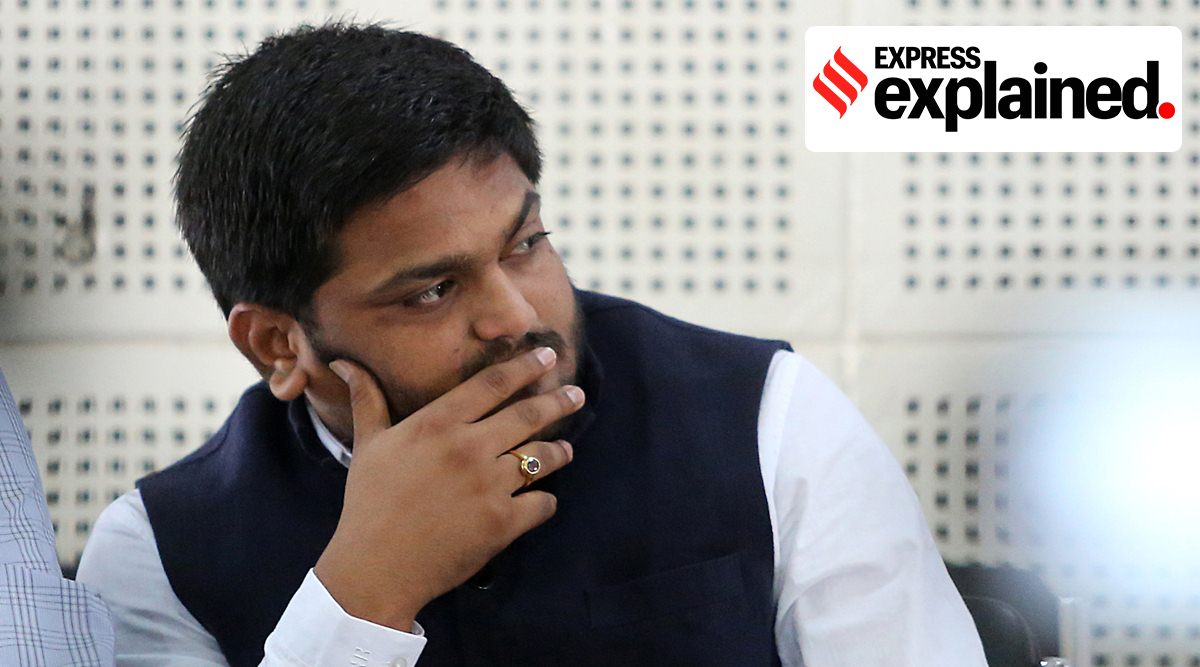
Hardik Patel during a press conference in Ahmedabad. (Express Photo: Nirmal Harindran, File)
A magisterial court in Ahmedabad on Monday (April 25) rejected the Gujarat government’s application seeking withdrawal of a 2017 rioting case against Gujarat Congress working president Hardik Patel and 18 others. The state government will appeal in the Ahmedabad sessions court against the order.
What is the case about?
You’ve Read Your Free Stories For Now
Sign up and keep reading more stories that matter to you.
On March 20, 2017, an FIR was filed on a complaint from Vastral BJP councillor Paresh Patel, naming Patel and 16 others as accused. The councillor alleged that Hardik along with 60-70 others had unlawfully assembled, rioted, trespassed and launched attacks inside his Vastral residential compound. Paresh had further alleged that the nameplate of his house was broken and the mob had burnt the BJP flag and the nameplate, and that the mob had verbally abused and threatened to kill Paresh. The accused were charged with offences punishable under IPC 120B (criminal conspiracy), 142, 143, 149 (unlawful assembly), 147 (rioting), 435 (mischief by fire), 452 (trespass), 294 (a), 506(1), the case was committed to the Ahmedabad magistrate court in December 2017, with 19 named as accused, including Patidar leader Hardik Patel.
Why did the government seek withdrawal of the case?
While former Gujarat chief minister Anandiben Patel in 2016 had assured withdrawal of about 246 cases against Patidars resulting from the 2015 Patidar agitation, the assurance was put on paper only last month. In February, Hardik had threatened to launch a state-wide agitation if the state government did not withdraw the pending cases against Patidar Anamat Andolan Samiti (PAAS) members, adding that Patidar youths would stage dharna outside houses of Patidar community MPs and MLAs of the BJP if they do not support the demand of dropping criminal cases. In March this year, a day before Hardik’s deadline for launching the agitation the Gujarat government filed applications for withdrawal of 10 criminal cases of Ahmedabad city against around 40 Patidar members for unlawful assembly and rioting from before the Ahmedabad magistrate court and sessions court. Nine of these cases (eight before sessions and one before magistrate) stand withdrawn as on date, following court’s order allowing the state’s applications for withdrawal. The latest case that the sessions court permitted to be withdrawn under provisions of CrPC section 321 being on April 11 which involved seven accused charged for offences of rioting and unlawful assembly under IPC and under provisions of the Prevention of Damage To Public Property Act. The 2017 Ramol case remains the only case where the state’s plea for withdrawal of the case has been rejected.
What did the court say while rejecting the state’s plea?
As per additional public prosecutor at Ahmedabad magistrate court DM Raval, the court had primarily reasoned that no public interest would be served if the case is withdrawn and that the state had not justified as to how public interest will be served by withdrawal of this case. While rejecting the state’s application, the court also sought the presence of the accused for framing of charges on May 2. Hardik faces 28 cases in all, of which two are under the sedition law, all related to the 2015 quota agitation violence. The Supreme Court recently stayed his conviction in a case of rioting lodged in Visnagar of Mehsana district during the agitation.
According to the additional public prosecutor at Ahmedabad magistrate court DM Raval, the state is in the process of filing an appeal against the magisterial court’s rejection, primarily on the ground that the magisterial court has erred in rejecting the state’s application for withdrawal of the case.
Sohini Ghosh is a Senior Correspondent at The Indian Express. Previously based in Ahmedabad covering Gujarat, she recently moved to the New Delhi bureau, where she primarily covers legal developments at the Delhi High Court
Professional Profile
Background: An alumna of the Asian College of Journalism (ACJ), she previously worked with ET NOW before joining The Indian Express.
Core Beats: Her reporting is currently centered on the Delhi High Court, with a focus on high-profile constitutional disputes, disputes over intellectual property, criminal and civil cases, issues of human rights and regulatory law (especially in the areas of technology and healthcare).
Earlier Specialty: In Gujarat, she was known for her rigorous coverage in the beats of crime, law and policy, and social justice issues, including the 2002 riot cases, 2008 serial bomb blast case, 2016 flogging of Dalits in Una, among others.
She has extensively covered health in the state, including being part of the team that revealed the segregation of wards at the state’s largest government hospital on lines of faith in April 2020.
With Ahmedabad being a UNESCO heritage city, she has widely covered urban development and heritage issues, including the redevelopment of the Sabarmati Ashram
Recent Notable Articles (Late 2025)
Her recent reporting from the Delhi High Court covers major political, constitutional, corporate, and public-interest legal battles:
High-Profile Case Coverage
She has extensively covered the various legal battles - including for compensation under the aegis of North East Delhi Riots Claims Commission - pertaining to the 2020 northeast Delhi riots, as well as 1984 anti-Sikh riots.
She has also led coverage at the intersection of technology and governance, and its impact on the citizenry, from, and beyond courtrooms — such as the government’s stakeholder consultations for framing AI-Deepfake policy.
Signature Style
Sohini is recognized for her sustained reporting from courtrooms and beyond. She specialises in breaking down dense legal arguments to make legalese accessible for readers. Her transition from Gujarat to Delhi has seen her expand her coverage on regulatory, corporate and intellectual property law, while maintaining a strong commitment to human rights and lacuna in the criminal justice system.
X (Twitter): @thanda_ghosh ... Read More