10 min read


© The Indian Express Pvt Ltd



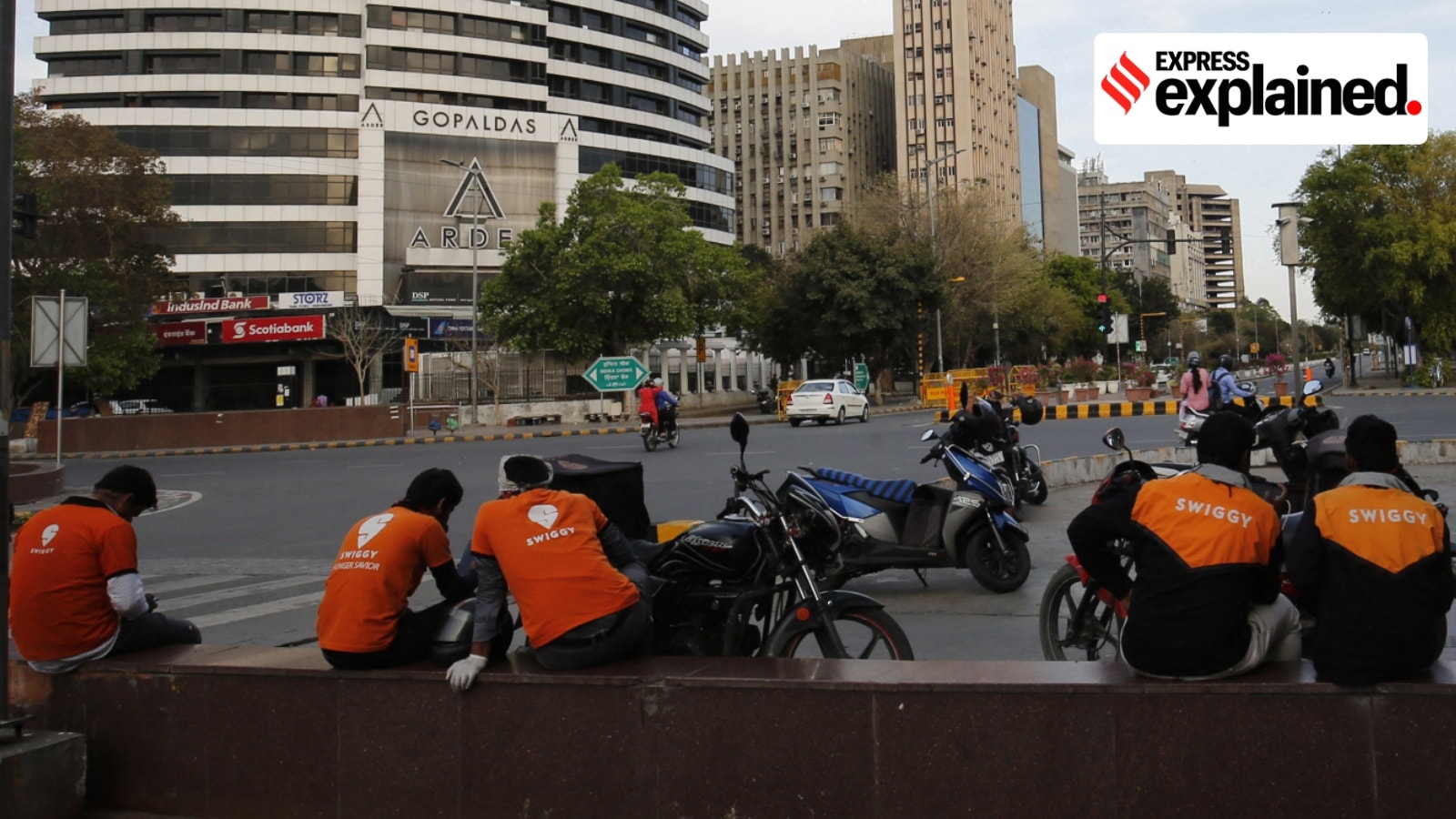 India’s gig economy, employed around 7.7 million people in 2020-21. The figure is estimated to reach 23.5 million by 2029-30. File photo
When thousands of delivery workers went on a nationwide strike on New Year’s Eve, demanding better pay, safety protections and social security, the backlash didn’t take long to come. Zomato founder Deepinder Goyal, and the wider start-up and investor community, began posting data on X within days, arguing that critics don’t understand how the gig economy works.
Among the most vocal voices in favour of the workers was that of AAP MP Raghav Chadha, who has for months now been raising the issue both inside Parliament and outside. He spent New Year’s Eve with delivery riders in Delhi’s Old Rajinder Nagar, saying such workers have helped build instant commerce companies but are now forced to protest just to be heard.
The online arguments have become a visible front in a broader debate over India’s gig economy, which employed around 7.7 million people in 2020-21 according to a NITI Aayog report. The figure has likely risen now, and is estimated to reach 23.5 million by 2029-30.
The debate raises several difficult questions — on the role of innovation, whether it has come at the cost of exploitation of workers, the importance of “gig” work in a country with high levels of unemployment, whether such work can merely just be a “flexible option” for those trying to make ends meet, and if there is an “oversupply” of such workers for this avenue for employment.
Delivery workers have said they face a range of issues — declining earnings, uncertain income, a low base pay, algorithms they say pushes them to ride for hundreds of kilometres a day in return for disproportionately low cash, rising fuel costs, no social security benefits, and a faceless management.
The 10-minute delivery model, implemented by companies such as Blinkit, Swiggy and Zepto, has also added speed into the mix.
So, on New Years’ Day and Christmas Day, typically among the busiest days for online food and grocery delivery platforms, thousands of delivery workers went on strike across the country — the latest flashpoint in their rising conflict with platform companies amid years of brimming discontent.
“The government must intervene immediately. Regulate platform companies, stop worker victimisation, and ensure fair wages, safety and social protection. The gig economy cannot be built on the broken bodies and silenced voices of workers,” said Shaik Salauddin, co-founder and national general secretary of the Indian Federation of App-based Transport Workers — the key union behind the strikes.
However, Goyal said the strikes were not successful. He put out data on X showing that deliveries were at a record high despite the protest call.
Controversially, he also dismissed striking workers as “miscreants” in his initial response to the December 31 protests. He wrote that support from local law enforcement helped keep the small number of “miscreants” in check, enabling over 4.5 lakh delivery workers across Zomato and Blinkit to deliver more than 7.5 million orders. The characterisation infuriated worker advocates and became a rallying point for critics.
At the centre of the debate is the promise that has defined quick commerce: deliveries in 10 minutes. As per Goyal, the 10-minute delivery promise is enabled by store density and planning, not by asking delivery partners to ride faster. According to him, dark stores are located close to neighbourhoods, items are picked and packed in two-and-a-half minutes, and delivery partners typically travel less than two kilometres at an average speed of 15 kilometres per hour. Crucially, delivery partners are not shown the promised delivery time on their app, he said.
But the workers remain unconvinced. They say that the per-delivery rate on such platforms has been declining, with a milestone-based and distance-dependent incentive structure taking its place. This means that workers get paid extra cash for completing a select number of deliveries a day, with the distance they drive to complete the deliveries also playing a role in the structure.
In 2023, Blinkit delivery workers had gone on strike after the per delivery fee was reduced from as high as Rs 50 to Rs 15, with a distance-based fee component being introduced. So, when companies say the growing density of their dark store networks near neighbourhoods mean workers don’t have to rush to make deliveries, the flipside is that workers also don’t typically get deliveries for longer distances and, as a result, miss out on higher earnings.
When we celebrate a 10-minute delivery, we should ask who pays the price when something goes wrong, Chadha argued, framing it as a public safety issue that extends beyond individual workers to everyone on the road.
The economic reality
The numbers tell competing stories. Goyal shared detailed data showing average hourly earnings for delivery partners at Zomato increased by approximately 10.9 per cent year-on-year in 2025, reaching Rs 102 compared to Rs 92 in 2024. Zomato has not previously divulged such granular numbers, and its founder’s impassioned defence of the company’s business model comes now that the delivery start-up is listed on the stock exchange.
Goyal calculated that someone working 10 hours a day for 26 days would earn around Rs 26,500 gross, or Rs 21,000 net after fuel and maintenance costs.
But, the rather startling fact he revealed was the duration for which an average worker stays engaged with the platform. Most delivery workers, according to Goyal’s data, worked only 38 days in 2025, averaging seven hours per working day. Only 2.3 per cent worked more than 250 days. This, he argued, shows the model is working as intended — “flexible”, part-time income rather than full-time employment.
But critics dispute this. They point to unpredictable pay, opaque algorithms that suddenly change incentive structures, and the absence of any grievance mechanism. What this could also point to is an “oversupply” of workers in a rush for limited employment opportunities. Workers say the only reason companies like Zomato and Blinkit can be successful in India is due to the labour cost arbitrage, which is simply not possible in more advanced countries.
And there is no evidence to suggest that workers are doing these gig jobs merely for the flexibility. Choice is a luxury. The high attrition rate could be an indicator that these jobs are not sustainable beyond a certain duration, as many workers attest to. There are socio-economic differences among even this poorly paid working class, and not everyone has the ability to quit a job, or go on strike on a day when there is an opportunity to make a little more money than usual.
“When one day’s income decides rent, electricity, or a child’s school fee, logging in on a strike day is not approval, it is survival. It is desperation. People remain trapped when better options do not exist. And please don’t sell people a distant dream to justify a present injustice. Promising that workers’ children will do better someday is not an answer to exploitation today,” Chadha wrote on X.
Class, visibility and moral discomfort
In perhaps his most intriguing thread, Goyal reframed the entire debate around inequality and visibility. He wrote that this is the first time in history that the working class and consuming class is interacting face-to-face at this scale. That discomfort with our own selves is why we are uncomfortable about the gig economy, he said.
His argument was that the gig economy hasn’t created exploitation, but has made existing inequality visible in ways that make middle-class consumers uncomfortable. Factory workers toiled behind walls, farmers in distant fields. Now, delivery workers arrive at your door, making the human cost of convenience impossible to ignore.
However, while delivery workers have become an increasingly common sight in urban spaces, many believe that Goyal’s take on gig work making inequality more visible is simply not true. The Indian landscape is filled with visible instances of inequality, from people’s interactions with their househelps, plumbers, and the people who iron their clothes. Indians interact with inequality, at various levels, everyday.
Goyal also said that the gig jobs have a very low entry barrier, and people do not need to be skilled to do the job.
Most gig workers are beings of the internet, and as a result have a good amount of digital literacy, as all their work interactions happen on a device. It’s a separate matter that unlike in other forms of employment, delivery workers have no space within their companies to showcase what they’re capable of that could determine things like promotions and increments. And, on a more human level, there is skill in patience and perseverance that is needed to work for the long hours that these workers put in. Not everyone can do what they do.
Regulating companies under the labour codes
Last year, the government notified the Code on Social Security, bringing gig and platform workers under a formal welfare framework for the first time. It enables their registration on a national database and opens access to schemes covering health, disability, accident insurance and old-age support. It aims to give millions of workers basic protections despite their non-traditional employment structure.
States such as Karnataka and Rajasthan have also passed laws to ensure that gig workers have dignity in their work.
Under the Code on Social Security, 2020, ‘gig workers’, ‘platform workers’, and ‘aggregators’ have been defined for the first time, as a person who performs work outside of the traditional employer-employee relationship. It envisions the creation of a Social Security Fund for gig and platform workers with contribution from Central and state governments, corporate social responsibility, fines collected due to compounding, etc.
Aggregators such as Amazon, Flipkart, Swiggy and Zomato will have to contribute 1–2 per cent of their annual turnover towards this fund, with the total contribution capped at 5 per cent of the amount payable by them to the workers.