ExplainSpeaking: Why record food grain production may trigger renewed demands for MSPs
The past six years have seen more and more farmers protesting against poor remuneration even when this period has seen a sustained increase in farm output. Are MSPs the answer?
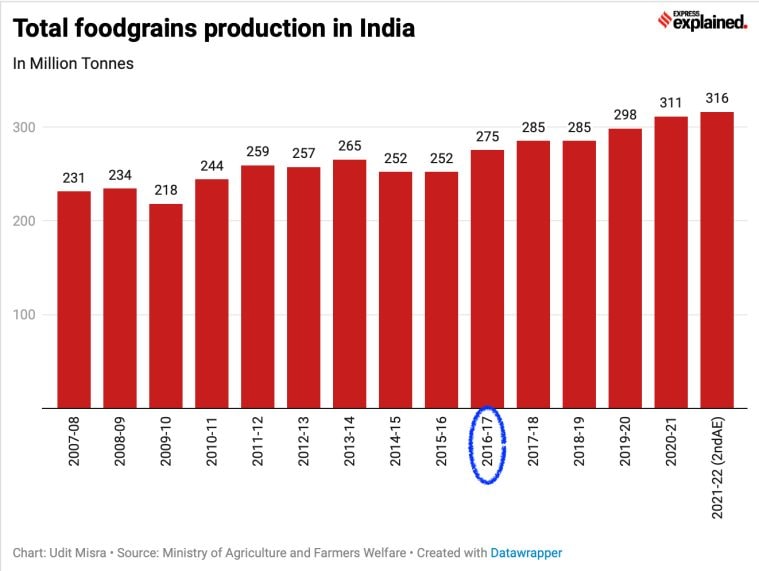
Last week, the Ministry of Agriculture and Farmers Welfare released the Second Advance Estimates of Production of Foodgrains for 2021-22. These estimates suggest that India’s farmers are all set to notch up the highest-ever production record. In fact, notwithstanding the Covid-induced disruption, foodgrains output has gone up 298 million tonnes in 2019-20 (before Covid) to 311 million tonnes in 2020-21 and now to 316 million tonnes in 2021-22.
Further, as Chart 1 shows, India’s total foodgrains production has grown every single year starting 2016-17. In the years immediately preceding 2016-17, total output fluctuated between 245 million tonnes and 265 million tonnes.
Total foodgrains production in India
But this sustained increase in foodgrains is only part of the picture. What this data fails to capture is the sustained increase in farmers’ distress even as farm output was increasing.
What explains this anomaly where increased farm output is accompanied by increased farmer distress?
There are two broad reasons.
One, the terms of trade (the relative prices of farm inputs and outputs) moved against the farmer. In other words, the rise in prices of inputs (such as fertilisers, diesel, electricity etc.) outstripped the rise in prices of farm outputs. As a result, farming became progressively unremunerative.
Two, the non-farm economy, which typically cushioned the blow for farmers when farming itself was not as remunerative, started to fail post-demonetisation, which was closely followed by the implementation of Goods and Services Tax. To be sure, India’s GDP growth rate rapidly decelerated from over 8% in 2016-17 to under 4% in 2019-20. The events of two years since then — one seeing a sharp contraction due to Covid and another seeing a recovery — have effectively cancelled each other out.
Story continues below this ad
These two factors explain why even before the massive agitation against the three farm laws (which have now been repealed), each passing year saw more and more farmers agitating. For instance, in June 2017 six farmers were killed when police opened fire on a group of protesting farmers demanding better crop prices in Mandsaur, Madhya Pradesh. Similarly, in early 2019, Maharashtra saw thousands of protesting farmers undertaking a long march. There were several other outbursts by farmers in other states as well.
Watch this episode of The Express Economist to know more about Indian farmers’ distress:
These two factors also explain why the farmers are now stuck at the demand for not just higher “minimum support prices” (or MSPs) but also a legal guarantee for MSPs. In other words, MSPs shouldn’t just be announced but also made effective.
For those who do not know, MSP is the price at which the government is supposed to procure/buy food articles from farmers if the market price falls below it. As such, MSPs provide a floor for market prices. The MSPs are announced for 23 commodities and are based on the recommendations of the Commission for Agricultural Costs and Prices (CACP). In reality, though, actual procurement varies with crop and geography.
Story continues below this ad
With increased production yet again this year, and with the prices of key farm inputs (especially energy prices) not only going up but also expected to go up further soon after the five state Assembly elections results are announced, it is quite possible that the farmers may redouble on their demands regarding MSPs.
So, should MSPs be raised? Should they have legal backing?
In the wake of the farm laws repeal, there are two diametrically opposite views. For many farmer leaders, MSP is non-negotiable. For others, the call for legal backing of MSPs would be disastrous for farming as well as financially ruinous for the government.
With the election season currently underway, it is not too hard to imagine that if the ruling BJP loses UP and fails to move the needle in Punjab, there might be political reasons — which may or may not have anything to do with economic logic — for acting on the demand for higher and legally-mandated MSPs.
But what about the economic factors? In a recent paper titled “Minimum Support Prices in India: Distilling the Facts”, three researchers — Prankur Gupta (University of Texas, Austin), Reetika Khera (IIT-Delhi), and Sudha Narayanan (International Food Policy Research Institute, Delhi) — have tried to make sense of the role of MSPs. This paper was published in the Review of Agrarian Studies (January-June 2021).
Story continues below this ad
Here are three notions about MSPs that tend to influence the views of most non-farmers.
That very few farmers (only 6 per cent) benefit from MSP
That government procurement under MSPs only benefits large farmers
And that only farmers of Punjab and Haryana (and, to some extent, western Uttar Pradesh) benefit from such procurement.
This paper examines the validity of each of these notions.
1. How many farmers benefit from MSP?
The estimate of 6% is derived from surveys conducted between June 2012 and June 2013 as part of the National Sample Survey’s Situation Assessment of Agricultural Households (NSS-SAS).
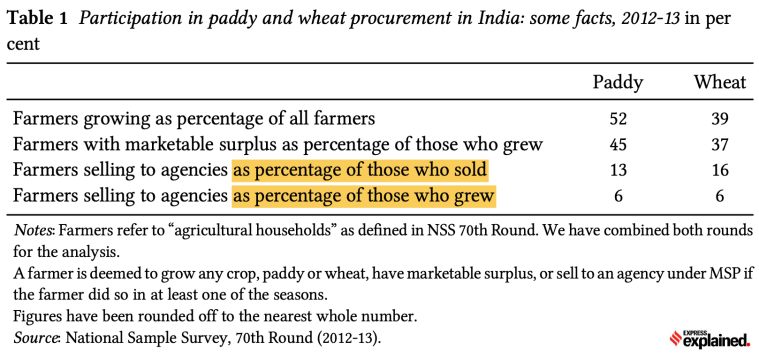
But it matters what variable one looks at. Table 1 below captures the conundrum.
Story continues below this ad
Table 1; Source: National Sample Survey
The key factor to remember here is that not every farmer who grows paddy or wheat has a “marketable surplus”. In other words, many produce just enough for self-consumption, especially since these are staple grains.
“As per the survey, 45 per cent of paddy growers that year sold any paddy, and 37 per cent of wheat growers sold any wheat. When one considers households that had any marketed surplus, i.e. had non-zero sales that year, the proportion of rice and wheat sellers who benefited from selling to the procurement system were 13 per cent and 16 per cent, respectively, considerably larger than the six per cent cited in the debates around MSP (Table 1),” state the authors.
There are two additional points to consider here.
One, there are large variations among states.
“For example, for rice in Chhattisgarh, the proportion is as high as 38 per cent, and it is just one per cent in states like Bihar, Tamil Nadu, and West Bengal. For wheat, this proportion is nearly two-thirds (62 per cent) in Punjab, followed by Haryana (39 per cent), Madhya Pradesh (16 per cent), and Uttarakhand (10 per cent),” state the authors.
Two, the 6% figure focuses only on the direct benefits of MSP sales for rice and wheat. “It neglects other MSP crops for which procurement, even if limited, is operational,” state the authors while referring to a 2016 Niti Aayog document that finds evidence to show that MSP props up market prices even for those who do not sell to the government.
Story continues below this ad
2. Which states/geographies benefit from MSPs?
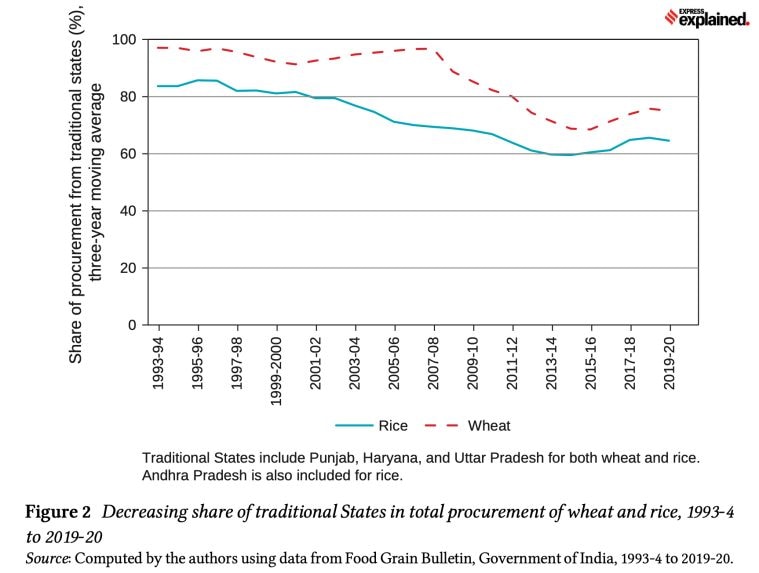
The claim, argue the authors, that procurement is relevant only for farmers in Punjab, Haryana, and western Uttar Pradesh is based on older data when Punjab and Haryana were virtually the sole providers of public stocks of rice and wheat. Instead of the NSS-SAS data set of 2012, authors use more recent state-level data on the procurement of rice and wheat to assess more recent trends in the geography of procurement.
“These data suggest that several states that were not historically involved in public procurement have emerged as significant regions of procurement, notably Madhya Pradesh for wheat, and Odisha and Chhattisgarh for rice,” they write.
Chart 2 maps the decreasing share of traditional states in total procurement of wheat and rice over the past three decades. The traditional states refer to Punjab, Haryana, and western Uttar Pradesh for wheat and Andhra Pradesh for paddy.
The decreasing share of traditional states in total procurement of wheat and rice over the past three decades.
It is noteworthy that a key driver of this change in the geographies of procurement is the introduction of decentralised procurement. “In 1997-98, precisely to address the flaws of a centralised system that was focused on just a few states, the government introduced a decentralised procurement (DCP) scheme,” they state.
Story continues below this ad
“(DCP) can expand the geographies of procurement and potentially include crops that are locally relevant and tied foremost to local needs for food-based schemes,” they state. Kerala is a case in point. Between 2011 and 2019, the state used decentralised procurement to reverse a “dramatic decline” in the area under rice within the state.
3. What kind of farmers benefit from MSPs?
Do MSPs only help large farmers? The authors point out that there are different ways of assessing who benefits.
One could look at the “number of beneficiary farmers”/agricultural households from each class-size, in absolute terms as well as relative to their representation among rice/wheat sellers.
Or one could look at the “share of procurement” accounted for by different classes of farmers, in absolute terms as well as relative to contribution to all rice/wheat sales.
Story continues below this ad
A third way is to look at the extent to which MSP sales is an important component of an agricultural household’s crop sales/income.
Overall, the authors find that “although at the national level there is a bias towards large farmers, this does not imply the exclusion of small and marginal farmers.”
Table 3; Source: National Sample Survey
For example, (see Table 3, above) when the authors looked at the proportion of farmer participants in the procurement system belonging to different landholding classes at the all-India level in 2012-13 they found that “…among those who sold paddy to the government 10 per cent were medium and large farmers, with just one per cent owning over 10 hectares of land. Small and marginal farmers with less than two hectares accounted for 70 per cent. The rest (20 per cent) were semi-medium farmers (2–4 hectares). In the case of wheat, the share of large farmers was thrice as high as paddy: three per cent of all wheat-selling farmers were large farmers; more than half (55 per cent) were small and marginal farmers. This suggests that smallholders are far from being excluded from the procurement system,” they conclude.
What is the solution to the distress among Indian farmers? Are MSPs the solution? Share your views and queries at udit.misra@gmail.com
Udit Misra is Senior Associate Editor at The Indian Express. Misra has reported on the Indian economy and policy landscape for the past two decades. He holds a Master’s degree in Economics from the Delhi School of Economics and is a Chevening South Asia Journalism Fellow from the University of Westminster.
Misra is known for explanatory journalism and is a trusted voice among readers not just for simplifying complex economic concepts but also making sense of economic news both in India and abroad.
Professional Focus
He writes three regular columns for the publication.
ExplainSpeaking: A weekly explanatory column that answers the most important questions surrounding the economic and policy developments.
GDP (Graphs, Data, Perspectives): Another weekly column that uses interesting charts and data to provide perspective on an issue dominating the news during the week.
Book, Line & Thinker: A fortnightly column that for reviewing books, both new and old.
Recent Notable Articles (Late 2025)
His recent work focuses heavily on the weakening Indian Rupee, the global impact of U.S. economic policy under Donald Trump, and long-term domestic growth projections:
Currency and Macroeconomics:
"GDP: Anatomy of rupee weakness against the dollar" (Dec 19, 2025) — Investigating why the Rupee remains weak despite India's status as a fast-growing economy.
"GDP: Amid the rupee's fall, how investors are shunning the Indian economy" (Dec 5, 2025).
"Nobel Prize in Economic Sciences 2025: How the winners explained economic growth" (Oct 13, 2025).
Global Geopolitics and Trade:
"Has the US already lost to China? Trump's policies and the shifting global order" (Dec 8, 2025).
"The Great Sanctions Hack: Why economic sanctions don't work the way we expect" (Nov 23, 2025) — Based on former RBI Governor Urjit Patel's new book.
"ExplainSpeaking: How Trump's tariffs have run into an affordability crisis" (Nov 20, 2025).
Domestic Policy and Data:
"GDP: New labour codes and opportunity for India's weakest states" (Nov 28, 2025).
"ExplainSpeaking | Piyush Goyal says India will be a $30 trillion economy in 25 years: Decoding the projections" (Oct 30, 2025) — A critical look at the feasibility of high-growth targets.
"GDP: Examining latest GST collections, and where different states stand" (Nov 7, 2025).
International Economic Comparisons:
"GDP: What ails Germany, world's third-largest economy, and how it could grow" (Nov 14, 2025).
"On the loss of Europe's competitive edge" (Oct 17, 2025).
Signature Style
Udit Misra is known his calm, data-driven, explanation-first economics journalism. He avoids ideological posturing, and writes with the aim of raising the standard of public discourse by providing readers with clarity and understanding of the ground realities.
You can follow him on X (formerly Twitter) at @ieuditmisra
... Read More