Premium
This is an archive article published on April 28, 2021

Explained: What is CT value in a Covid-19 test, and how does it correlate with viral load and disease severity?

What is Ct-value in a coronavirus home test? The cycle threshold value emerges in RT-PCR tests for the coronavirus, and determines whether a person is positive for Covid-19 or not. To what extent does it correlate with viral load and disease severity?

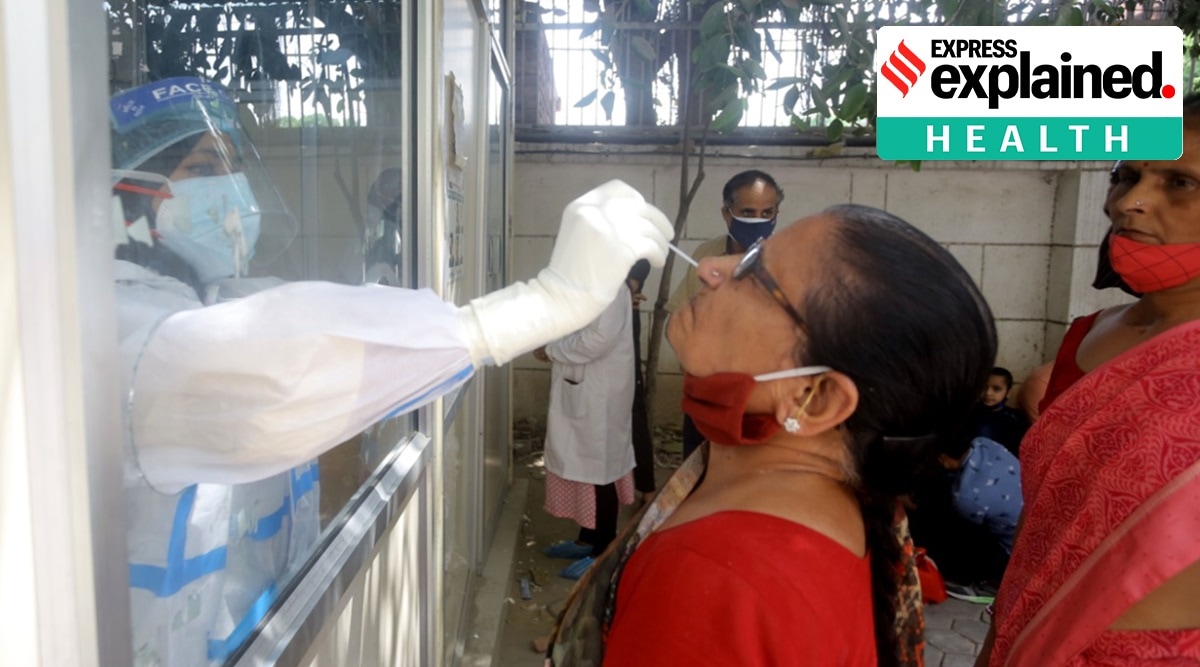
what is CT value, ct value covid 19 test, What is CT value home test kit, CT value meaning in RT-PCR test, how to read Covid test report, Indian ExpressCT-Value Covid-19 test: An RT-PCR test detects the virus; Ct value sets a benchmark for whether a person is to be counted as positive. (Express Photo: Amit Mehra)

Among various scientific terms that Covid-19 has made part of the public vocabulary, one is the ‘Ct value’ in RT-PCR tests for determining whether a patient is positive for Covid-19.

This was the subject of a recent request sent by the Maharashtra government to the Indian Council of Medical Research (ICMR). The state sought clarity whether it was advisable to treat a person as Covid-negative if the Ct value is more than 24 and the person is asymptomatic.

State officials said various ICMR documents had mentioned different Ct values and there were divergent views even among Niti Aayog and the National Centre for Disease Control.

Days later, the ICMR DG wrote back to the state Health Secretary that ICMR has taken inputs from virology laboratories across the country to arrive at a single Ct value cut-off. All patients with a Ct value less than 35 may be considered as positive while those with a Ct value above 35 may be considered as negative, ICMR said.

But what is Ct value?

Short for cycle threshold, Ct is a value that emerges during RT-PCR tests, the gold standard for detection of the SARS-CoV-2 coronavirus. In an RT-PCR test, RNA is extracted from the swab collected from the patient. It is then converted into DNA, which is then amplified. Amplification refers to the process of creating multiple copies of the genetic material — in this case, DNA. This improves the ability of the test to detect the presence of virus. Amplification takes place through a series of cycles — one copy becomes two, two becomes four, and so on — and it is after multiple cycles that a detectable amount of virus is produced.

According to the ICMR advisory, the Ct value of an RT-PCR reaction is the number of cycles at which fluorescence of the PCR product is detectable over and above the background signal. Put simply, the Ct value refers to the number of cycles after which the virus can be detected. If a higher number of cycles is required, it implies that the virus went undetected when the number of cycles was lower. The lower the Ct value, the higher the viral load — because the virus has been spotted after fewer cycles.

Why is CT value important?

To put that in context, let us look at the ICMR advisory and Maharashtra’s letter to ICMR. According to the ICMR, a patient is considered Covid-positive if the Ct value is below 35. In other words, if the virus is detectable after 35 cycles or earlier, then the patient is considered positive. If the benchmark were to be lowered to 24 — the value mentioned in Maharashtra’s letter — it would mean that Ct values in the range 25-34 would not be considered positive. A benchmark of 35, therefore, means that more patients would be considered positive than we would get if the benchmark were 24. The ICMR has said lowering Ct threshold parameter may lead to missing several infectious persons.

Story continues below this ad

One can think of Ct value as a measure of transmission potential, said leading virologist Dr Shahid Jameel. “So if there is more virus in my throat and nose, I will transmit it better,” said Dr Jameel, who is Director of the Trivedi School of Biosciences at Ashoka University.

What is the significance of the ICMR threshold of 35?

Globally, the accepted cut-off for Ct value for Covid-19 ranges between 35 and 40, depending on instructions from the respective manufacturers of testing equipment. The ICMR has arrived at the Ct value of 35 based on laboratory experiences and inputs taken from several virology labs.

There was no new advisory, but ICMR informed the Maharashtra government that it was not advisable to use a lower cycle threshold parameter as it would lead to missing several infectious persons and increase disease transmission, Dr Balram Bhargava, DG of ICMR, has said.

Is there any correlation between a Ct value and severity of disease?

No. Although Ct value is inversely correlated with viral load, It does not have any bearing on the severity of the disease, experts have said. A patient can have a low Ct value, which means her viral load is high enough to be detected rapidly, but she may still be asymptomatic.

Story continues below this ad

A small study published in the Indian Journal of Medical Microbiology in January this year found that there was no correlation between Ct values and severity of disease or mortality in patients with Covid-19 disease. It found that the time since the onset of symptoms has a stronger relationship with Ct values as compared to the severity of the disease.

The Ct value tells us about the viral load in the throat and not in the lungs, said Dr Parikshit Prayag, consultant for infectious diseases at Deenanath Mangeshkar Hospital, Pune. “The Ct value does not correlate with severity – only with infectivity. In the first report I do not really look at the Ct value, but for follow -up of patients in the hospital, I do consider the Ct value, as then I can decide whether to transfer the patient to the non-Covid building or not. From the infectivity point of view, it can matter, not severity,” Dr Prayag said.

Does a high Ct value always mean a low viral load?

While that may be the obvious inference, some experts stress that some patients can have a high Ct value and yet have a very significant level of Covid-19 infection, and vice versa. Many factors are important in interpreting an RT-PCR test, and the results may also depend on the method of specimen collection and time from infection to collection and to analysis.

An ICMR advisory in August last year noted that Ct values depend on how the sample has been collected. A poorly collected sample may reflect inappropriate Ct values. Besides, Ct values are also determined by the technical competence of the person performing the test, calibration of the equipment, and the analytical skills of the interpreters.

Story continues below this ad

Again, Ct values may differ between nasal and oropharyngeal specimens collected from the same individual. The temperature of transportation, as well as the time taken from collection to receipt in the lab, can also adversely impact Ct values.

Newsletter | Click to get the day’s best explainers in your inbox

Anuradha Mascarenhas is a Senior Editor at The Indian Express, based in Pune. With a career spanning three decades, she is one of the most respected voices in Indian journalism regarding healthcare, science and environment and research developments. She also takes a keen interest in covering women's issues . Professional Background Education: A gold medalist in Communication and Journalism from Savitribai Phule Pune University and a Master’s degree in Literature. Author: She authored the biography At The Wheel Of Research, which chronicles the life and work of Dr. Soumya Swaminathan, the former Chief Scientist at the WHO. Key Focus: She combines scientific accuracy with storytelling, translating complex medical research into compelling public and human-interest narratives. Awards and Recognition Anuradha has won several awards including the Press Council of India's national award for excellence in journalism under the gender based reporting category in 2019 and the Laadli Media award (gender sensitivity -2024). A recipient of the Lokmat journalism award (gender category-2022), she was also shortlisted for the RedInk awards for excellence in journalism-2021. Her debut book At The Wheel Of Research, an exclusive biography of Dr Soumya Swaminathan the inaugural chief scientist of World Health Organisation was also nominated in the Popular Choice Category of JK Paper AUTHER awards. She has also secured competitive fellowships including the Laadli Media Fellowship (2022), the Survivors Against TB – New Research in TB Media Fellowship (2023) and is part of the prestigious 2025 India Cohort of the WomenLift Health Leadership Journey.” Recent Notable Articles (Late 2025) 1. Cancer & Specialized Medical Care "Tata Memorial finds way to kill drug-resistant cancer cells" (Nov 26, 2025): Reporting on a breakthrough for triple-negative breast cancer, one of the most aggressive forms of the disease. Discipline, diet and purpose; How a 97-year-old professor defies ageing'' (Nov 15, 2025) Report about Prof Gururaj Mutalik, the first Head of Department at Pune's B J Government Medical College who at 97 credits his longevity to healthy habits and a strong sense of purpose. 2. Environmental Health (The "Breathless Pune" Series) Long-term exposure even to 'moderate' air leads to chronic heart, lung, kidney issues" (Nov 26, 2025): Part of an investigative series highlighting that even "safe" pollution levels are damaging to vital organs. "For every 10 µg/m3 increase in PM2.5 level, there was 6-8% jump in medicine sales" (Nov 23, 2025): Using commercial data to prove the direct link between air quality and respiratory illnesses in Pune. 3. Lifestyle & Wellness News "They didn't let cancer, diabetes and heart disease stop them from travelling" (Dec 22, 2025): A collaborative piece featuring survivors who share practical tips for traveling with chronic conditions. At 17, his BP shot up to 200/120 mmHG; Lancet study flags why child and teen hypertension doubled between 2000 and 2020'' (Nov 12,2025)--A report that focusses on 17-year-old-boy's hypertensive crisis and reflects the rising global trend of high blood pressure among children and adolescents. 4. Scientific Recognition & Infrastructure For promoting sci-comm, gender diversity: IUCAA woman prof highlighted in Nature" (Nov 25, 2025): Covering the global recognition of Indian women scientists in gender studies and physics. Pune researchers find a spiral galaxy like the Milky Way from early universe'' (December 3, 2025)- A report on how Indian researchers discovered a massive galaxy that existed when the universe was just 1.5 billion years old , one of the earliest to have been observed so far. Signature Beat: Health, Science & Women in Leadership Anuradha is known for her COVID-19 reportage, where she was one of the first journalists to provide detailed insights into the Covishield and Covaxin trials. She has a dedicated interest in gender diversity in health and science, often profiling women researchers who are breaking the "leaky pipeline" in STEM fields. Her writing style is scrupulous, often featuring interviews with top-tier scientists and health experts from various institutions.   ... Read More


Latest Comment
Post Comment
Read Comments
Advertisement
Advertisement
Advertisement
Advertisement