© The Indian Express Pvt Ltd
 5 min read


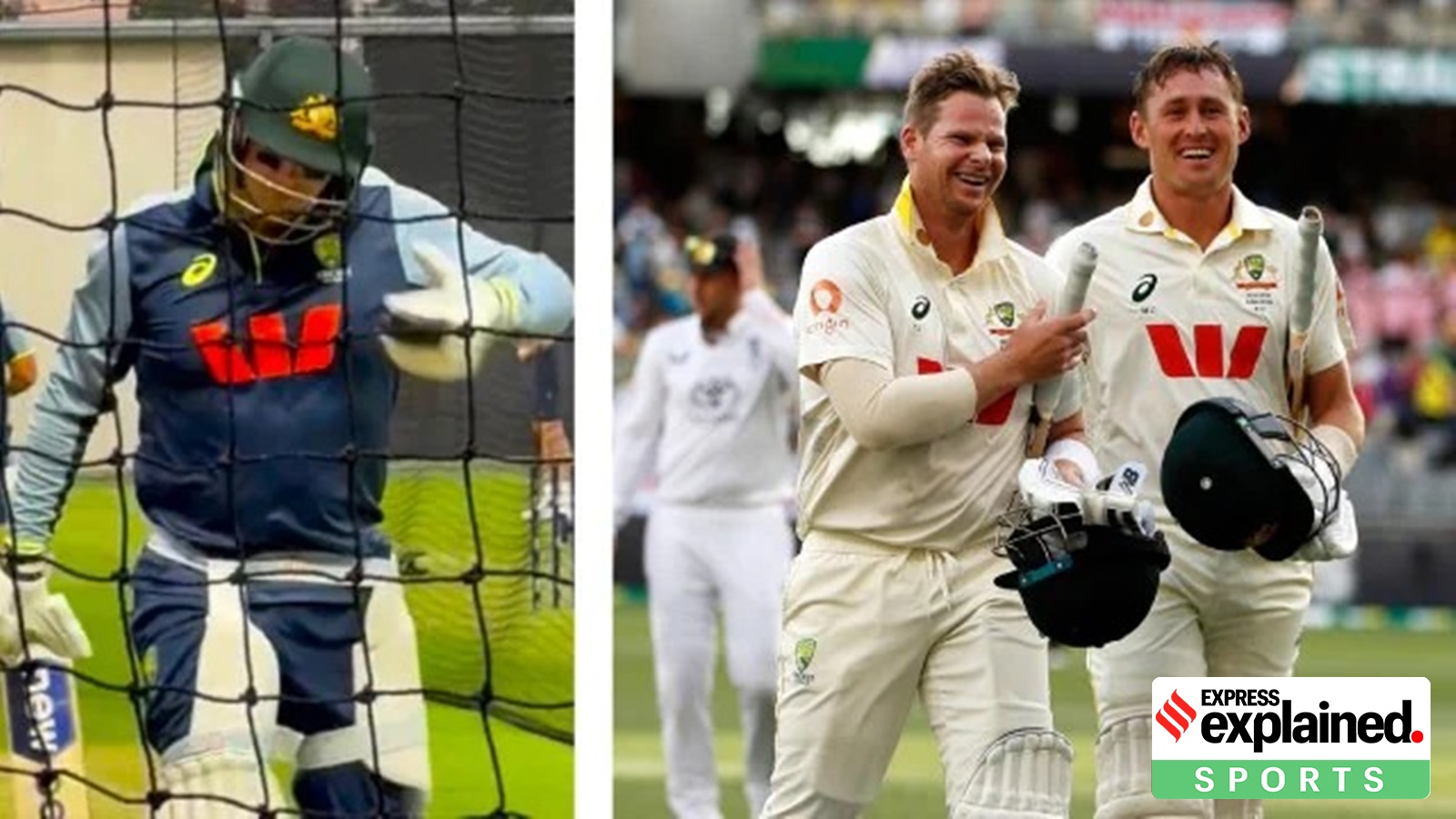 (Left) Steve Smith with the black anti-glare strips under his eyes while training for the 2nd Ashes Test match; Smith and Marnus Labuschagne leave the field after winning the first Ashes Test match against England in Perth. (AP Photo)
Australia’s stand-in captain and batting talisman Steve Smith was on Sunday seen batting with eye blacks beneath his eyes as his side began preparations for the second Ashes Test against England at Brisbane, starting on December 4, a day-night pink-ball affair.
On videos shared on social media, the 36-year-old could be seen entering the nets in full gear with eye blacks underneath his eyes.
Here’s an explainer on eye blacks, why they can be useful in pink-ball matches and what scientific studies say.
An eye black is a thin, flexible adhesive patch that is applied to the upper cheek, underneath the eyes. They are designed to decrease the amount of stray light that reaches a player’s eyes from below and from the sides — a region especially prone to glare due to facial curvature and natural skin reflectivity.
Eye blacks are popularly used in American football and baseball as these sports are played under high-intensity floodlights with rapid ball or player movement on giant, bright stadium backdrops. Eye blacks help because dark, matte surfaces tend to absorb light rather than diffusing it.
Why do eye blacks matter more with the pink ball?
The pink ball behaves differently from the red ball, and a lot of the difference has to do with how it interacts with light. The pink ball is coated with a more reflective lacquer to preserve colour and visibility under lights, but the same shine makes it prone to catching and scattering light in ways that can blur a batter’s view momentarily.
One of the challenges for players in a pink-ball day-night Test match is the twilight period. During the 20–30 minutes after sunset, when natural light fades but floodlights haven’t taken full effect, the pink ball can blend into the mixed sky background. This is the period when most batters say they “lose” the sight of the ball for a split second. Any glare reflecting off their cheeks only extends the problem, washing out contrast when the ball is moving around the most.
Additionally, the pink ball also tends to stay visually “lively” for longer. The reflective coating means that even minute variations can cause background flashes that compete for a batter’s attention. That can put extra strain on the eye, and eye blacks reduce some of that by reducing the light that bounces upward into the eyes.
Why is Steve Smith using eye blacks ahead of the pink-ball Test?
Smith has played 13 out of the 14 pink-ball Tests, but has a modest record in these games with 815 runs at an average of 37.04. The 36-year-old has admitted that the challenges of the pink-ball Tests are different and the balll behaves differently from the red one.
“The pink ball, in general, is just a completely different game. Personally, I find it quite tricky just picking the ball up at certain times of the day and things like that, and the way it behaves is completely different to a red one,” Smith said.
With the Ashes holding extra importance, Smith has decided to take matters into his own hands to ensure he can deliver a standout performance in a pink-ball Test in the most prestigious match of them all in the game.
“There must be sort of science or theory around it. I haven’t read into it. I think it’s something to do with glare, especially on the wicket. The glare up from the wicket. Maybe it helped pick the ball up better. I look at it either way, if there is a science behind it or whether it is a placebo. If it doesn’t, but it feels like it works, both ways, it works,” Smith’s teammate Marnus Labuschagne said.
What do studies say about eye blacks in sports?
In 2016, Brian DeBroff, a professor of ophthalmology & visual science at Yale School of Medicine, summarised the benefits of using eye blacks for athletes in his review paper, titled “The ophthalmic science behind Eye Black grease and its use in professional and youth athletics”.
He argued that eye black grease altered the reflectance of the skin under the eye, thereby decreasing stray light that would degrade retinal image quality. Several outdoor sports demand high contrast detection under strong light, and even the smallest of improvements in contrast sensitivity could be beneficial.
Which other cricketer has used eye blacks?
West Indian batting great Shivnarine Chanderpaul developed a reputation for batting with eye blacks under his eyes. The 51-year-old said that using the patches helped him take a large percentage of the glare off his eyes.
“I always used it whenever it was very glary. I stick them on, and it does help take 60-70 per cent of the glare off my eyes, and that was good for me,” he told Gulf News in 2018.