5 min read
© The Indian Express Pvt Ltd



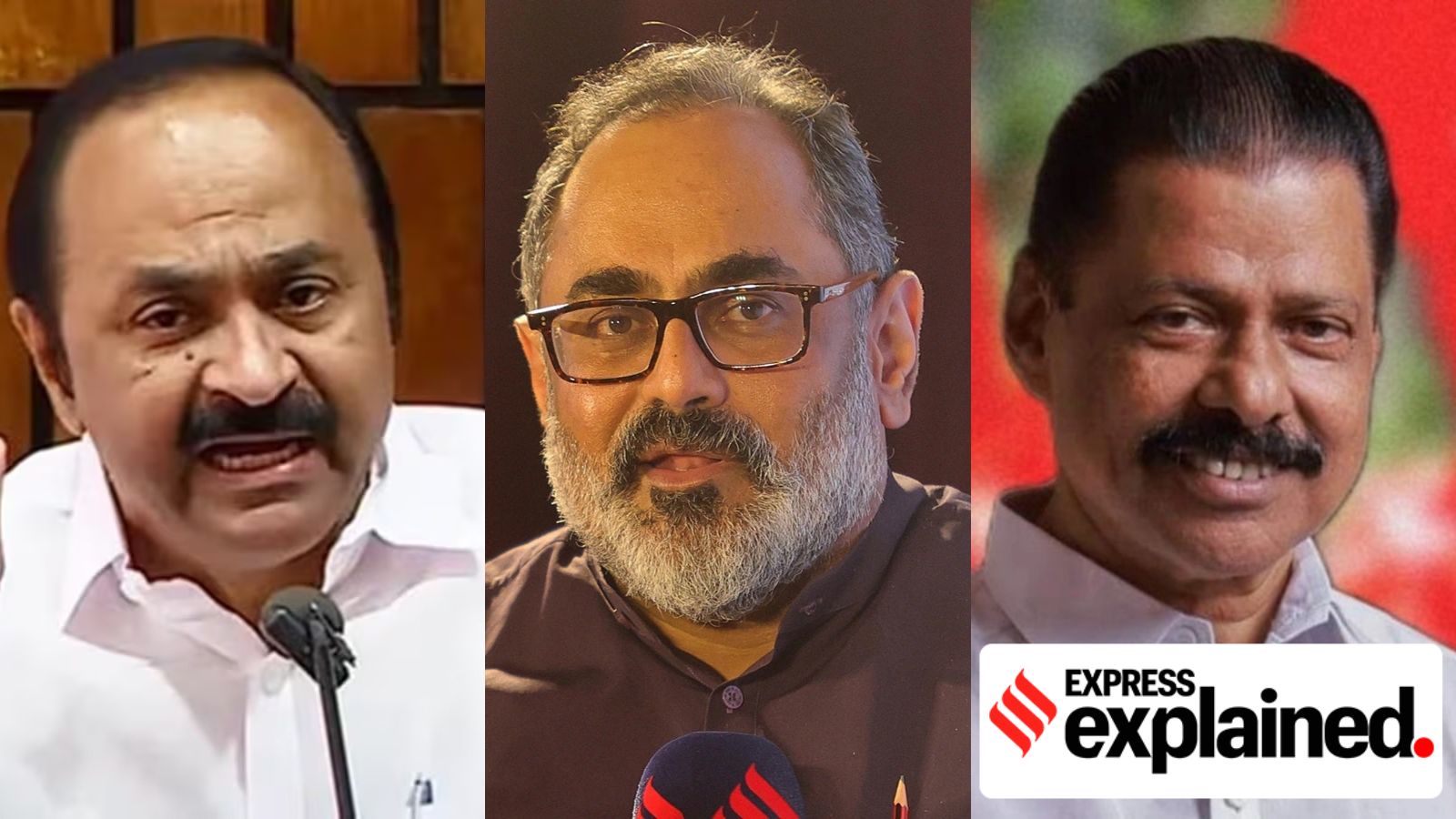 From left to right: VD Satheesan, Leader of Opposition (UDF), Rajeev Chandrasekhar, BJP state president, MV Govindan, CPIM state secretary (Express File, IE Malayalam)
With vote-counting underway for the Kerala local body elections, the Congress-led United Democratic Front (UDF) has taken the lead in municipal corporations, municipalities and panchayats, ahead of the ruling CPI(M)-led Left Democratic Front (LDF).
The UDF won four of the six corporations and 54 of 86 municipalities. Among the panchayats, the UDF is leading in 492 of 941 grama panchayats, eight out of 14 district panchayats, and 81 of the 152 block panchayats.
The BJP-led National Democratic Alliance (NDA) made an impressive showing in the polls, winning the Thiruvananthapuram Municipal Corporation. Prime Minister Narendra Modi acknowledged the result, thanking the people of Kerala for voting for the NDA. “Kerala is fed up of UDF and LDF. They see NDA as the only option that can deliver on good governance and build a #VikasitaKeralam with opportunities for all,” he wrote in a social media post.
My gratitude to the people across Kerala who voted for BJP and NDA candidates in the local body polls in the state. Kerala is fed up of UDF and LDF. They see NDA as the only option that can deliver on good governance and build a #VikasitaKeralam with opportunities for all.
— Narendra Modi (@narendramodi) December 13, 2025
Voting unfolded in two phases on December 9 and 11 in 1,199 of the state’s 1,200 local bodies. The voter turnout for the first phase was 70.91%, while 76.08% of the electorate voted in the second phase. Here are three takeaways:
The LDF’s prospects took a massive hit from the Sabarimala gold plating scandal, which came to light in early October. The Kerala High Court-appointed special investigation team (SIT), tasked with probing the alleged theft of gold from the temple, arrested veteran CPI(M) leader and former MLA A Padmakumar last month over his alleged involvement. In 2019, Padmakumar was the president of the Travancore Devaswom Board (TDB), the governing body that oversees Sabarimala and other temples, when the alleged theft of gold occurred.
For the CPI(M), this harkened back to its troubles in 2018, when it complied with a Supreme Court ruling permitting the entry of women of menstruating age into the temple, against prevailing custom.
UDF leaders have repeatedly highlighted this point on Saturday, even as the coalition’s lead in the local body polls became clear and absolute. All India Congress Committee (AICC) General Secretary (Organisation) K C Venugopal described the UDF’s domination as a wave, and a rejection of “those who had stolen (Lord) Ayyappa’s gold.”
The BJP-led NDA has won 50 of the state capital, Thiruvananthapuram’s 101 wards, compared to the incumbent LDF’s 29 and the principal Opposition Congress-led UDF’s 19, with two seats going to Independents. The election in one seat was cancelled after the death of a candidate last week.
This victory has helped the BJP end the LDF’s 45-year-long reign of the district, but has not occurred in a vacuum. The party chose to focus its efforts on the Thiruvananthapuram district, where it has cultivated a strong Hindutva vote bank since the 1980s. The RSS maintains a robust network in the capital, with areas like Kazhakootam, Nemom and the old Fort area known for being RSS bastions.
The BJP has seen a meteoric rise in the district since the 2009 LS polls, rising from 11% then to 32% in 2014, riding the Narendra Modi wave, and electing its first-ever state legislator, O Rajagopal, in 2016. A similar success has been seen in the local body elections, with the party electing six councillors in the 2010 elections, 35 in 2015 and 34 in 2020, and emerging as the principal opposition over the last decade.
The social and caste demographic of the district works in its favour, given that Thiruvananthapuram has over 60% Hindu votes, with a predominant share of Nair and Ezhava votes. The middle class in the constituency, comprising government employees, has also been known to lean towards the BJP.
Under the leadership of the present state unit president, Rajeev Chandrasekhar, the party chose to pivot away towards a narrative of development politics.
The UDF’s showing, at the very least, will boost its prospects ahead of the upcoming state Assembly elections, expected in April 2026. Ahead of the 2016 and 2021 Assembly elections, the LDF had secured decisive victories in the local body elections in the preceding local body elections in 2015 and 2020, respectively.
It must be noted that the issues and leadership at the grassroots level vary fundamentally from those pertaining to an Assembly poll or a Lok Sabha election. However, the current result may well reflect the mood across the state as it gears to elect a new cabinet in six months.
The LDF’s campaign was centred on the successes of the near-decade-long tenure of the Pinarayi Vijayan-led government. Central to these were its declaration of eliminating extreme poverty (explained here) and its last-minute welfare push to increase the monthly welfare pension and introduce a new scheme for BPL women. However, setbacks in the form of the gold plating scandal and the CPM’s unilateral move to implement the PM-SHRI scheme, earning the ire of its ally, the CPI, are likely to have added to its troubles. CPM state secretary MV Govindan said the party and the front would introspect on this result.