4 min read
© IE Online Media Services Pvt Ltd



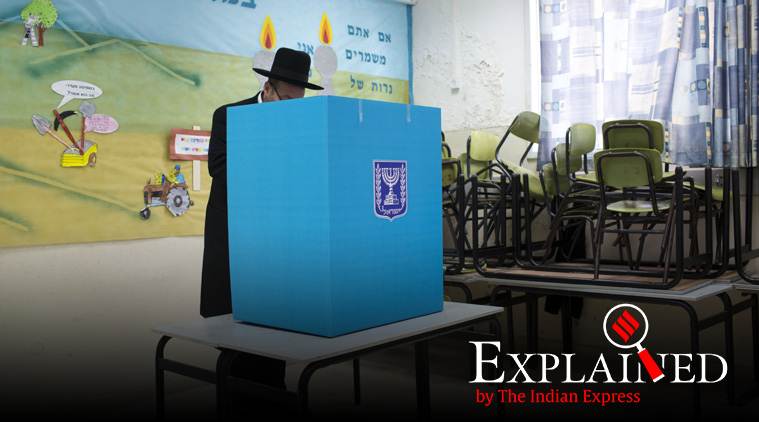 The 120 seats in Parliament are distributed among parties as per their share of the national vote.
Late on Tuesday (March 3) evening India time, Israel’s Prime Minister Benjamin Netanyahu had begun talks to form a “strong” national coalition after exit polls projected a small majority for his party in the third general election in less than a year.
The polls predicted the right-wing Likud coalition to win 59 seats in the 120-member Knesset, just two short of a majority. That, however, is no comfort for Netanyahu — he had come even closer after the April 9, 2019 election, but had failed to win just the one member that he needed to form the government then.
This election was essentially a plebiscite on Netanyahu, who was indicted for corruption in November 2019.
Why has Israel had to hold election after election?
Israel went to polls in April and September 2019. On both occasions, neither of the two main groups in Israeli politics — Netanyahu’s religious-conservative bloc or his centrist and secular opponents — got enough seats to form a ruling coalition.
Netanyahu has been leading a caretaker government with reduced powers, including the power to set a budget. In the Israeli system, the only way to break the deadlock is to keep holding elections until someone gets a majority.
How does Israel’s general election work?
The vote is for parties, not individual candidates as is the case in India. The 120 seats in Parliament are distributed among parties as per their share of the national vote.
The way this works makes it almost impossible for a single party to win a majority (61 seats). Alliances are the rule, and the smaller parties, who represent specific interests, hold powerful bargaining positions. The alliances are often awkward, comprising parties with widely differing positions.
Palestinians in the occupied territories cannot vote.
Who were the main competitors this time?
Netanyahu’s bloc has Likud and a clutch of ultra-Orthodox and far-right parties. His main opponent, Benny Gantz, is head of a secular centrist alliance called Blue and White. If he were to form the government, Gantz would need the support of a left-of-centre group.
Why was this election important?
Quite apart from the fact that Israel needs a proper government, this election comes after President Donald Trump presented, in January, his solution for the Israeli-Palestinian conflict.
It was criticised both by human rights groups who said the Palestinians had got very little, and the Israeli settlers who complained that not enough Palestinian land had been given to Israel. But both Netanyahu and Gantz backed the proposal.
More importantly, Netanyahu was indicted on corruption charges in November. So, if re-elected, he will become the first Prime Minister to hold office while being tried for a crime.
Gantz says the integrity of Israel’s democracy is at stake. Netanyahu says Gantz has no competence to run Israel, which only he, with his vast experience, can do.
What will happen if no one can form the government even this time?
To begin with, it’s not even clear whether Netanyahu can actually form a government while under indictment. Israel’s Supreme Court is seized of the matter.
Weird as it may sound, no one is ruling out a fourth election. But all parties dread it. Elections are costly, and having them repeatedly reduces trust in the political process. It remains to be seen if these considerations can force a few parties to make certain compromises to avoid election number 4.