© The Indian Express Pvt Ltd
 3 min read


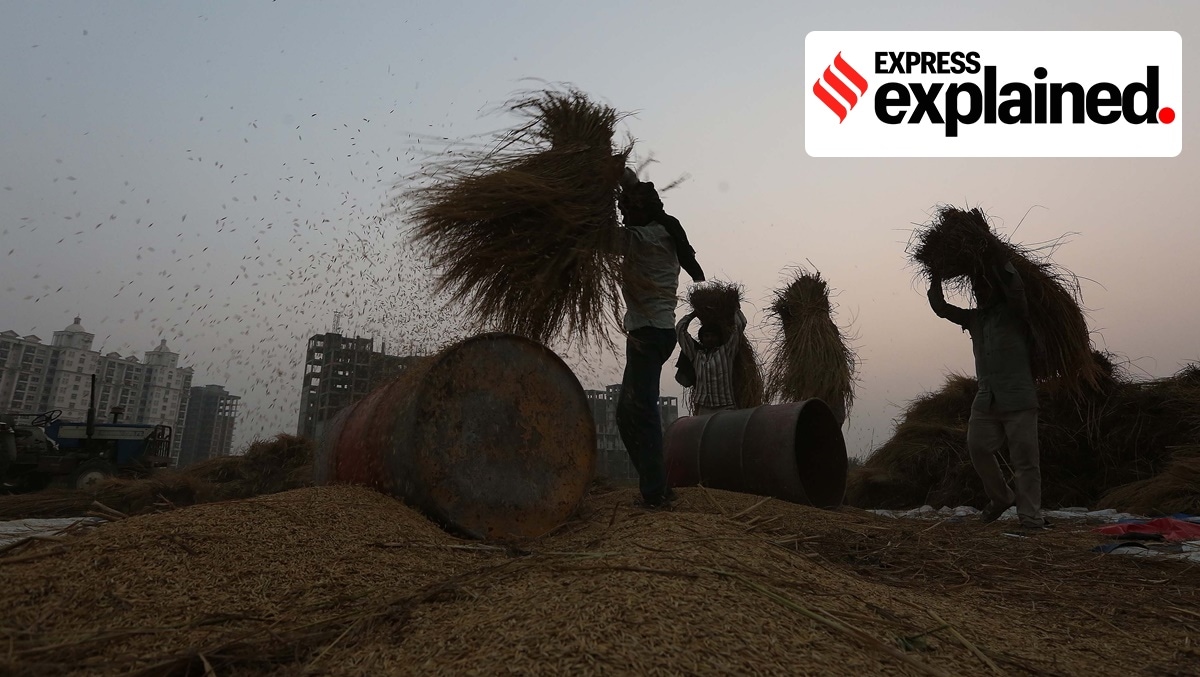 Labourers thrashing basmati paddy in the field at a village near Kharar. (Express Photo: Jasbir Malhi, File)
Why are India and Pakistan fighting over basmati?
India, the world’s largest exporter of basmati rice, has applied for protected geographical indication (PGI) status from the European Union’s Council on Quality Schemes for Agricultural Products and Foodstuffs. This would give it sole ownership of the basmati title in the EU. Pakistan, which is the only other basmati rice exporter in the world, has opposed this move as it would adversely impact its own exports, especially as the EU is a major market for its basmati.
Newsletter | Click to get the day’s best explainers in your inbox
Where does basmati actually grow?
In India, historically, the long-grained, aromatic rice has been cultivated in Indo-Gangetic plains at the foothills of the Himalayas. In modern India, this region is spread over Himachal Pradesh, Punjab, Haryana, Uttarakhand, Uttar Pradesh, Delhi and Jammu and Kashmir. Basmati has also been grown for centuries in the Kalar tract, which lies between the Ravi and Chenab rivers in Pakistan’s Punjab province.

Why does the basmati title need protection?
Given the high premium that basmati, an export-oriented product, fetches in the international market, there have been frequent disputes over granting the protected status to rice that may have been bred from basmati varieties and has the same qualities, but isn’t grown in the historical basmati-growing belt. In India, for example, the Madhya Pradesh government has been lobbying the central government for its basmati rice varieties to be granted the GI status, even taking the matter to the Supreme Court. The All India Rice Exporters’ Association (AIREA) is opposed to this, on the basis that it compromises basmati’s integrity.
The Agricultural and Processed Food Products Export Development Authority (APEDA) itself had stated that GI status is strongly linked to a particular geographical region and, based on this, AIREA has argued that granting MP’s request would open the door to other regions within India as well as rival rice exporters like China and Pakistan to grow basmati varieties anywhere in their territories, thus diluting the power of the basmati brand.
In fact, India’s attempts to protect the basmati title can be traced all the way back to a bitter dispute between the Indian government and the US company RiceTec in the late ’90s. The latter had sought a patent for certain rice varieties that it had bred from basmati strains, with names like Kasmati, Texmati and Jasmati. The patent was granted in 1997, much to the chagrin of the Indian government and the public, which argued that this would result in Indian-grown basmati being edged out of the US market. There was also much anger in India over what was perceived as the government’s inability to protect Indian agricultural heritage, with many arguing that the lack of legal protection for basmati even within India made it possible for such “bio-piracy” to occur. A legal battle followed, after which, in 2001, the US narrowed the patent to only three variants produced by RiceTec. Within India, the GI tag for basmati came through only in 2016.