© The Indian Express Pvt Ltd
 6 min read


 Suvendu Adhikari, Trinamool Congress MP from Tamluk. (Express Photo By Partha Paul)
Disgruntled Trinamool Congress leader Suvendu Adhikari resigned from the membership of the West Bengal Legislative Assembly on Wednesday. While the suspense continues over Suvendu’s plans – whether he would stay with Trinamool or cross over to the BJP ahead of Assembly elections that are due in the next few months – the buzz that his resignation as MLA has generated underlines his enormous importance in the politics of his party and the state.
A powerful family
Crossing the Rupnarayan river at Kolaghat in West Bengal’s Purba Medinipur district, it soon becomes clear that this is Adhikari country.
Posters and banners – with Suvendu’s picture sans the TMC symbol, put up by a newly formed group called Dada’s Anugami or Brother’s Followers – are everywhere, and roadside chatter attests to the importance and popularity of the area’s preeminent political family.
Also read | Suvendu should not stay with TMC even a minute more: BJP MP
Over the last two decades, the Adhikaris have dominated the politics of the district, repeatedly winning Lok Sabha and Vidhan Sabha seats in the area, and building a solid base for the TMC there and beyond in the state.
Family patriarch Sisir Adhikari, 79, who is now in his third term in Lok Sabha, also won Assembly elections in the state thrice, and was a minister in Prime Minister Manmohan Singh’s government.
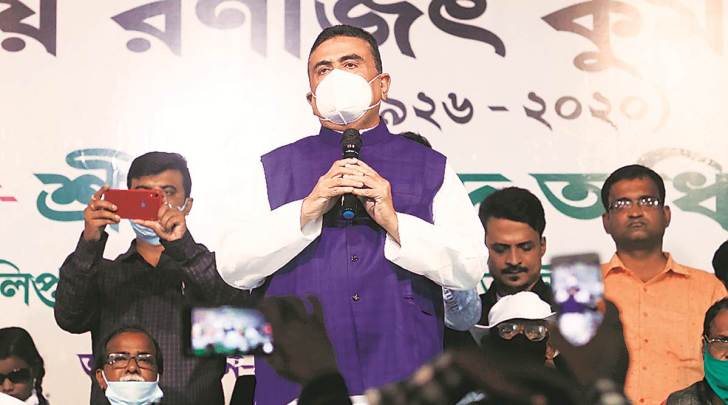 Suvendu Adhikari at a rally on Sunday. (Express Photo: Partha Paul)
Sisir’s son Suvendu, 49, showed his ability for political organisation early, first entering the West Bengal Assembly in 2006, and then winning the Tamluk Lok Sabha seat in 2009 and again in 2014. In 2016, he quit Parliament to become an important minister in Mamata’s government.
Suvendu’s younger brother Dibyendu Adhikari, 43, won Assembly elections in 2009, 2011, and 2016 before winning the Lok Sabha by-election for the seat vacated by Suvendu. Dibyendu was re-elected MP from Tamluk in 2019. 📣 Follow Express Explained on Telegram
A third brother, Soumendu Adhikari, is currently chairman of the Kanthi Municipal Corporation.
Nandigram and after
Suvendu’s rise began after Mamata’s Nandigram movement in Purba Medinipur in 2007, which he closely coordinated on the ground. The Nandigram agitation played a powerful role in ending the Left Front’s 34-year-rule in the Assembly election of 2011. Mamata was impressed, and over the years that followed, she gave respect and importance to Suvendu and his family, and rewarded them for their dedication to the TMC.
Also in Explained | The importance of Suvendu Adhikari – to TMC and BJP
Suvendu rapidly strengthened the organisation of the party and increased his own clout beyond Purba Medinipur. He came to have significant influence in the three districts of Jangalmahal — Bankura, Purulia, and Paschim Medinipur — apart from his home turf of Purba Medinipur. These four districts together have nine Lok Sabha and 63 Assembly seats, and Suvendu is believed to be in a position to influence election outcomes in 20-30 of them.
Mamata entrusted Suvendu with the responsibility of being the TMC’s observer in many parts of the state, primarily in Jangalmahal, Malda, and Murshidabad. He is influential in the party’s organisation in South Bengal, especially in the Haldia port area, and among the trade unions in the Haldia industrial area.
Don’t forget to read this story | ‘No one came to Nandigram’: TMC outreach fails to cut ice with minister
Points of friction
His strong political base in Purba Medinipur and Paschim Medinipur meant Suvendu was not dependent on Mamata’s popularity and charisma for votes in the same way that many other TMC leaders were.
When Mukul Roy was number 2 in the TMC, he tried to curb Suvendu’s influence by putting his loyalists in organisational posts in Purba and Paschim Medinipur. After Mukul – who switched to the BJP in 2017 – Suvendu had friction with Abhishek Banerjee, Mamata’s nephew, whom the Chief Minister promoted. As a young mass leader with proven capabilities, Suvendu expected to be recognised as the most influential person in the party after Mamata herself. Abhishek’s rise to a position where he has come to virtually run the party with the help of political analyst Prashant Kishor, was interpreted by Suvendu – whom the TMC leadership has always treated as a leader of just Purba Medinipur – as signal that his political ambitions would not be realised. He has in recent months also faced a series of attacks from party leaders such as state Urban Develpment Firhad Hakim and Chief Whip in Lok Sabha Kalyan Banerjee.
Also Read | BJP and TMC spar over Suvendu Adhikari, Congress chimes in
By dissociating himself from the TMC especially over the past four months, Suvendu has sought to demonstrate his individual influence and popularity outside the party banner. His resignation from the ministry was a statement of intent to his party – as also a signal to the BJP that he was available for negotiations.
Should Suvendu ultimately leave, many others could follow. There are at least two ministers and a number of MLAs who are sitting on the fence – and some of them have publicly expressed their unhappiness. Some in the TMC believe the party’s cadre base could split down the middle, with a large section shifting its loyalty from Didi to “Dada”.
There are others, however, who are not convinced that Mamata is quite that vulnerable – for all of his organisational strength and popularity, Suvendu cannot actually match up to the Chief Minister, and the situation could change rapidly once she begins to campaign, this section believes.