5 min read

© IE Online Media Services Pvt Ltd



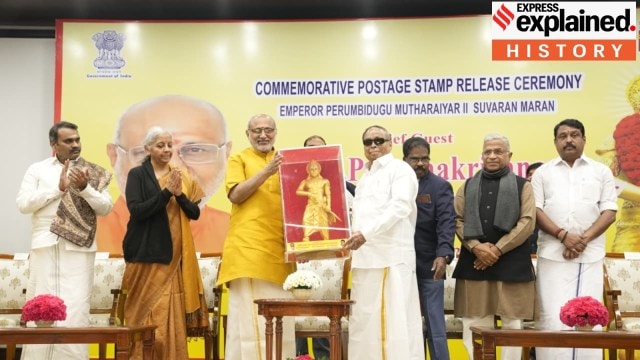 Vice-President C P Radhakrishnan, Finance minister Nirmala Sitharaman and others as a commemorative postage stamp to honour Perumbidugu Mutharaiyar II is released at the Vice-President’s Enclave, New Delhi, on December 14. (Photo: X/@CPR_VP)
Perumbidugu Mutharaiyar Stamp: A commemorative postage stamp in honour of the king Perumbidugu Mutharaiyar II (Suvaran Maran) was released by Vice President C P Radhakrishnan on Sunday.
Commenting on this, Prime Minister Narendra Modi posted on X that Suvaran Maran “was a formidable administrator blessed with remarkable vision, foresight and strategic brilliance… I call upon more youngsters to read about his extraordinary life.”
Here are three things to know about Perumbidugu Mutharaiyar II and why a stamp to commemorate him has been released now.
According to historical records, Perumbidugu Mutharaiyar (705 AD-745 AD), also known as Suvaran Maran, was a ruler of the Mutharaiyar lineage, feudatories of the Pallavas. As the Pallavas’ rule weakened, many such chiefs earned more power and prominence and were treated as rulers in their own right. Perumbidugu Mutharaiyar is believed to have fought bravely in several battles alongside the Pallava king Nandivarman, and is remembered as a great administrator.
The Mutharaiyars held sway over areas including Thanjavur, Pudukkottai, Perambalur, Tiruchirappalli, and others near the Cauvery river.
The Pallava reign saw a religious revivalism of Hinduism amid the dominance of Jainism and Buddhism. As their feudatories, the Mutharaiyars were great temple builders.
Suvaran Maran was also known as Shatrubhayankar. He seems to have patronised Shaivya and other scholars, as a Jain monk Vimalachandra is mentioned as visiting his court to debate them.
Historian DG Mahajan writes in a paper (‘Ancient Dravidian Jain Heritage’) included in Proceedings of the Indian History Congress, Vol. 19 (1956), that “Jain Ächärya Vimalachandra, who belonged to the Sravanbelgolā in Mysore State congregation, visited the court of Shatrubhayankar identified with Suvaran Maran, also called Perumbidugu Muttarayar, who as a vassal of the Pallavas, ruled over the parts of the modern Tanjore and Trichinopolly districts and the Pudukkottai old State — the ancient Thondāimandalam, where he challenged the Saivas, Pāsupatās Buddhists, Ķāpalikas.”
A 1975 volume called Studies in Indian Temple Architecture, edited by University of Chicago professor Pramod Chandra, has a chapter on ‘Early Pāndya, Muttarayar and Irukkuveļ Architecture’, written by KV Soundara Rajan. Crediting the Muttarayars with influencing the architecture of the Cholas, the chapter says, “The Muttarayars ruled almost from the time of Parameśvaravarman I [of the Pallava dynasty, ruled from 670 – 695 CE], as seen from the fact that the three early kings given in the Sendalai genealogy appropriated the titles videlvidugu, mārppidugu, etc. of their corresponding Pallava contemporaries.”
Soundara Rajan also writes that the Muttarayars were “engaged in cave temple enterprises up to the opening decades of the ninth century, and (in some stray examples) even up to the middle of that century”.
“They initially appear to have confined themselves to a structural ground tala and a stucco šikhara, or to cave temples with added structural mandapas. But they later erected complicated stone temples, well before the advent of the Vijayālaya line of the Cholas,” the author says.
It is Vijayālaya Chola who is believed to have defeated the Muttarayars by capturing Thanjavur.
Radhakrishnan said the release of the stamp was part of the Centre’s ongoing process of recognising and honouring Tamil kings and leaders. In a post on X, he said “recognising unsung heroes is essential to revive the cultural pride of the nation as India marches towards Viksit Bharat.”
Perumbidugu Mutharaiyar, however, has long been a part of Tamil Nadu politics. In fact, in November, the DMK government in the state had requested the Centre to release such a stamp, an old demand, with the state Minister for Backward Classes Welfare Siva V Meiyanathan writing to the Union Parliamentary Affairs and Minority Welfare Kiren Rijiju. In May, his 1,350th birth anniversary was observed across the political divide in Tamil Nadu.
In 2022, DMK youth wing secretary and son of CM MK Stalin, Udhayanidhi Stalin, unveiled a life-size statue of Perumbidugu Mutharaiyar in Madurai district. The AIADMK has also courted the king. The Mutharaiyar community is influential in central Tamil Nadu and hails Suvaran Maran as its icon.
For the BJP, honouring Suvaran Maran is in line with its efforts to highlight powerful figures from pre-Islamic India. It also helps the BJP counter the Dravidian parties’ seeming monopoly on the Tamil pride sentiment. The fact that Mutharaiyars are listed as Most Backward ties in with another strand of the BJP’s politics, of honouring historical heroes of SC/ST and OBC communities, like Maharaja Suheldev in UP.
The Vice-President said that Mutharaiyar was “among the most renowned rulers of ancient Tamil Nadu and belonged to the illustrious Mutharaiyar dynasty, which ruled the central regions of Tamil Nadu between the 7th and 9th centuries CE. He noted that the Emperor ruled from Tiruchirappalli for nearly four decades and that his reign was marked by administrative stability, territorial expansion, cultural patronage, and military prowess,” an official press release said.
Radhakrishnan also said that “inscriptions found across several locations in Tamil Nadu bear testimony to the Emperor’s contributions to temple endowments, irrigation works, and Tamil literature.”