6 min read
© The Indian Express Pvt Ltd



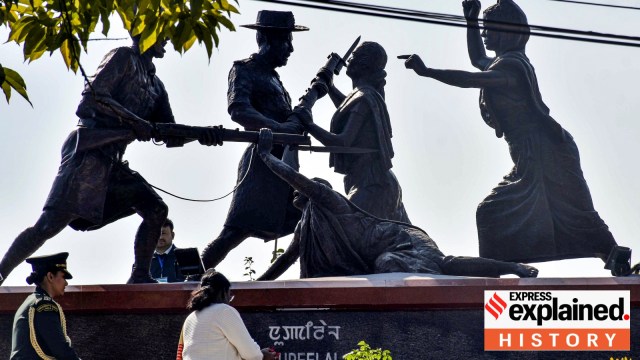 President Droupadi Murmu pays tribute at the Nupi Lan Memorial Complex on the occasion of the 86th Nupi Lan Day, in Imphal on Friday. PTI
President Droupadi Murmu Friday paid tributes at a memorial in Manipur’s Imphal on the occasion of the 86th Nupi Lan Day.
Nupi Lan, literally ‘Women’s War’ in the Meitei language, refers to two women-led movements against British colonial policies, the first in 1908 and the second in 1939.
While Nupi Lan Day is associated with both uprisings, it is observed on the day the second movement broke out, December 12.
The second movement started as an agitation by Manipuri women against the economic policies of the Maharaja and exploitation by Marwari businessmen under British rule. It then transformed into a movement for constitutional and administrative reform in Manipur.
“…It prepared the ground for… the emergence of a new Manipur after the end of the Second World War,” wrote historian Sanamani Yambem in an article in the Economic and Political Weekly in 1976.
Here’s a brief history of the second Nupi Lan.
Manipuris, Marwaris and the politics of rice
Although Manipuri people are rice-eaters, only the fertile Imphal valley is fit for cultivating paddy. In pre-colonial times, this was not a problem. Almost all of the rice produced in Manipur would be consumed by its people.
But the British annexation of the kingdom in 1891 led to large-scale rice exports, often leading to scarcity and price rise in the valley. When motor vehicles replaced bullock carts in the early 20th century, exports picked up, fuelled in part by the insatiable appetite of the British bureaucracy and military posted in the Northeastern frontier.
Much of this trade was captured by Marwari businessmen, who had entered Manipur with the British. In the 1930s, they were given a monopoly over the Cart Tax, a levy on rice exported — Marwari businessmen would collect tax from cultivators at rates far beyond what they paid to the Maharaja. Resentment against rice exports grew.
“The area under rice cultivation in Manipur between 1921 and 1939 increased by merely 18,838 acres, while the volume of rice exported increased by 2,92,174 maunds (roughly 37 kg). Rice export… reached an all-time record of 3,72,174 maunds in 1938…,” Yambem wrote in ‘Nupi Lan: Manipur Womens Agitation, 1939’.
A bad harvest & an unsympathetic Maharaja
Excessive rain in July-August 1939 seriously damaged the early paddy crop in Manipur. Hail storms in November damaged the late crop. With record exports the previous year, Manipur had next to no buffer stock to fall back on.
While many in the Maharaja’s administration pushed to ban rice exports that year, the British political agent was less sympathetic, in part due to the need to feed the burgeoning British Indian forces in the Northeast after World War II broke out. Eventually, Maharaja Churachandra Singh caved in to pressure from Marwari businessmen and the British political agent. After a brief 40-day ban, exports resumed on November 21.
This was the final straw for a population that had grown increasingly resentful to the Maharaja’s economic policies and the wanton exploitation by Marwari businessmen. As scarcity became rampant and the price of rice skyrocketed, a famine-like situation began to emerge in the Valley. Then a massive popular agitation broke out.
A mass movement led by women
Women have always been integral to Manipur’s agrarian economy. Notably, they are responsible for selling rice (and other products) at local bazars. As rice became scarce, with available stocks lapped up by “outsiders”, women’s livelihoods were directly affected.
On December 11, some 50 to 60 women retailers arrived at Imphal’s historic Khwairamband Bazar (popularly known today as the Ima Market or “Mother’s Market”); they found no rice to buy, and thus, had none to sell. They decided to launch an agitation the next day. Word spread, and the protest ballooned.
On December 12, thousands of women began gathering around the administration’s office, calling for an immediate halt to rice exports. They would capture T A Sharpe, a British official, and confine him and some other bureaucrats to the telegraph office.
The administration decided to resort to force. A company of Assam Rifles was sent to free the imprisoned officials. But this only turned the thousands of protestors more militant. Chants of “Vande Mataram” echoed as clashes broke out between women protestors and British troops.
Although rice exports were banned on December 14, the Nupi Lan spawned militant political consciousness in Manipuri society. Women boycotted the Khwairamband Bazar for more than a year, turning their focus on exploitative Marwari merchants. But learning from its past mistakes, the administration treaded with caution when it came to dealing with agitating women.
Christopher Gimson, then the Political Agent, wrote: “Economic distress or political excitement may lead the women of Manipur to take up other forms of agitations (compared to a boycott), as they had done in the past” (as cited by Yambem).
Laying the foundation for new Manipur
Since 1891, the British ruled Manipur through a Political Agent, who held tremendous sway over the Maharaja. The people had come to resent this system: a simmering agitation for administrative and constitutional reforms began in 1938.
But it was the Nupi Lan which brought things to a head: from initially agitating to end rice exports, protesters would eventually make ambitious demands for the complete overhaul of the administrative setup.
The impending Japanese invasion put everything else, including the women’s agitation, on the backburner by late 1941, but the foundation for a new post-War, post-Independence Manipur had been laid; and, as Yambem wrote, “it was the women of Manipur who were in the vanguard of change”.