3 min read

Journalism of Courage



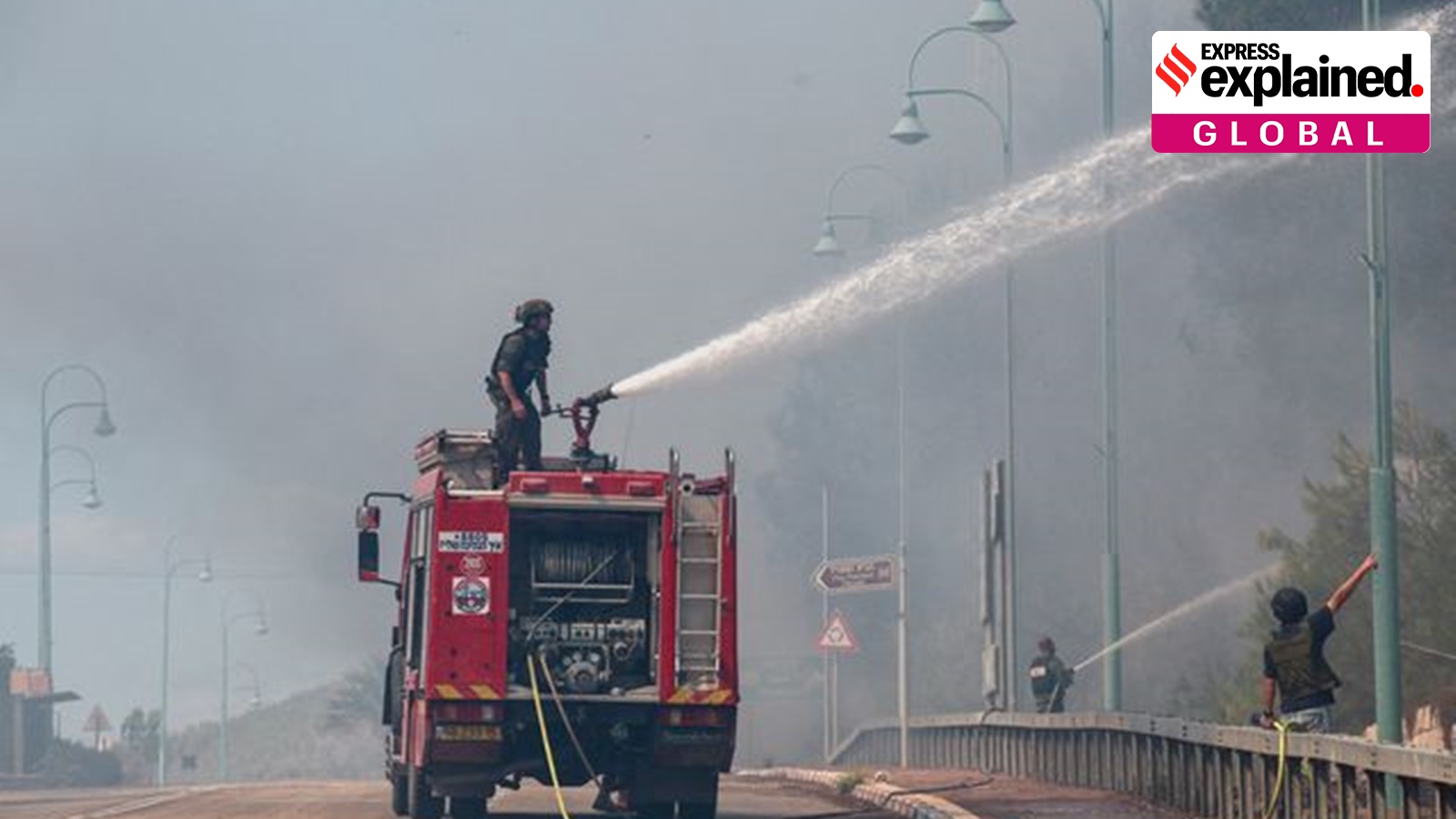 Water is sprayed from a fire truck, amid ongoing hostilities between Hezbollah and Israel, near Shlomi, northern Israel, October 19, 2024. (REUTERS/Gonzalo Fuentes)
Israeli Prime Minister Benjamin Netanyahu said “Iran’s proxy Hezbollah” had attempted to “assassinate” him and his wife on Saturday, after a drone was fired towards his home in the town of Caesarea on Saturday.
While there were no casualties, the incident once again highlights Israel’s vulnerability to drones, despite having a highly advanced air defence system.
Last week, when a Hezbollah drone strike on an army base in northern Israel killed four soldiers, the New York Times had explained why it is difficult for the Iron Dome, David’s Sling, Arrow, and other layers of Israel’s air defence to intercept drones. Here’s the explainer, written by Patrick Kingsley and Gabby Sobelman:
While Israel has a world-leading system to detect and intercept missiles, which can travel faster than 1,000 mph, its radar systems have found it more challenging to spot unmanned aircraft, which sometimes move slower than 100 mph.
Drones often contain less metal and emit less heat than high-velocity rockets and shells, meaning that they do not always set off alerts. And even when they are spotted, enemy drones are sometimes mistaken for Israeli aircraft, including small private planes, because they fly at similarly low altitudes and speeds.
“All the systems that we have in the Western world — it’s not only Israel — are built to defend or to protect the airspace from regular fighter planes and missiles,” said Ofer Haruvi, a former head of the drone department in the Israeli air force. “You need to redesign part of these systems so that they can see and detect and track this kind of slow-moving target.”
Israel’s Iron Dome anti-rocket system destroys the vast majority of rockets fired from the Gaza Strip and Lebanon, while its Arrow 3 interceptors were instrumental in largely blocking two massive barrages of ballistic missiles fired by Iran in April and again this month. To enhance those defenses, the United States said Sunday that it would send Israel another antimissile system, the Terminal High Altitude Area Defense system, or THAAD.
But Israel’s anti-drone system in particular requires improvement, experts said.
It relies mainly on radar, which is primarily designed to detect relatively large metallic objects like planes by transmitting a signal and receiving the signal’s reflected echo, according to Onn Fenig, the head of R2 Wireless, a company that designs drone detection systems and works with the Israeli military.
He said there are alternatives, including receptors that passively detect and classify the radio waves emitted by a drone, optical sensors that scan the skies for visual signs of a drone and acoustic sensors that detect the sound of a drone’s engine.
All these systems have advantages and blind spots, and Israel needs to combine them in order to build a more robust drone detection system, Fenig said.
“There’s no magic solution that, if implemented, would solve all your problems,” he said. “But we need a complete change in mindset.”