7 min read


© The Indian Express Pvt Ltd



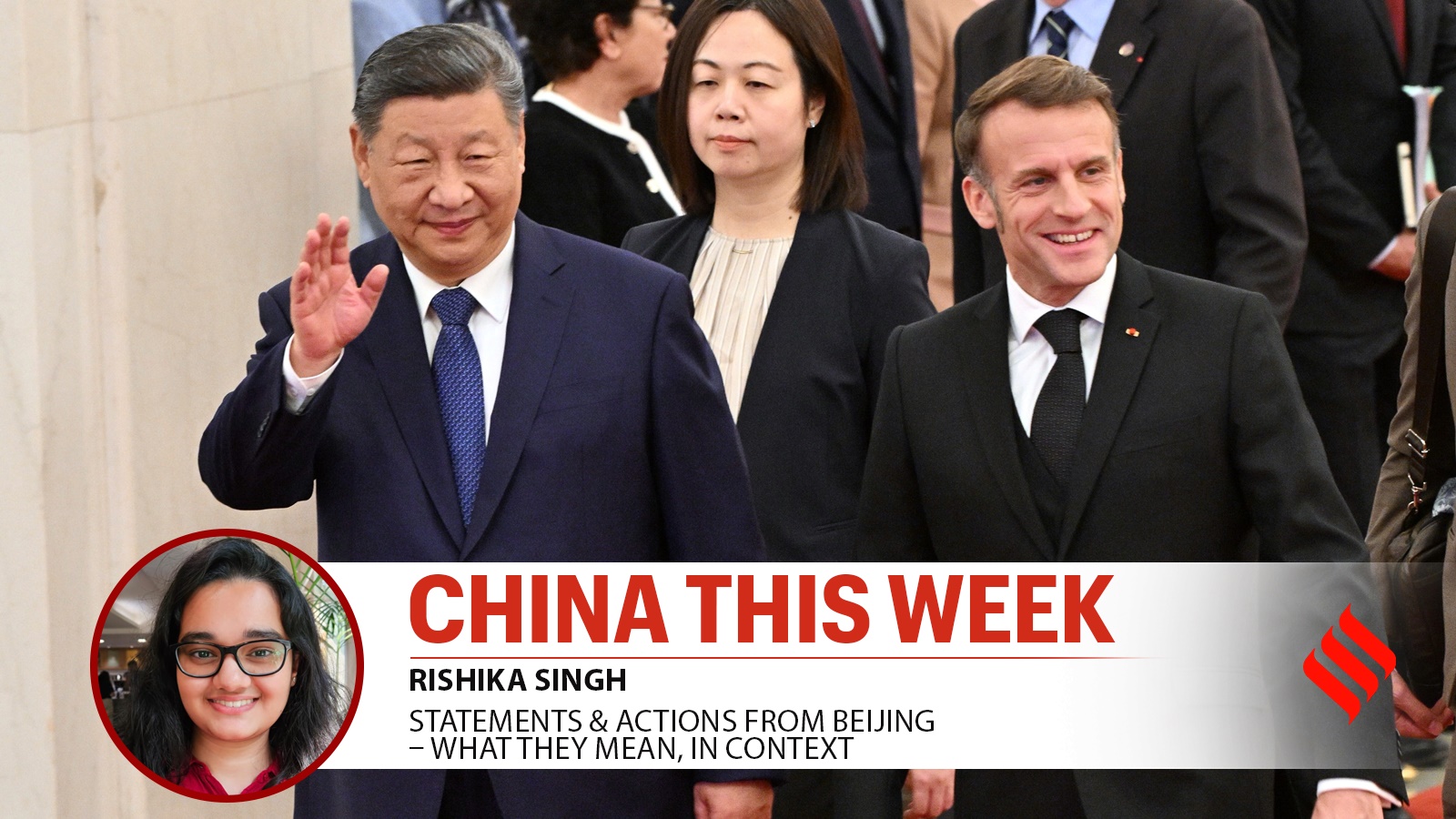 France's President Emmanuel Macron, right, and China's President Xi Jinping, left, walk during a state visit at the Great Hall of the People in Beijing Thursday, Dec. 4, 2025. (Adek Berry/Pool Photo via AP)
French President Emmanuel Macron visited China from December 3 to 5, thanking Chinese President Xi Jinping for the “warm welcome” he received. However, their joint statements lacked major new commitments, likely due to persistent disagreements over trade and diplomacy. These issues have also impacted the wider China-Europe ties of late.
Next, China’s Special Administrative Region, Hong Kong, saw elections for the Legislative Council. It comes soon after a fire incident — the worst in decades for the city — caused over 159 deaths in November. As of Sunday evening (December 7), the turnout stood at a low 30%, caused by some public anger over the incident, as well as several China-led institutional changes.
Finally, amid the ongoing Japan-China tussle and recent geopolitical tensions that we mentioned last week, the upcoming anniversary of an important historical date has gained newfound significance. On December 13, 1937, China witnessed one of its worst modern atrocities at the hands of Japan, in what is known as the Nanjing Massacre. The countries’ recent issues also have a historical backdrop, and perhaps in anticipation, the Japanese embassy in China issued a safety advisory.
Here is a closer look at these developments:
The two leaders discussed several issues during the visit, ranging from global politics to nuclear energy cooperation. An official statement said they reaffirmed the commitment to “promoting the safe development of nuclear energy and strengthening collaboration across the nuclear energy industry chain”.
On global issues, they pledged support for the two-state solution for the Israel-Palestine conflict. Macron urged Xi’s aid in ending the Ukraine War, and while Xi did not directly make a commitment, he said, “China supports all efforts that work towards peace”.
UPSHOT: In July, a major summit marking 50 years of China-European Union relations was held in Beijing. It was planned months in advance, but just a few weeks before the event, it was learnt that it had been curtailed from two days to one. That was said to be indicative of the low expectations from the event.
European Commission chief Ursula von der Leyen even said in Beijing that the ties had reached an “inflection point”, and there was a dire need to rebalance trade, which currently skews heavily in China’s favour. According to an Associated Press report, China alone represents 46% of France’s total trade deficit. Macron reiterated those concerns, inviting Chinese investments into France.
Despite the many areas of cooperation emerging between the countries, such as on green economy, climate change and the Gaza conflict, trade and China’s deepening ties with Russia have prevented a natural realignment. Thus, even as attempts are being made from both sides (Xi visited France last year), in the absence of key policy changes, there are several limitations to closer alignments.
Hong Kong residents voted for elections to the top legislative body in the city on Sunday, with turnout at around 30.4%, according to the South China Morning Post. It said the figure “surpasses the 30.2 per cent cumulative turnout rate in the 2021 election (the lowest ever turnout), but remains below the 52.57 per cent recorded in 2016 at the same time”.
UPSHOT: Two reasons have been cited for the low numbers. First is a sense of grief and public anger after last month’s deadly fire in a residential complex.
The use of substandard construction material has been blamed for the quick spread of the blaze, even as the government has ordered the foreign media in Hong Kong not to spread “false information” or “smear” government efforts, according to Reuters. In a city where such a scale of deaths and lapses is rare, the incident has continued to resonate.
The second factor is the longer-term changes that the Chinese government has made to Hong Kong’s governance and politics. In the 19th century, Hong Kong was taken over by the British on a lease from China. Even when they transferred the city to the Chinese government in 1997, it was decided that it must retain its liberal, capitalist system until the next 50 years, or 2047.
In recent years, however, Hong Kongers have frequently protested against rules from the mainland that seek to assert greater control. Large-scale protests were held in 2019 against an extradition law, which was seen as potentially targeting critics of the government. While the government attempted to put down the protests, the rules were eventually withdrawn.
However, subsequent rules in the post-Covid era further curbed the freedoms once guaranteed to the financial hub. The number of seats that were directly elected to the Legislative Council was reduced, and the government said only “patriots” would pass the screening to be eligible to run for office. Subsequently, the government also cracked down heavily on the young people who led the 2019 agitation. As a result, over time, participation in the electoral process has declined.
The Japanese embassy has released an advisory ahead of the Nanjing Massacre anniversary. “Anti-Japanese sentiment tends to rise on days related to historical issues between Japan and China, and special caution is required in light of recent local reporting on Japan-China relations,” it said. It asked people to refrain from having identifiers, such as clothing, related to their Japanese identity for some days.
UPSHOT: The recent exchange of words between Chinese and Japanese leaders concerns Japanese Prime Minister Sanae Takaichi’s recent comments and how China reacted to them. She said that Japan would defend itself if China were to launch a military campaign over Taiwan, given the increasingly assertive Chinese claims on the island. One Chinese official responded with a threat of violence towards her in an online post, saying they should “cut off that dirty neck”.
Apart from the geopolitical rivalries at play, there is also a bloody history that has added to the intensity of such comments. Until its loss in World War 2 in 1945, Japan was a dominant imperialist power that launched attacks on several Asian countries, including China.
Within a few weeks, through December 1937 and January 1938, the Japanese Army is said to have killed somewhere between 100,000 and 300,000 Chinese people in and around the eastern city of Nanjing. Japanese commander Matsui Iwane was ultimately tried by the International Military Tribunal for the Far East (IMTFE) after WW2 for his role in ordering the killings, and was sentenced to death.
Such incidents have been revived time and again by nationalist groups in both countries. While China has repeatedly demanded official apologies from Japan amid its own rise in world politics, Japan has at times questioned the severity of historical events and attempted to downplay them.