5 min read


© The Indian Express Pvt Ltd



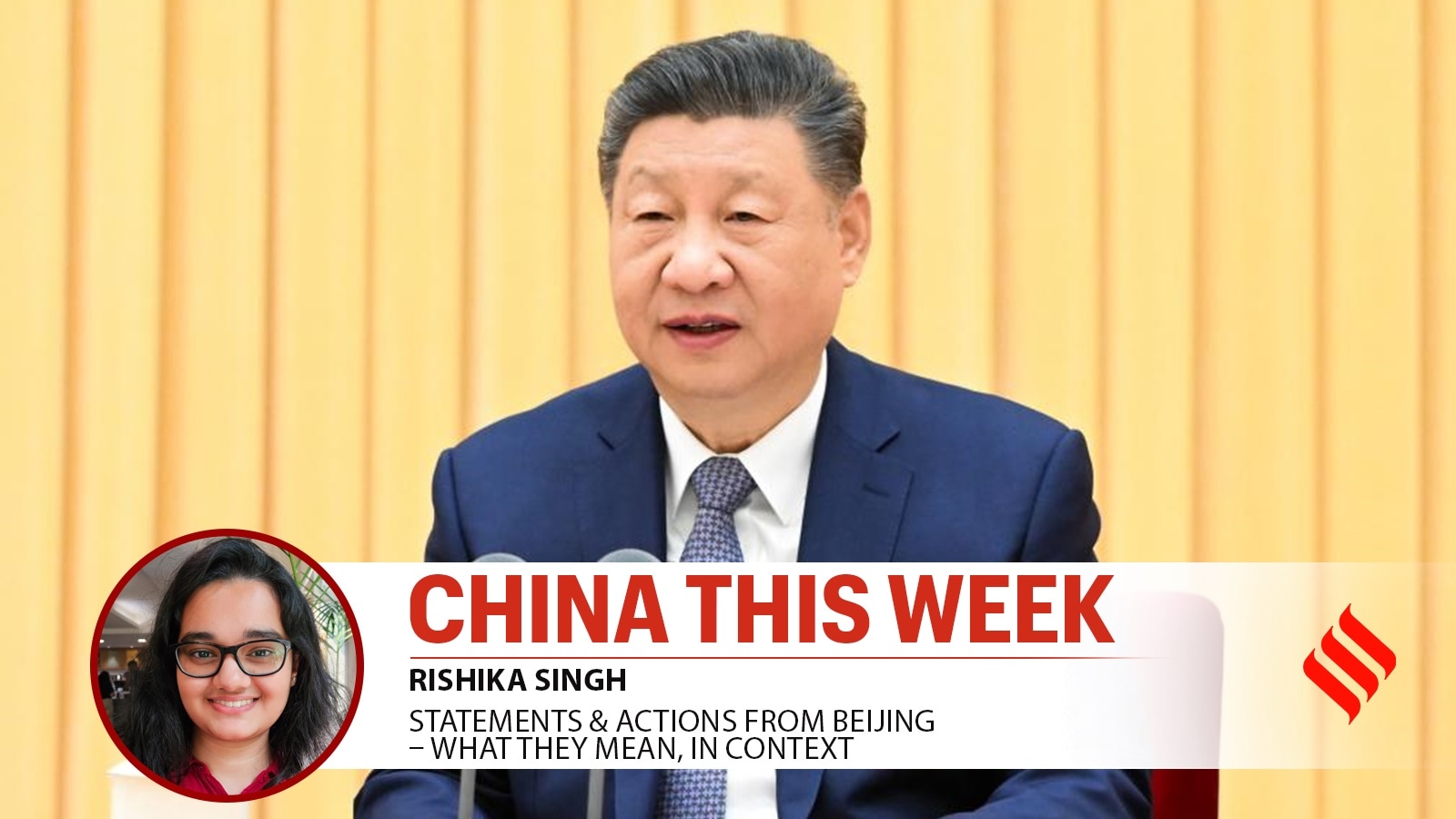 Chinese President Xi Jinping at the Central Economic Work Conference this week. (X/PDChina)
Last week saw three important events on the economic front in China — the country hitting a $1 trillion trade surplus in 2025, data showing investment falling for the third straight month in November, and an important official meeting on the outlook for the coming year.
All of them point to the familiar successes, problems and trends that have come to be associated with the Chinese economy. By virtue of its sheer size and deep linkages, any major development impacts the rest of the world, too.
Here is a closer look:
We wrote about the trade milestone — something no other country has achieved in just one year — earlier in the week. Here, Lizzi C Lee, an analyst of the Chinese economy, discussed what the number means. While the gigantic figures may seem objectively impressive at first glance, she noted that the surplus has grown “partly because production capacity kept expanding, while consumption and investment at home lagged. It is as much a sign of imbalance as it is of strength.”
Apart from the longstanding concerns about low domestic demand within China, it is indicative of the country’s tendency to produce goods cheaply at a large scale, to the point that many producers are now hurting from constantly lowering prices to compete in the market. This state of overcapacity and “involution” is something that policymakers have also cautioned against.
Finally, the huge amount of Chinese exports comes amid countries increasingly and loudly criticising China for flooding their markets. It has raised fears of another “China Shock”, or job losses, in the face of cheap Chinese goods possibly dealing a blow to their domestic industries.
Reflecting the trend seen in the third quarter GDP data this year (July to September), the first 11 months of 2025 saw investment in fixed assets (excluding rural households) fall by 2.6% year on year. In particular, the investment in infrastructure declined by 1.1%, that in manufacturing grew by 1.9%, and that in real estate development declined by 15.9%.
The fall in investment has been attributed, among other things, to a loss of trust in the economy among the private sector in recent years, owing to abrupt policy changes and a lack of consistency. Then there is the continued slowdown in the property sector, which was overleveraged and thus became the focus of government regulations over the last few years. Home prices are still falling, and that matters in a country where real estate was a major recipient of household investment.
Additionally, the government has sought to reallocate investment away from certain sectors in a bid to curb overcapacity. According to the Financial Times, analysts at Goldman Sachs estimated that about 60% of the fall in fixed-asset investment stemmed from “a statistical correction of previously over-reported data”. But even a lower share nevertheless points to a concerning amount of investment reduction.
Interestingly, the International Monetary Fund (IMF) also had a diagnosis and prescription in its review of the Chinese economy this week.
It said, “The key policy priority is to transition to a consumption-led growth model, which is one of the government’s stated objectives in the 15th Five-Year Plan. In [IMF] staff’s view, this transition requires more urgent and forceful expansionary macroeconomic policies, reforms to reduce elevated household savings, and a scaling back of inefficient investment and unwarranted industrial policy support. Such a policy package will also reduce external imbalances.”
The annual Central Economic Work Conference (CEWC) was held this week. The meeting sets China’s economic priorities for the coming year, while noting the current state of the economy. Chinese President Xi Jinping and Premier Li Qiang both made speeches on the occasion. Other senior Communist Party leaders, such as Zhao Leji and Cai Qi, were also in attendance.
Eight key areas were identified, the first being “prioritising domestic demand and building a strong domestic market.” The meeting also discussed addressing “involutionary” competition in the quest for high-quality development and the deepening and expansion of artificial intelligence, including in governance.
According to a report in the South China Morning Post, Xi said, “It has been proven in practice that efforts to choke China cannot succeed.” He added that China’s responses amid a precarious global trade situation, with tariffs and other policy shifts, showed its “moral backbone and strength” and had “won the respect of the international community”.
At the same time, he acknowledged concerns: “The meeting pointed out that my country’s economic development still faces many old problems and new challenges, the impact of changes in the external environment is deepening, the contradiction between strong supply and weak demand is prominent, and there are many risks and hidden dangers in key areas.”