Premium
This is an archive article published on October 21, 2023

Who are the Bedouin Arabs in the Israeli army?

A popular video on social media shows local Israelis expressing their gratitude to a Bedouin commander named Ashraf for putting up an effective defence against Hamas fighters. What is the relationship of these nomadic people with the Jewish state?

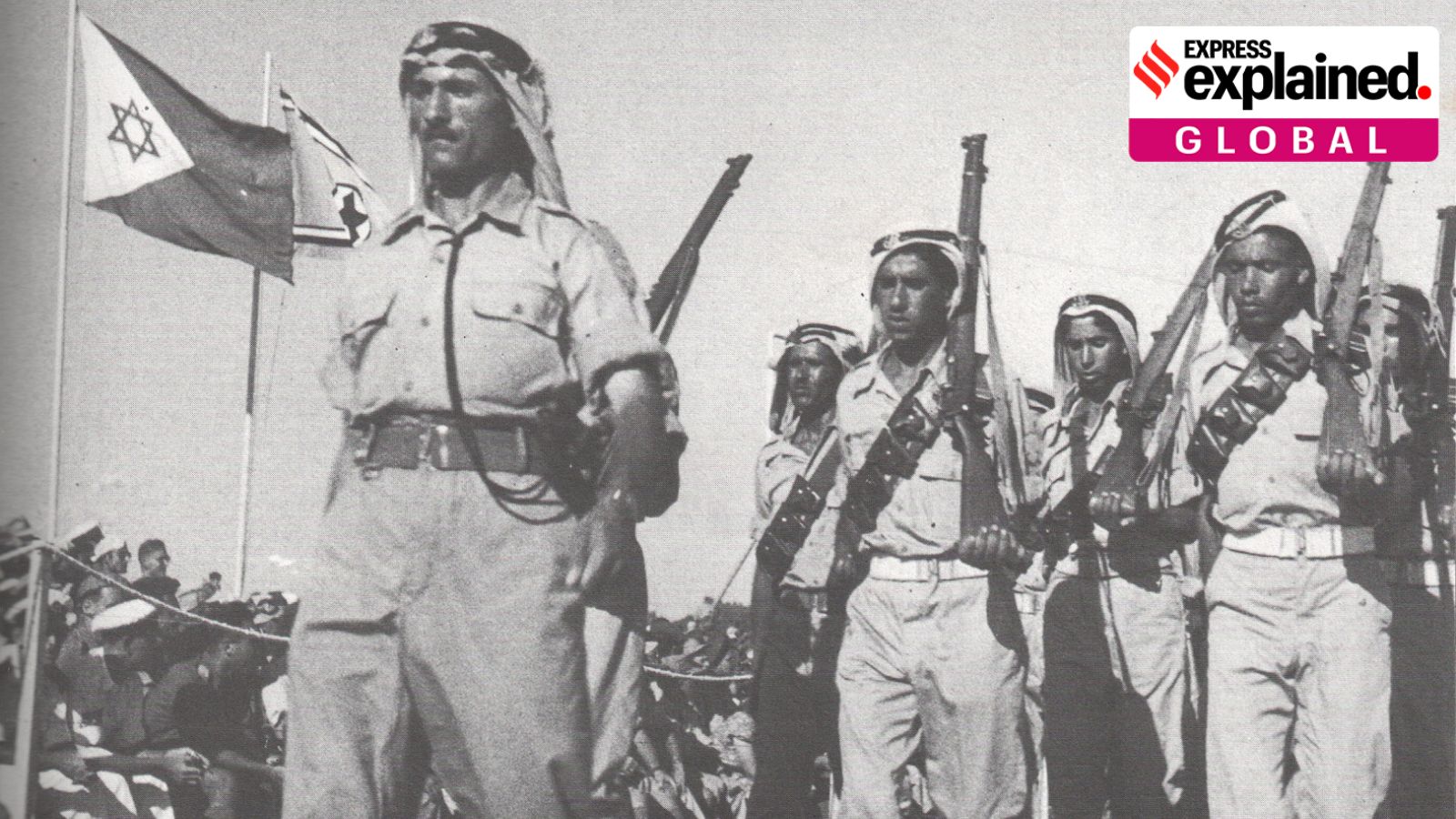
BedouinBedouin IDF soldiers of Rumat al-Heib during a military parade in Tel-Aviv in June 1949. (Wikimedia Commons)
Listen to this article
Who are the Bedouin Arabs in the Israeli army?
x
00:00
1x 1.5x 1.8x

Among the casualties on the Israeli side since the October 7 Hamas assault plunged Israel and Gaza into a vortex of violence, are at least four Bedouin soldiers. A popular video on social media shows local Israelis expressing their gratitude to a Bedouin commander named Ashraf for putting up an effective defence against Hamas fighters.

The Bedouins are a nomadic Muslim Arab people who live mainly in the Negev desert of southern Israel. They have traditionally been pastoralists with no powerful or exclusive national affiliation, who would, until about a century and a half ago, wander the area between Saudi Arabia and the Sinai with their livestock.

How did the Bedouins come to join the Israel Defence Forces (IDF)?

During the last several decades of Ottoman rule, the Bedouin began to settle into a largely sedentary life. Before the formation of Israel, groups of Bedouin were employed by early Jewish settlers to guard clusters of their communities in Palestine. During the Arab-Israeli war of 1948-49, many Bedouin provided valuable intelligence to the Jewish militias and the newly formed IDF, and some of them also fought against the Arab armies alongside the Jews.

In the 1950s, Israel recognised a large number of Bedouin as its citizens, and subsequently helped build settlements for them in the Negev. Many Bedouin continued to serve in the IDF, primarily in scouting or tracking units. In 1970, a Bedouin scouting unit was established in the IDF’s Southern Command, and similar units have since been established in other areas. In 1986, a desert-scouting unit was formed, and stationed near the Gaza Strip.

In 2003, the IDF created several specialised search and rescue units of mainly Bedouin to serve in the border areas.

In 1993, Israel inaugurated a memorial to Bedouin warriors on a hilltop in Galilee, bearing the names of 154 Bedouin soldiers who lost their lives in the service of the country. The Garden of the Broken Heart is dedicated to Bedouin soldiers whose burial places remain unknown.

Is it compulsory for the Bedouin to train with the IDF?

No. Army training is compulsory only for the Jewish population of Israel. However, many Bedouin youth also volunteer. Many of the IDF’s Bedouin soldiers come from families with a tradition of joining the defence forces.

Story continues below this ad

In 2021, a record number of around 600 Bedouins voluntarily enlisted in the Israeli military. In a post from 2014, the IDF claimed on its Facebook page that “about 450 Bedouin men volunteer to serve in the IDF each year”.

To what extent are the Bedouin integrated in Israeli society?

Many of the Bedouin serving in desert reconnaissance units hail from the north of Israel. In communities like Shibli in the north, Bedouin have coexisted with Jewish and Arab communities since the 1950s.

One individual who underwent army conscription and now works with the Israeli civil services, told this reporter in an interview last year that training with the Israeli army helped him appreciate aspects of Jewish culture, even though he did struggle with the Hebrew language initially.

The Bedouin population in Israel currently numbers 210,000 individuals residing in various regions of the state, with a significant presence in the Negev desert in the South.

Story continues below this ad
For a primer on the conflict | A to Z of the Israel-Palestine conflict

In 2020, the Israeli foreign ministry appointed Ishmael Khaldi as Israel’s first Bedouin ambassador. The first Bedouin high-tech company in Israel, Sadel Technologies, was co-founded by Ibrahim Sana, a Bedouin, and his two partners.

In November 2022, the Israeli government launched Operation Negev Shield, one of the goals of which is to help Bedouin communities integrate into society through educational programmes aimed at steering young men away from criminal activity. Each week, IDF officers visit schools in various Bedouin communities to educate children.

(The reporter visited Israel at the invitation of the Israeli government in November 2022)

Manraj Grewal Sharma is a senior journalist and the Resident Editor of The Indian Express in Chandigarh, where she leads the newspaper’s coverage of north India’s most politically and institutionally significant regions. From Punjab and Haryana to Himachal Pradesh and the Union Territory of Chandigarh, she oversees reporting at the intersection of governance, law, politics and society. She also reports on the diaspora, especially in Canada and the US. With a career spanning journalism across several countries, academia and international development, Manraj brings a rare depth of perspective to regional reporting. She is widely regarded as a leading chronicler of Punjab’s contemporary history and socio-political evolution, particularly its long shadow of militancy, federal tensions and identity politics. Her book, Dreams after Darkness, remains a definitive account of the militancy years and their enduring aftermath. Professional Background & Expertise A gold medalist in mass communication and a post-graduate in English literature, Manraj has a multifaceted career spanning journalism, academia, and international development. She was also awarded a fellowship by National Foundation of India and did several in-depth pieces on Manipur. Internationally, she has reported from Israel, US, UK, Myanmar, and Mauritius Her key focus areas include: Regional Politics, History, Agriculture, Diaspora, and Security. Of late, she has started focusing on Legal & Judicial Affairs: Much of her recent work involves reporting on high-stakes cases in the Punjab and Haryana High Court, ranging from environmental policy to civil rights. International Consulting: She previously served as a consulting editor for the Asia Pacific Adaptation Network and a publishing consultant for the Asian Development Bank (ADB) in Manila. Academia: For five years, she was the managing editor of Gender, Technology and Development, a peer-reviewed international journal at the Asian Institute of Technology, Bangkok. Recent Notable Articles (Late 2025) Her recent reportage focuses heavily on judicial interventions and regional governance: 1. Environment & Governance "‘NGT can’t test legality of policy’: HC hears challenge to Punjab’s ‘Green Habitat’ plan" (Dec 22, 2025): Covering a critical legal battle over whether the National Green Tribunal has the authority to strike down a state policy regularizing farmhouses on delisted forest land. "High court pulls up Punjab poll panel over audio clip probe" (Dec 10, 2025): Reporting on judicial concerns regarding the transparency and fairness of local body elections. 2. Legal Rights & Social Welfare "HC issues notice to Punjab, Haryana over delay in building old age homes" (Dec 22, 2025): Reporting on a contempt petition against top officials for failing to establish government-run homes for the elderly as promised in 2019. "Victims can appeal acquittals in sessions court without seeking special leave" (Dec 19, 2025): Highlighting a significant procedural shift in criminal law following a Supreme Court ruling. "HC upholds benefits for Punjab FCI officer acquitted in 20-year-old bribery case" (Dec 19, 2025): A report on the concept of "honourable acquittal" and its impact on employee benefits. 3. Human Rights & Identity "As Punjab denies parole to MP Amritpal Singh, HC asks it to submit ‘foundational material’" (Dec 1, 2025): Covering the legal proceedings regarding the radical preacher and sitting MP's request to attend Parliament. "Protecting life paramount: HC backs Muslim woman in live-in after verbal divorce" (Nov 6, 2025): Analyzing judicial protections for personal liberty in the context of traditional practices. Signature Beats Manraj is recognized for her ability to decode complex judicial rulings and relate them to the everyday lives of citizens. Whether it is a 30-year-old land battle in Fazilka or the political implications of Kangana Ranaut’s candidacy in Mandi, her writing provides deep historical and regional context. Contact @grewal_sharma on X manrajgrewalsharma on Instagram ... Read More


 

Latest Comment
Post Comment
Read Comments
Advertisement
Loading Taboola...
Advertisement
Advertisement
Advertisement