5 min read

© The Indian Express Pvt Ltd



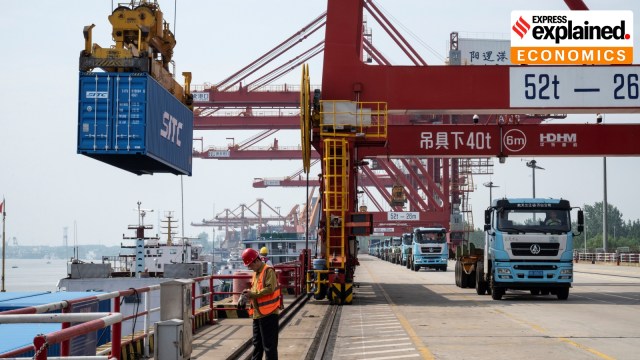 China’s Yangluo Port, a domestic and international freight harbour on the Yangtze River in Wuhan. (NYT)
US President Donald Trump’s tariff war seems to have had little effect on China’s export-driven economy with the country clocking a record $1-trillion trade surplus with the rest of the world in 2025.
The landmark is clearly a reaffirmation of China’s stranglehold over global merchandise trade and a stark reminder of the fact that while Trump’s tariffs may have thwarted shipments to the US, exports to South and Southeast Asia, Africa and Latin America have correspondingly spiked.
And the deluge may have only started, which some analysts say could be the beginning of a “second China shock”.
This could potentially lead to economic and social consequences in countries such as Indonesia, Thailand, Malaysia and India, as well as much of Africa and Southeast Asia. Europe, already bracing for the impact of Chinese electric vehicles and consumer electronics, is perhaps now stuck “between an ultra-competitive China and a protectionist America,” said Politico. Beijing’s trade surplus “is untenable,” French President Emmanuel Macron told the Les Echos financial newspaper.
There has been an evolving bipartisan consensus in Washington DC that China has gotten away with low-cost manufacturing for too long. This is more significant now than in earlier decades, when trade represented a much lower share of global goods production and consumption.
Weakening domestic demand, alongside export-facilitating policies in products, where China is the world’s dominant manufacturer, has led to prices collapsing globally and driving other national producers out of business. While the benefit of this has been a phase of sustained lower global inflation, China has simultaneously created a progressive stranglehold over global manufacturing: a level of manufacturing dominance by a single country seen only twice before in world history — by the UK at the start of the Industrial Revolution, and by the US just after World War II, according to research by the Rhodium Group and Noah Smith’s opinion article, Manufacturing is a war now.
What makes China’s dominance worse is the continuing weakness in domestic demand. That, too, comes from the problem of China’s unwillingness to vacate its earlier specialisation in low value-added manufactured products as it moved up the global value chain.
This has concomitantly led to a weakness in Chinese domestic demand for imported goods, which was expected to rise if China had ceded the manufacture of low value-added manufactured goods. So, more than Beijing’s export competitiveness, weak Chinese imports explain this continuing imbalance.
Trump had ostensibly set out to address this imbalance early into his second term. So, while many might not have agreed with Trump’s solution, it’s difficult to wish away the problem that he set out to address.
Responding to the Chinese trade surplus, the International Monetary Fund linked China’s rising exports and growing trade imbalances in part to “a real depreciation of the yuan”. In a carefully-worded note Wednesday, IMF officials said the country’s low inflation relative to price levels among its trading partners has led to a weaker yuan in real terms. They urged Chinese policymakers to adopt bolder stimulus to boost consumption, which would lift consumer prices, while allowing more exchange rate flexibility.
According to analysis by Brian Hart, Hugh Grant-Chapman and Leon Li of the non-profit thinktank Center for Strategic and International Studies (CSIS), China’s manufacturing boom has fuelled decades of export-oriented economic growth, undercutting foreign competitors and contributing to a growing appetite for tariffs in the US and Europe.
In the US and other developed economies, consumers have enjoyed cheaper products — but their manufacturers have struggled to compete. The subsequent political backlash has contributed to a growing appetite for tariffs and industrial policies, the CSIS study of January 2025 said.
In the face of these tensions, Chinese leader Xi Jinping has doubled down with calls for China to become a “manufacturing power” and dominate global markets for advanced high-tech goods such as EVs, high-end electronics and defence equipment.
This even as China continues to hold on to its share of traditional export items like garments while shifting some lower-end value chains to Vietnam and the Philippines.
The view in India’s policy circles has been that the China-led trade imbalances need to be corrected and that New Delhi is supportive of any global efforts towards that end. That was before Trump’s tariff onslaught ended up hitting India and Brazil the worst.
More recently, the concerns here have started to focus on a potential deluge of Chinese goods that were originally intended for the US and could end up in India and other countries, especially as New Delhi has started to dismantle some of its protectionist quality control barriers that it had progressively erected across product groups over the last 36 months. Chinese imports into India have surged in the first seven months of this fiscal, threatening to upend a steadily widening trade imbalance.