Premium
This is an archive article published on December 21, 2024

Why is the Indian rupee falling against the US dollar?

Like any other trade in life, the relative value of one currency against another depends on which is demanded more. If Indians demand more US dollar than Americans demand the Indian rupee, the exchange rate will tilt in favour of the US dollar

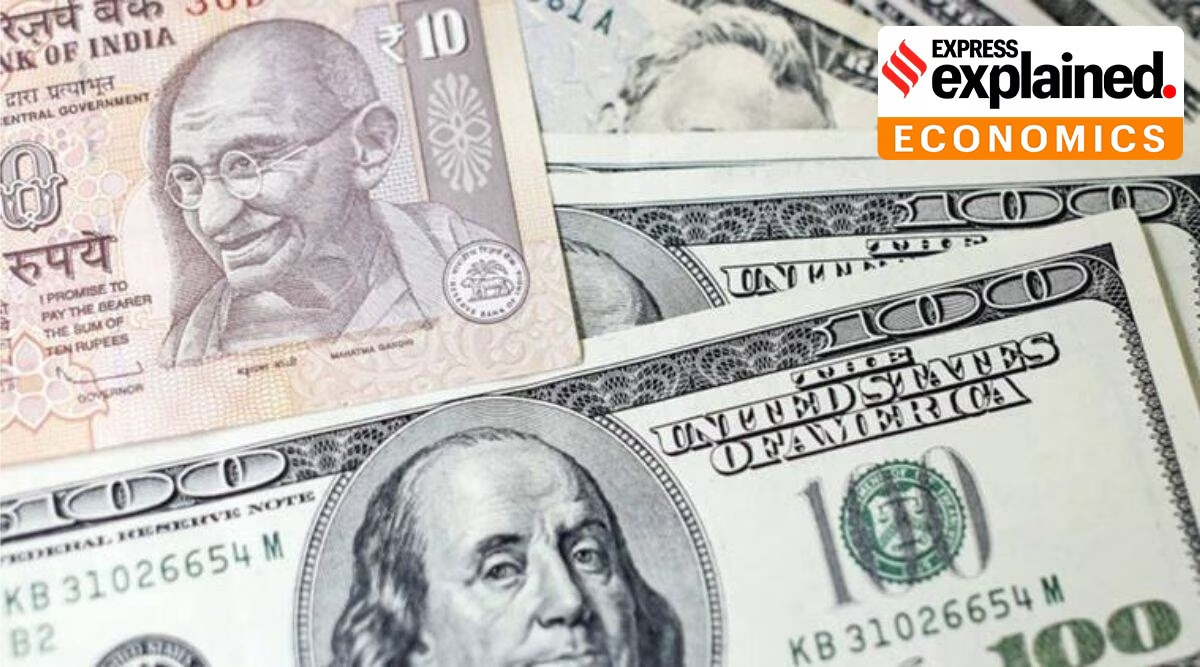
currency rateThe value of each currency relative to another currency is called the exchange rate. These values can stay the same over time but more often than not they keep changing. (File)

The Indian rupee’s exchange rate against the US dollar has breached the 85 mark. In other words, one would have to pay Rs 85 to buy $1. In April, this “exchange rate” was around 83 and a decade ago, when Prime Minister Narendra Modi took charge, it was around 61. As such, the rupee has been weakening in value relative to the dollar. To be sure, this is a long-term trend as CHART 1 shows.

currency Chart 1

What is the exchange rate?

Typically, we buy goods (such as a pizza or a car) and services (such as a haircut or a hotel stay in a hill station) using our money — the Indian rupee. But there are many things where we need things from outside the country — say an American-made car or Swiss vacation or indeed, crude oil. For all such goods and services we might have to first buy the US (dollar) or Swiss currency (euro) using our domestic currency before we buy the final item. The rate at which one can swap between currencies is the exchange rate. In other words, how many rupees would buy you a dollar or a euro.

In such a market — also referred to as the currency market — each currency is like a commodity itself. The value of each currency relative to another currency is called the exchange rate. These values can stay the same over time but more often than not they keep changing.

What determines the exchange rate?

Like any other trade in life, the relative value of one currency against another depends on which is demanded more. If Indians demand more US dollar than Americans demand the Indian rupee, the exchange rate will tilt in favour of the US dollar; that is, the US dollar will become relatively more precious, more valuable, and more costly. If this situation keeps repeating every day, such a trend will become stronger and the rupee will keep losing value relative to the US dollar. This movement will show up in the form of the rupee’s exchange rate weakening against the dollar.

But what factors determine the demand for rupee vis a vis dollar?

There are several factors that can affect the demand for currencies.

One big component of demand comes from trade of goods. For the sake of simplicity, imagine a world where there are only two countries — India and the US. If India imports more goods from the US than what it exports to the US, then the demand for US dollar will outstrip the demand for Indian rupee. This, in turn, will make the US dollar gain strength against the rupee and its exchange rate versus the rupee will appreciate. Put differently, the rupee’s exchange rate relative to the dollar will weaken. As a result, more rupees will be required to buy a single US dollar.

The other big component is trade in services. If Indians buy more US services — say tourism — than Americans buy Indian services, then again, demand for dollar will outstrip the demand for rupee, and rupee will weaken.

Story continues below this ad

The third component is investments. If Americans invest in India more than Indians invest in the US, then the demand for rupee will outstrip the dollar and rupee will appreciate against the dollar.

These are the three main ways in which the exchange rate can change.

But what factors affect these three kinds of demands?

Of course, there are several factors that can affect these three demands.

Suppose the US decides that it will not allow Indian imports. In such a scenario, the demand for Indian rupees will plummet. After all, if the Americans can’t buy Indian goods, why would they go to the currency market to buy Indian rupees?

Story continues below this ad

End result: rupee will weaken. Something similar is expected to happen if, as President-elect Donald Trump has promised, the US slaps high tariffs against Indian goods, making them so costly that no one in America will buy them.

Similarly, imagine a scenario where both India and the US are experiencing high inflation. By definition, inflation eats away the value of a currency because an inflation of 5% means that whatever one could buy for Rs 100 in first year, requires Rs 105 to buy in the second year.

Now imagine that in five years time, the US reduces its inflation to zero while in India it stays at 6%. This would mean that if an American decides to invest in the Indian stock market thinking that Indian companies/shares give an annual return of 10%, he or she would end up getting only 4% real return because six out of those 10% would be eaten up by inflation. On the other hand, the US stock market might give a return of just 5% but since inflation is at 0%, the final return would be 5%.

In such a scenario, an investor may not make any fresh investments into India; worse still, he or she may actually pull out money from India and invest it back in the US. Both these actions will reduce the demand for rupees relative to the dollar and the rupee will weaken against the dollar. Again, something similar is happening at present as the investors pull out money from India.

Udit Misra is Senior Associate Editor at The Indian Express. Misra has reported on the Indian economy and policy landscape for the past two decades. He holds a Master’s degree in Economics from the Delhi School of Economics and is a Chevening South Asia Journalism Fellow from the University of Westminster. Misra is known for explanatory journalism and is a trusted voice among readers not just for simplifying complex economic concepts but also making sense of economic news both in India and abroad. Professional Focus He writes three regular columns for the publication. ExplainSpeaking: A weekly explanatory column that answers the most important questions surrounding the economic and policy developments. GDP (Graphs, Data, Perspectives): Another weekly column that uses interesting charts and data to provide perspective on an issue dominating the news during the week. Book, Line & Thinker: A fortnightly column that for reviewing books, both new and old. Recent Notable Articles (Late 2025) His recent work focuses heavily on the weakening Indian Rupee, the global impact of U.S. economic policy under Donald Trump, and long-term domestic growth projections: Currency and Macroeconomics: "GDP: Anatomy of rupee weakness against the dollar" (Dec 19, 2025) — Investigating why the Rupee remains weak despite India's status as a fast-growing economy. "GDP: Amid the rupee's fall, how investors are shunning the Indian economy" (Dec 5, 2025). "Nobel Prize in Economic Sciences 2025: How the winners explained economic growth" (Oct 13, 2025). Global Geopolitics and Trade: "Has the US already lost to China? Trump's policies and the shifting global order" (Dec 8, 2025). "The Great Sanctions Hack: Why economic sanctions don't work the way we expect" (Nov 23, 2025) — Based on former RBI Governor Urjit Patel's new book. "ExplainSpeaking: How Trump's tariffs have run into an affordability crisis" (Nov 20, 2025). Domestic Policy and Data: "GDP: New labour codes and opportunity for India's weakest states" (Nov 28, 2025). "ExplainSpeaking | Piyush Goyal says India will be a $30 trillion economy in 25 years: Decoding the projections" (Oct 30, 2025) — A critical look at the feasibility of high-growth targets. "GDP: Examining latest GST collections, and where different states stand" (Nov 7, 2025). International Economic Comparisons: "GDP: What ails Germany, world's third-largest economy, and how it could grow" (Nov 14, 2025). "On the loss of Europe's competitive edge" (Oct 17, 2025). Signature Style Udit Misra is known his calm, data-driven, explanation-first economics journalism. He avoids ideological posturing, and writes with the aim of raising the standard of public discourse by providing readers with clarity and understanding of the ground realities. You can follow him on X (formerly Twitter) at @ieuditmisra           ... Read More


Latest Comment
Post Comment
Read Comments
Advertisement
Advertisement
Advertisement
Advertisement