Premium
This is an archive article published on July 6, 2024

How to read India’s Balance of Payments

India’s current account registered a surplus in Q4 of 2023-24. But current account surpluses are not necessarily good, nor is a deficit always bad. Here’s how to read India’s Balance of Payments

India trade Balance of PaymentsThe Balance of Payments is essentially a ledger of a country’s transactions with the rest of the world. (File Photo)

Last week, data from the Reserve Bank of India (RBI) showed that India’s current account registered a surplus during the fourth quarter (Jan-Mar) of the 2023-24 financial year. This was the first time in 11 quarters that India had witnessed a surplus.

Movements in the current account are closely monitored as they not only impact the exchange rate of the rupee and India’s sovereign ratings, but also because they point to the overall health of the economy.

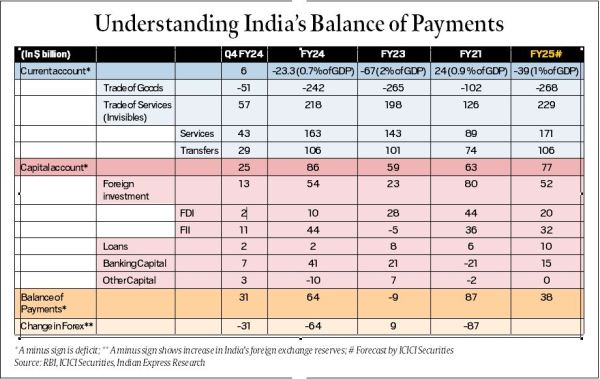
However, the country’s current account cannot be understood in isolation. The larger picture is provided by the so-called ‘Balance of Payments’ table alongside.

What is Balance of Payments?

The Balance of Payments (BoP) is essentially a ledger of a country’s transactions with the rest of the world. As Indians trade and transact with the rest of the world, money flows in and out of the country. The BoP shows how much money (shown here in billions of US dollars) went out of the country and how much money came in. All the money coming into the country is marked positive and all the money going out is marked negative. As such, in the BoP table, a minus sign points to a deficit.

The BoP matters because it captures the relative demand of the rupee vis-à-vis the demand for foreign currencies (represented in dollar terms). Hypothetically, if there were only two countries in the world, India and the US, every time an Indian wanted to buy an American good or service, or to invest in the US, they would have to hand over a certain number of rupees to first buy the dollars needed to complete that transaction. In the end, the exchange rate would be determined by the relative demand of the two currencies — if Indians demanded more dollars than Americans demanded rupees, the ‘price’ (or the exchange rate) of the dollar relative to the rupee would go up.

Balance of Payments  

What are the constituents of the BoP?

The table shows the constituents of India’s BoP. The BoP has two main ‘accounts’ — Current Account, and Capital Account.

CURRENT ACCOUNT: The current account, as the name suggests, records transactions that are of a ‘current’ nature. There are two subdivisions of the current account: the trade of goods, and the trade of services.

Story continues below this ad

The trade or merchandise account refers to the export and import of physical goods (cars or wheat or gadgets, etc), which determines the ‘balance of trade’. If India imports more goods than it exports, it is running a trade deficit, which is shown by a negative sign.

The second part of the current account is made up by the ‘invisibles’ trade, so called because it refers to trade in services and other transactions that are typically ‘not visible’ in the same way as, say, the trade in cars or chairs or phones is.

‘Invisible’ transactions include services (e.g., banking, insurance IT, tourism, transport, etc.); transfers (e.g., Indians working in foreign countries sending back money to families back home); and incomes (such as the income earned from investments).

The net of these two kinds of trades is the current account. As can be seen from the table, in Q4, India registered a surplus on the current account. There was a surplus on the invisibles, but there was a deficit on the trade account.

Story continues below this ad

CAPITAL ACCOUNT: The capital account captures transactions that are less about current consumption and more about investments, such as Foreign Direct Investment (FDI) and Foreign Institutional Investments (FII). The table for Q4 shows a net surplus of $25 billion on the capital account.

Lastly, the BoP table always balances through the change in the foreign exchange reserves column. When there is a BoP surplus — net of current and capital account — implying billions of dollars coming into the country, the RBI sucks up these dollars and adds to its foreign exchange reserves.

If the RBI did not do this, the rupee’s exchange rate would appreciate — and undermine the competitiveness of India’s exports.

How should the data in the table be read?

Contrary to the images they evoke in the lay person’s mind, the words ‘deficit’ and ‘surplus’ do not always correlate to ‘bad’ and ‘good’ respectively. So, a current account deficit may not always be bad for an economy, nor is a current account surplus necessarily a good development.

Story continues below this ad

The first thing to note is the difference between the Q4 data and the full year (FY2023-24) data.

The current account balance, which is surplus in Q4, is in deficit for the full year. Typically, for a country such as India, a current account deficit happens because a developing economy needs to import lots of capital goods (read machinery) to build up its capacity to produce more exports. A trade deficit also suggests that India’s underlying economy has a strong demand impulse.

Look at the data from FY2020-21, which shows a surplus on the current account. But this was the year when Covid-induced lockdowns brought the shutters down on economic activity. The current account surplus in FY21 was not a desirable one.

According to N R Bhanumurthy of the National Institute of Public Finance and Policy (NIPFP), an autonomous research institute under the Finance Ministry, it is broadly agreed that a current account deficit of 1.5%-2% of GDP is consistent with a GDP growth rate of 7%-8%.

Udit Misra is Senior Associate Editor at The Indian Express. Misra has reported on the Indian economy and policy landscape for the past two decades. He holds a Master’s degree in Economics from the Delhi School of Economics and is a Chevening South Asia Journalism Fellow from the University of Westminster. Misra is known for explanatory journalism and is a trusted voice among readers not just for simplifying complex economic concepts but also making sense of economic news both in India and abroad. Professional Focus He writes three regular columns for the publication. ExplainSpeaking: A weekly explanatory column that answers the most important questions surrounding the economic and policy developments. GDP (Graphs, Data, Perspectives): Another weekly column that uses interesting charts and data to provide perspective on an issue dominating the news during the week. Book, Line & Thinker: A fortnightly column that for reviewing books, both new and old. Recent Notable Articles (Late 2025) His recent work focuses heavily on the weakening Indian Rupee, the global impact of U.S. economic policy under Donald Trump, and long-term domestic growth projections: Currency and Macroeconomics: "GDP: Anatomy of rupee weakness against the dollar" (Dec 19, 2025) — Investigating why the Rupee remains weak despite India's status as a fast-growing economy. "GDP: Amid the rupee's fall, how investors are shunning the Indian economy" (Dec 5, 2025). "Nobel Prize in Economic Sciences 2025: How the winners explained economic growth" (Oct 13, 2025). Global Geopolitics and Trade: "Has the US already lost to China? Trump's policies and the shifting global order" (Dec 8, 2025). "The Great Sanctions Hack: Why economic sanctions don't work the way we expect" (Nov 23, 2025) — Based on former RBI Governor Urjit Patel's new book. "ExplainSpeaking: How Trump's tariffs have run into an affordability crisis" (Nov 20, 2025). Domestic Policy and Data: "GDP: New labour codes and opportunity for India's weakest states" (Nov 28, 2025). "ExplainSpeaking | Piyush Goyal says India will be a $30 trillion economy in 25 years: Decoding the projections" (Oct 30, 2025) — A critical look at the feasibility of high-growth targets. "GDP: Examining latest GST collections, and where different states stand" (Nov 7, 2025). International Economic Comparisons: "GDP: What ails Germany, world's third-largest economy, and how it could grow" (Nov 14, 2025). "On the loss of Europe's competitive edge" (Oct 17, 2025). Signature Style Udit Misra is known his calm, data-driven, explanation-first economics journalism. He avoids ideological posturing, and writes with the aim of raising the standard of public discourse by providing readers with clarity and understanding of the ground realities. You can follow him on X (formerly Twitter) at @ieuditmisra           ... Read More


Latest Comment
Post Comment
Read Comments
Advertisement
Advertisement
Advertisement
Advertisement