Premium
This is an archive article published on June 28, 2023

ExplainSpeaking: Why India’s workforce is becoming increasingly male-dominated

Of all the Indians aged 15 years and above, only 39.5% are even asking for a job. Among men, this proportion was 66% and among women, just 8.8%.

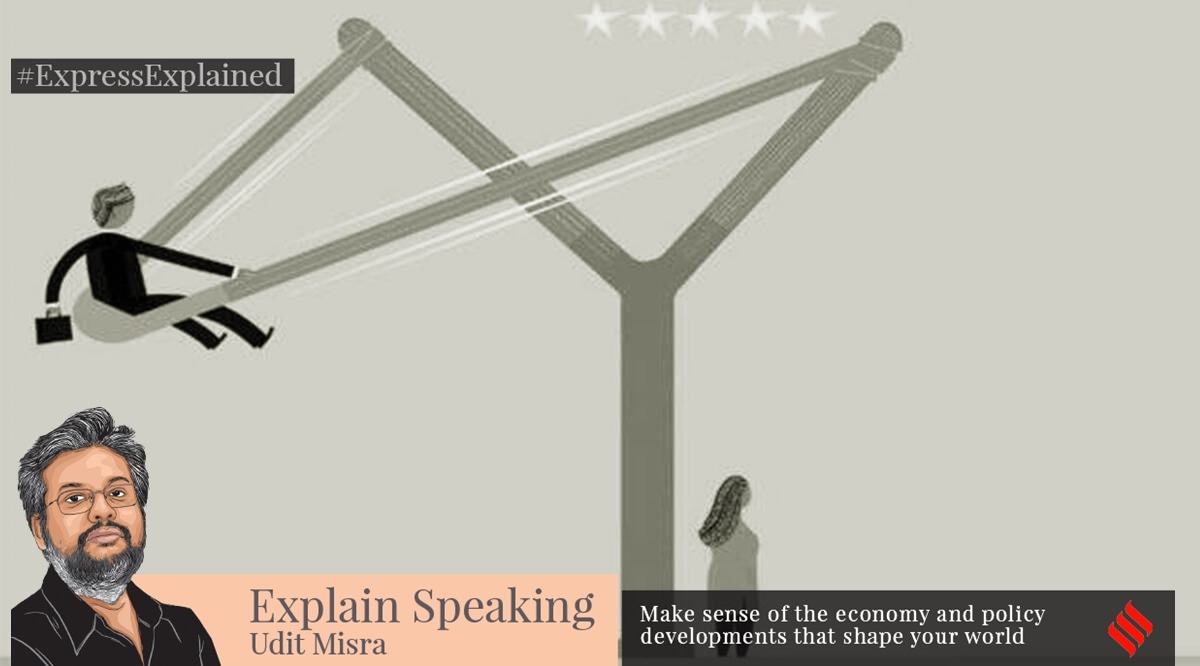
Less female participation in labour forceIndia’s workforce is becoming increasingly male-dominated, thanks to India's starkly low female labour force participation rate (LFPR). (Illustration: C R Sasikumar)
Listen to this article
ExplainSpeaking: Why India’s workforce is becoming increasingly male-dominated
x
00:00
1x 1.5x 1.8x

According to the latest data available from the Centre for Monitoring Indian Economy (CMIE), India’s labour force participation rate (LFPR) fell to 39.5% in the last financial year (2022-23) that ended in March. This is the lowest LFPR reading since 2016-17. The LFPR for men stood at a seven-year low of 66% while that of women was pegged at a mere 8.8%.

Apart from being worrisome because they are so low, these numbers also explain why India’s workforce is becoming increasingly male-dominated, even more than it already was.

The LFPR is the share of the working-age population (aged 15 years and above) that is employed or unemployed, willing and looking for employment.

In other words, of all the Indians aged 15 years and above, only 39.5% are even asking for a job. Among men, this proportion was 66% and among women, just 8.8%.

Why LFPR matters

Typically, policymakers and the general public is focussed on the unemployment rate in the economy. The unemployment rate is the share of people who are unemployed despite looking for work. If the proportion of people looking for work is high and stable, then the unemployment rate is a good way to assess the stress in the job market.

But in India’s case, the unemployment rate is an inadequate measure because India’s LFPR (or the proportion asking for a job) has not only been lower than the global average but also falling.

Story continues below this ad

A low and falling LFPR is never a good sign for a developing economy because it shows that, despite low levels of income, its workers are opting out of the jobs market. Typically, this happens when workers fail to get a job for long periods of time, get discouraged and decide to sit out of the labour force.

Secular decline

The CHART alongside shows how much is the dip.

Two things stand out.

One, the LFPR has been falling in a secular manner since 2016-17 and has hit its lowest in 2022-23. It is noteworthy that the fall has happened despite the fast growth rate of the economy. For instance, the GDP grew by 7.2% in 2022-23.

Second, India’s female LFPR has fallen to just 8.8% in FY23. In other words, more than 90% of all working-age women in India don’t even look for a job.

Global laggard

CMIE admits that its measure of assessing LFPR are more stringent than others. For instance, the International Labour Organization (ILO) pegged India’s LFPR at 49% for 2022 — distinctly higher than CMIE’s 40% for 2022.

Story continues below this ad

However, even by ILO’s standards, India’s LFPR lagged far behind other countries.

According to CMIE, India’s LPR is woefully low when compared to some Latin American and Asian economies that boast far higher labour participation rates as estimated by the same ILO model. In Indonesia, for instance, around 67 per cent of the working-age population entered the labour force in 2022 in search of employment. In countries like South Korea and Brazil, the labour participation rates were as high as 63-64 per cent. Argentina, Bangladesh and the Philippines recorded LPRs in the 58-60 per cent range. Over 51 per cent of the population of Sri Lanka was in the labour force in 2022. In India, on the contrary, less than half the working-age population had a job or was even willing to seek employment.

Key takeaways

One, regardless of the rate of GDP growth, the decline in LFPR is unabated.

Two, data shows that the bulk of the decline happened before the Covid pandemic. This was the time when the economy was decelerating sharply. The GDP in 2019-20 grew by less than 4%.

Story continues below this ad

Three, India’s workforce is becoming increasingly male-dominated, thanks to India’s starkly low female LFPR. CMIE data shows that in 2016-17, females comprised only 15.3 per cent of the labour force in India. This fell to 12 per cent in 2019-20 and fell further to a mere 10.3 per cent in 2022-23.

Udit Misra is Senior Associate Editor at The Indian Express. Misra has reported on the Indian economy and policy landscape for the past two decades. He holds a Master’s degree in Economics from the Delhi School of Economics and is a Chevening South Asia Journalism Fellow from the University of Westminster. Misra is known for explanatory journalism and is a trusted voice among readers not just for simplifying complex economic concepts but also making sense of economic news both in India and abroad. Professional Focus He writes three regular columns for the publication. ExplainSpeaking: A weekly explanatory column that answers the most important questions surrounding the economic and policy developments. GDP (Graphs, Data, Perspectives): Another weekly column that uses interesting charts and data to provide perspective on an issue dominating the news during the week. Book, Line & Thinker: A fortnightly column that for reviewing books, both new and old. Recent Notable Articles (Late 2025) His recent work focuses heavily on the weakening Indian Rupee, the global impact of U.S. economic policy under Donald Trump, and long-term domestic growth projections: Currency and Macroeconomics: "GDP: Anatomy of rupee weakness against the dollar" (Dec 19, 2025) — Investigating why the Rupee remains weak despite India's status as a fast-growing economy. "GDP: Amid the rupee's fall, how investors are shunning the Indian economy" (Dec 5, 2025). "Nobel Prize in Economic Sciences 2025: How the winners explained economic growth" (Oct 13, 2025). Global Geopolitics and Trade: "Has the US already lost to China? Trump's policies and the shifting global order" (Dec 8, 2025). "The Great Sanctions Hack: Why economic sanctions don't work the way we expect" (Nov 23, 2025) — Based on former RBI Governor Urjit Patel's new book. "ExplainSpeaking: How Trump's tariffs have run into an affordability crisis" (Nov 20, 2025). Domestic Policy and Data: "GDP: New labour codes and opportunity for India's weakest states" (Nov 28, 2025). "ExplainSpeaking | Piyush Goyal says India will be a $30 trillion economy in 25 years: Decoding the projections" (Oct 30, 2025) — A critical look at the feasibility of high-growth targets. "GDP: Examining latest GST collections, and where different states stand" (Nov 7, 2025). International Economic Comparisons: "GDP: What ails Germany, world's third-largest economy, and how it could grow" (Nov 14, 2025). "On the loss of Europe's competitive edge" (Oct 17, 2025). Signature Style Udit Misra is known his calm, data-driven, explanation-first economics journalism. He avoids ideological posturing, and writes with the aim of raising the standard of public discourse by providing readers with clarity and understanding of the ground realities. You can follow him on X (formerly Twitter) at @ieuditmisra           ... Read More


Latest Comment
Post Comment
Read Comments
Advertisement
Advertisement
Advertisement
Advertisement